
Why is “SELFISH-ALTRUISM” a LAST CHANCE for YOU and the WORLD?
CAPITALISM marries SOCIALISM. A Win-Win deal for Everybody.
CAPITALISM is about meritocracy but also selfishness.
SOCIALISM is about altruism but risks promoting incompetence.
SELFISH-ALTRUISM is a marriage of both. A Win-Win deal for all.
Read on to know more …
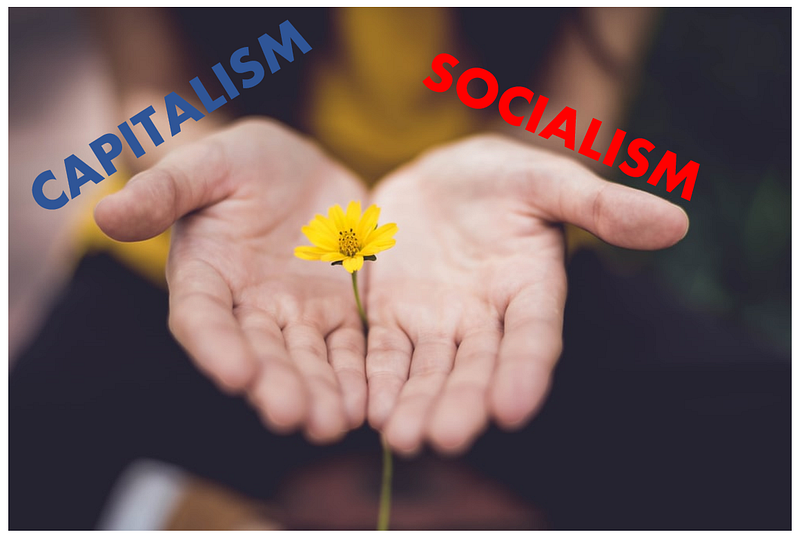
Until recently, the vast majority of the world’s population worked on farms and the total production of the world’s economy came mostly from agricultural output, and this output was limited by the fixed size of the land. Although, the population kept increasing year over year, the total output of the economy did not change, as the size of the land was fixed. The world was a ZERO SUM GAME.
In a ZERO SUM GAME the more the number of people, the more fierce the competition is and lesser is the share of the PIE you get. The size of the pie is fixed. This is ingrained in our psyche through evolution and education. This is what makes us SELFISH.
A history of SELFISHNESS
In such a stagnating world, the only way to get better off was if someone else got worse off. If you took a bigger piece of the pie, someone else got a smaller one. If you wanted more food than your fair share, then, conquering, plundering, and stealing were great strategies. Your neighbour’s loss was your gain and it made perfect sense to be SELFISH.

Humans by nature are programmed to be selfish. Not just humans, but any living organism that exists on the face of Earth, is programmed by it’s DNA to be selfish. This is the central argument in Richard Dawkins’ path breaking book, The Selfish Gene.
According to the book, a certain degree of selfishness is crucial to our own survival and to propagating our genes. This means that not only is it crucial for own survival, but it is also crucial for evolution. The selfish programming of genes however was by chance and not by design.
When organisms reproduced they had selfish and non-selfish variations in the genomic code amongst various off-springs. However, because of the ZERO SUM WORLD, the organisms, be they humans, animals, plants or bacteria, the ones that had more selfish genes in them, always had a better chance of survival.
It is therefore a harsh but true statement, that we all are children of selfish ancestors, or else we could not have reached this far in the game of evolution. At this stage, it is important to note that selfishness might mean evilness in some cases, but not necessarily in all cases.
It is therefore a harsh but true statement, that we all are children of selfish ancestors, or else we could not have reached this far in the game of evolution.
What Richard Dawkins explained about human nature from a biologist’s point of view, had already been told before by Ayn Rand in her fiction and non-fiction writings, from a philosopher’s point of view.
Being “Selfish” according to her, is necessarily not a bad thing and is a widely misunderstood concept. By being selfish, what Ayn Rand means is that — you should only indulge in helping others and keeping the interests of others above your own interests and likings if that is what you really like. Do not be altruistic if you feel altruism is a kind of sacrifice. Do it only if that actually gives you joy and fun.
The reason, for such an argument is that if you keep the welfare and choices of others above your own, then you will lead a dissatisfied and unhappy life. You will think that you are some kind and great soul and are sacrificing your life for the good of others but at a certain stage you will reach your limit and get frustrated when you will not get the rewards, returns or the thanks that you had expected.
Do not be altruistic if you feel altruism is a kind of sacrifice. Do it only if that actually gives you joy and fun.
Many people do pretend to be saintly in saying that they do not expect anything back, but in reality most if not all lie to themselves and end up getting frustrated.
That said, there are an exceptional few who do like being altruistic just for the satisfaction and joy of it and really love serving others. Those people however, do not end up frustrated. This blog is NOT for them.
But for the rest of you, CARRY ON READING …
A history of ALTRUISM
Having taken a look at selfishness, let us now discuss briefly the concept of altruism.
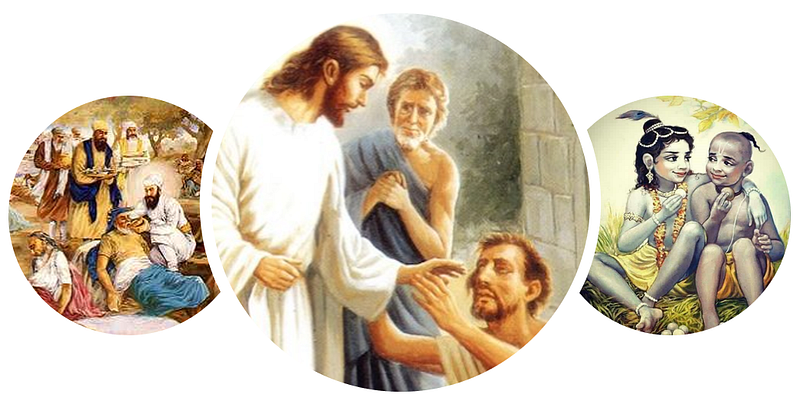
Unlike selfishness, altruism is counter-intuitive to our human nature. We humans needed to be bound in the shackles of religion, in somewhat of a carrot and stick arrangement cleverly formulated by organized religion, in order to encourage us to be altruistic.
Jesus stood up for the underdogs in society.
Krishna helped Sudama ( his poor friend).
The Sikh gurus stood up for the underdogs in society.
However, one never finds a cold and rational mathematical argument based on pure economics on why should one go against her or his innate human nature of selfishness, and be altruistic?
Why go against common-sense and help others develop?
Why should I do charity and not expect anything in return?
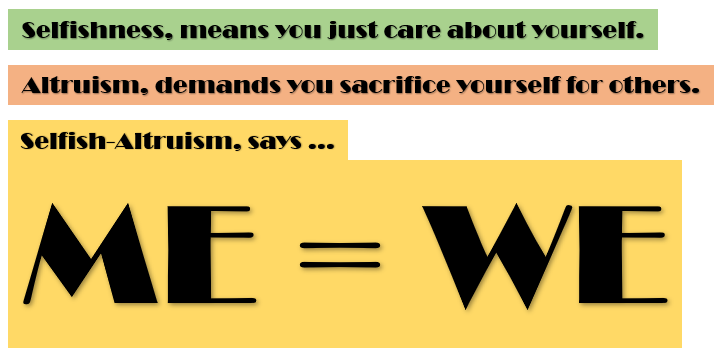
And this is where we can introduce the concept of SELFISH-ALTRUISM.
A history of SELFISH-ALTRUISM
In the first section on SELFISHNESS, we saw that economy of the World since thousands of years had remained a ZERO SUM GAME and it made perfect sense for one to be selfish.
This was the state of things for thousands of years. Societies invaded each to get a bigger share of the pie, until, … well until the INDUSTRIAL REVOLUTIION happened, and everything changed.
With the INDUSTRIAL REVOLUTION came the idea of an expandable PIE. With a BIG leap in science and engineering came in better fertilizers, better machinery and hence better crops in both quality and quantity. The PIE had started to expand.
From 1700CE to 1870CE, the production of iron in Britain increased one hundred and thirty seven times ( this was then followed by the development in other nations of the developed west and we can see the same in China and India now). The Industrial Revolution, enabled an unimaginable increase in economic output, which had remained almost stagnant for thousands of years before that! This then changed the World from a ZERO SUM GAME to a POSITIVE SUM GAME!
POSITIVE SUM GAME meant that we had a means to increase the supply to meet the increasing demand. We had means to expand the PIE.
This POSITIVE SUM WORLD, fueled by a few breakthrough innovations in science and engineering has existed for the last two hundred and fifty years now. However, in the bigger scheme of things, this is just 0.1% of the total span of human existence on this planet. This is also the reason why our psyche which evolved to be selfish, has failed to catch up with this fairly new and very rapid development.
Let us now jump from the year 1870CE to the year 1990CE. By this time we were beginning to see the emergence of the personal computer and the internet for widespread commercial and domestic use. Companies like Microsoft, Facebook and Google, earned far more in the last thirty years what traditional mechanical engineering based companies like Ford, Mercedes and so on earned in the past one hundred and twenty years! The IT revolution enabled the PIE to expand at breathtaking speeds as never seen before in history.
Understanding it further:- The PIE, however, can not keep on increasing in a happy and healthy way just by increasing production. There also needs to be a demand for what has been produced. The expanding PIE is an expansion of the economy, not just an increase in production.
To keep the demand high, there need to be more and more people who need to be wealthy enough to be able to afford a certain product or service. And this is a genuine selfish argument for making the world a better place. This is where CAPITALISM and SOCIALISM meet.
In a positive sum world, the more people are well-off the better your own life is.
SUPPLY and DEMAND:- This is because of the nature of innovation. Innovation is driven by SUPPLY and DEMAND. If the SUPPLY increases when more people have the education, freedom and means to contribute. There would be more thinkers, researchers and inventors who could come up with new ideas.
The DEMAND however, increases only when there are more people who are rich enough to afford these new ideas and innovations. Innovation follows incentive. So naturally if there are many people who can afford the innovation, it will catch the potential innovator’s attention.
Understanding the SOLUTION with an example:
Let us take the example of something which is either a matter of concern or is close to the heart for most of us — a cure for cancer.
Let us say, at the moment there are only two billion people on the planet who can pay for some kind of cancer treatment and only 250 million who can really afford a top-notch-cutting-edge treatment for cancer. And let us say, that there are only ten thousand researchers, scientists and doctors around the world who are working on this.
The remaining 5.5 billion people of the planet do have either access or affordability to a cancer treatment. Needless to say they are also most probably not educated enough to be able to research and find a cure for the same.
Now, although your innate instinct from evolution might make you feel happy that you are ahead in the race as compared to these 5.5 billion people, given the present scenario being ahead in that race is not of much consequence to you. In fact they might end up being a burden on your pocket and also on your conscience.
On the contrary, if these 5.5 billion could also afford a cure to cancer , then there would be 7.5 billion people who would be willing to fund for cancer research and cure.
Since innovation follows incentive there would also now be more capable people who would be willing to take up cancer cure research as their life’s mission. Instead of five thousand there would now be fifty thousand researchers and better ability.
That would surely be a good thing for everybody.
A WIN-WIN for ALL.
A humble submission from a Design Thinker on solving complex systemic problems, what we call wicked problems.
To subscribe to email notifications if you like this blog: https://aruproy-68841.medium.com/subscribe
For more on using design thinking to solve systemic problems:
- https://uxplanet.org/the-4-hour-work-week-by-timothy-ferriss-ce96dd9b3546?sk=15ddb5914bdcca897a2ed22657440f79
- https://uxplanet.org/applying-ux-r-d-to-parenting-650ba37900cd?sk=9873f0f2001b7f38450198f314e7f0cc
- https://uxplanet.org/the-real-saraswati-understanding-the-metaphor-c0b56c784d75?sk=7d6c8ba689c186a8b37d2682b949a280


