Why is Jammu and Kashmir making a lot of headlines?
Ever wondered why Jammu and Kashmir have been emphasised too much on the news every day? There has been a series of events which took place in the last week which made the headlines. So, what exactly happened, why and what to expect? What is our opinion? This blog will be the answer to all such questions. We won’t give our opinion here, instead, we give you facts and answer FAQs about this, will tell you how fake news is being spread and expect you to make your own opinion.
Last week, the Government of India under Prime Minister Narendra Modi, passed a constitutional amendment, scrapping article 370 of the constitution and converting the state to two union territories. This move was lauded by the majority of Indians, including many leaders across party lines. Talking about Jammu and Kashmir- It is a state in India (Capital Jammu and Srinagar), but which is classified as a disputed territory internationally. So let us look into what is article 370 and why it was scrapped. For that, we need to go back in history even before India got Independence.
Brief History
In 1938, after Maharaja Hari Singh took over in 1925 as the king of the princely state of Kashmir, Sheikh Abdullah the leader of National Conference started to protest against the autocratic rule of the king. He wanted to replace the monarchy with democracy. This campaign went on till 1947, where he was jailed multiple times. In 1947, after India and Pakistan got partitioned, three princely states did not want to join either India or Pakistan rather chose to stay independent namely Kashmir, Hyderabad and Junagadh.
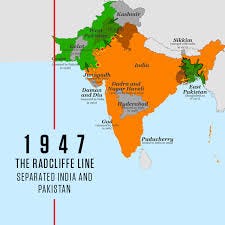
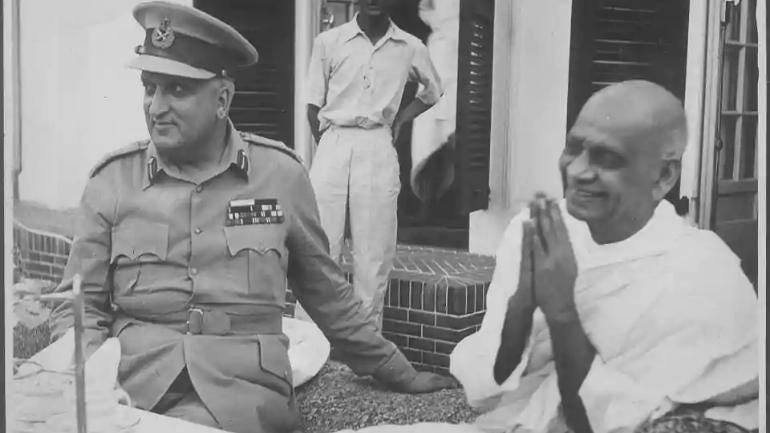
Sardar Vallabhai Patel was the man behind bringing states to join India. He was convinced on why he should force Hyderabad and Junagadh to join India. Hyderabad was a big block, which he believed could hinder North-South integration which (he called as cancer to the stomach )was a better decision as we know today on what happened to East Pakistan. Indian army later exiled the nawab and later annexed Hyderabad to India. Coming to Junagadh, it was a Hindu major state with a Nawab. Sadar Patel understood that locals will be willing to join India, thus a referendum was conducted for a small sample, with the majority agreeing to join India. The problem still existed with Kashmir as the majority population was Muslim and the ruler a Hindu. This made Raja Hari Singh sign the standstill agreement with Pakistan. He wanted the state to stay independent as he was sure that locals will not be convinced either way. Sardar Patel believed that the population in Kashmir would not be interested in joining India but may choose Pakistan. It was rather Jawaharlal Nehru who wanted Kashmir to be with India as he himself was a Kashmiri Pandit. Jinnah, on the other hand, was willing to leave Junagadh to India but was adamant on Kashmir.
Even though Kashmir signed the Standstill Agreement was signed with Pakistan. Pashtun tribesmen from Pakistan’s Northwest Frontier province attacked Kashmir. They gained approximately 1/3rd of the land. Hari Singh alarmed by the invasion asked India for help. India kept a condition for helping Kashmir that Kashmir will be given help if it is ready to accede to India. Raja Hari Singh later signed the Instrument of Accession to India.
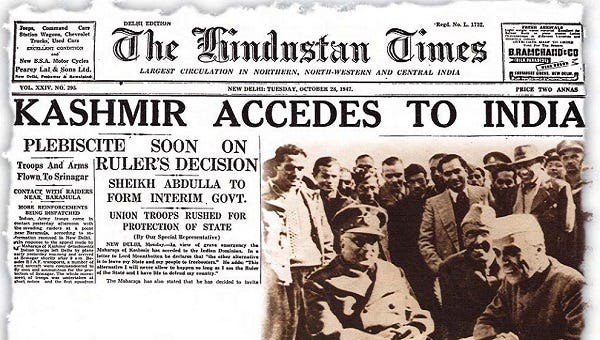
India sent its troops to Srinagar along with National Conference workers to fight Pakistan. Later on, Pakistan’s army entered the conflict. India later decided to take up the issue of Pakistan’s invasion in the United Nations rather than sending its army to fight directly to which Sheikh Abdullah was opposed. He wanted the army to fight. This was known as the Indo-Pak War of 1947. India took the issue to the UN under article 35 of the charter. UN sought mediation between two countries, issuing UNSC resolution 47 establishing a special Committee on India and Pakistan- UNCIP. The UNCIP, asked troops of both nations to withdraw, which India agreed but not Pakistan. India moved ahead with the accession of Kashmir. UNCIP under Sir Dixon made a plan called Dixon Plan, which gave birth to how Kashmir will look like, with a territorial division plan with a ceasefire. There were a lot of discrepancies left though. The land still left with Pakistan is known as Pak occupied Kashmir- POK as called by India. The UN suggested for a plebiscite referendum which never happened till now.
In 1962, parallel to the Cuban Missile Crisis, China invaded India. This was a big blow to the Indian military. The ceasefire was created. This was gain to China in addition to some land which was given by Pakistan on the basis of friendship. In 1965, Pakistan infiltrated to Kashmir by Operation Gibraltar, which India tried to retaliate, leading to the world’s largest tank battles after WW2. This war ended with the Tashkent Treaty ceasefire where PM of India Lal Bahadur Shastri died after cardiac arrest after signing it.
In 1972, Shimla Agreement was signed after Pakistan was humiliated after losing the 1971 East Pakistan liberation war. This agreement declared the creation of Line of Control (LOC) as the ceasefire line between the two countries, also known as International Border. This agreement declared Kashmir as a bilateral issue making the UN military observer group insignificant. The agreement also tried to mend the relations between both nations. LOC was decided to be fenced to stop infiltration. 1989–1990 saw the exodus of Kashmiri Pandits from the Kashmir valley.
The last major armed conflict was the 1999 Kargil War despite signing the Lahore declaration, where the Pakistan Army under Parvez Musharaff intruded deep into Indian territory, taking control of civilian areas and highways. It took a lot of time for the Indian army to recognise that invasion happened and later to fight and win over Kargil, Siachin Glacier and Tiger Hill. India celebrated Kargil Vijay Diwas’ 20th anniversary this year.
The territorial dispute over Kashmir
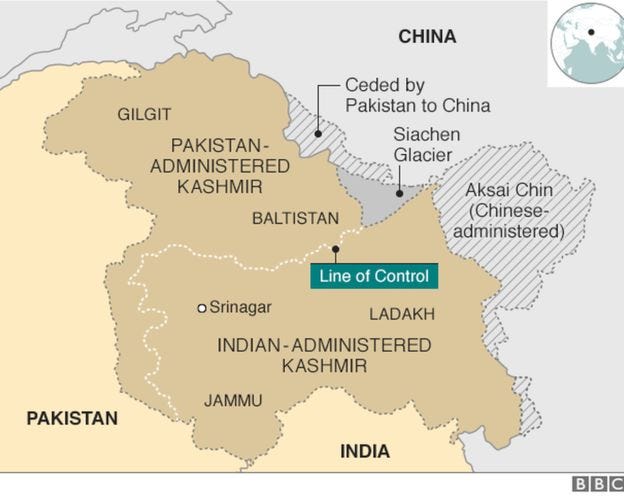
Kashmir is the biggest territorial dispute in South Asia, which is also known as Indian Subcontinent by Indians. It has two big bags India and Pakistan, along with small nations of Bhutan, Bangladesh, Sri Lanka, and Nepal. The Kashmir dispute is bilateral between India and Pakistan but China is also involved. It is a prestige issue for both the nations, that is why even today it is not solved.
India controls 55% of the Kashmir state(but claims the whole) which includes Jammu region, Kashmir valley, Kargil, Leh-Ladakh and the Siachen glacier, the capital cities are Srinagar and Jammu. Siachin Glacier was also a matter of dispute before 1984. Pakistan, on the other hand, controls 30% of the land(but claims the whole), namely the Azad Kashmir and Gilgit Baltistan, with Capital at Muzzafrabad and Gilgit respectively. China controls Aksai Chin and Sakshagam Valley. The border between India and China is the McMohan line but it is not accepted by China. The present control border is the Line of Actual Control. The Siachin Glacier is the trijunction point of India, Pakistan and China.
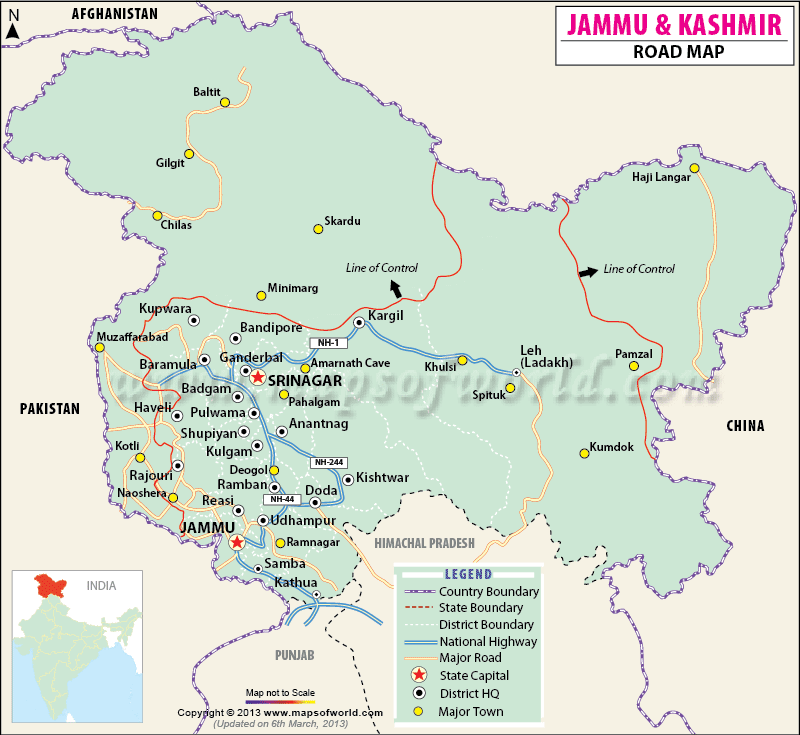
Why Pakistan adamant on Kashmir while it already acceded to India?
Kashmir for Pakistan is much more than prestige. Remember that it had gained some part of Kashmir by tribal invasion (POK). That part is strategically important for it. It would never wish to lose it even if other parts of Indian Kashmir doesn’t come on its side.
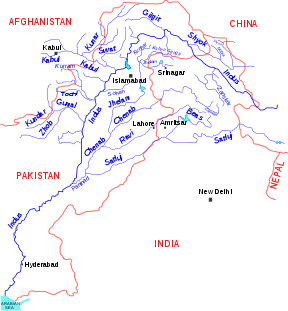
The primary reason for this is the River system that originates in JK, which is the lifeline of Pakistan. The majority of rivers of Punjab start from JK.
These rivers irrigate much of POK, Punjab and Sind. The fight over the Indus river treaty is also an interesting theory to learn.
The second reason will be that it Kashmir is the only land buffer between Pakistan and China. This is a sign of friendship. In return, China is heavily investing in Pakistan for railroad infrastructure named CPEC. POK is also home to the Highest Motorable highway in the world- Karakoram highway. Gilgit is also the town, where Hindu Kush range, Karakoram range and Himalayas meet at trijunction. It is also home to Mt K2 which is the second-highest peak in the world, putting Pakistan on the tourist map. The landscape of POK is arguably much beautiful as well.
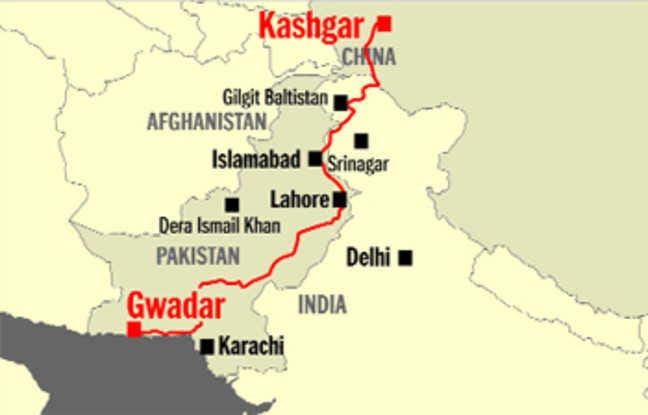
The last and the most obvious reason is that Muslim identity. Pakistan wants to instil the idea to Indian Kashmiris that you don’t belong to India, but to Pakistan. It has tried multiple times to say it. The conflict is still on.
Why does India want Kashmir to stay with it?
This is an obvious answer but it needs to be answered. Starting from Gandhiji to Nehru to Patel to Vajpayee to Modi- All had the same answer. Kashmir belongs to India and it will be for always. But their idea of how Kashmir was to India was different. For Gandhi, he wanted to disprove the theory of Pakistan that India cannot have a Muslim major state in India. Nehru wanted his homeland to remain with India. So did Patel who supported Nehru after knowing its importance. Vajpayee and Modi are part of RSS which believes in the idea of Akhand Bharat, which means unpartitioned India(hypothetical idea). They want India to annex POK, merge it with India and had also wanted to remove article 370. They value their homeland as Bharath Mata. People of Ladakh and Jammu prefer to stay with India. There have been several terror attacks in Kashmir and the main one being 2019 Pulwama attack.
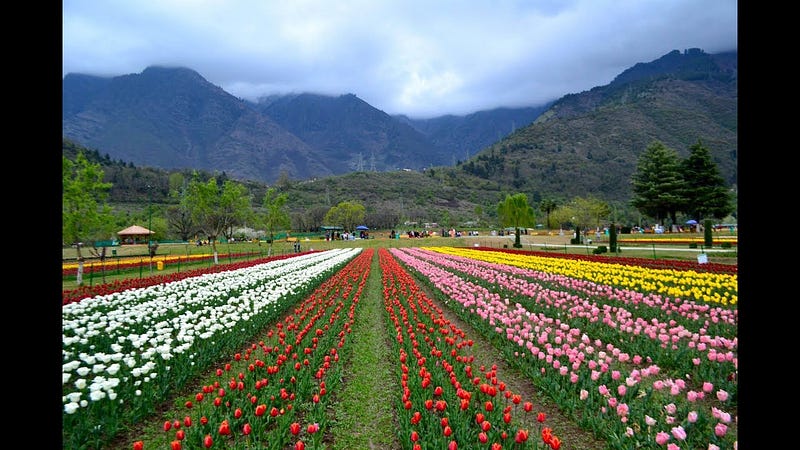
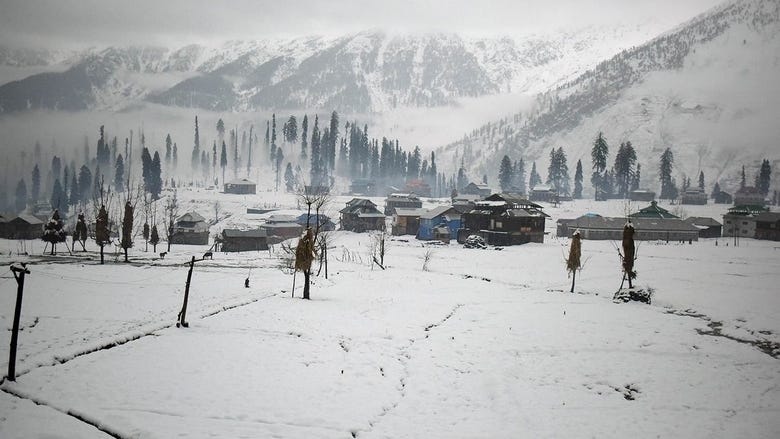
Keeping Kashmir close to India has helped it to boost tourism from both foreign countries as well as domestic tourists. It is the favourite destination for people who want to stay in a houseboat, enjoy lake ride, a bullet ride through Ladakh, a pleasant stay in Srinagar, experience snowfall in Gulmarg, see Tulip gardens, etc. It is also nicknamed as Paradise on earth as well as the Switzerland of the East. JK is more economically and culturally vibrant than many other states of India.
Apart from that, it is a Prestige issue. India’s most of the armed forces and paramilitary are deployed in Kashmir. It doesn’t want to lose more territory, just like how partition happened.
Kashmiri politics is dominated by the National Conference founded by Sheikh Abdullah now under Omar Abdullah, People’s Democratic Party founded by Mufti Mohammad Saeed, now under Mehbooba Mufti, the Indian National Congress and the Bharathiya Janatha Party. The JK assembly elected in 2015 is now dissolved and there is no elected govt in place.
What is Article 370? Why was it scrapped? What is article 35A?
Remember that the Kashmir state acceded to India with the Instrument of Accession? The same, treaty when putting into a legal framework, where parameters on what all basis, India and Kashmir would stay joined is what is documented in this article of the constitution. It was termed as a temporary framework. This article includes different clauses including the ones which give JK special constitution, autonomy, special rights to its people etc. This subject was a bit controversial and is even today. Autonomy means the ability to govern itself. There are many autonomous regions in the world, which include- Hong Kong, Tibet, Kurdistan, Catalonia etc.
Article 370 is not scrapped. Shocked? It is true.
The article entirely has not been fully struck down, but rather some provisions under the same, which gives special status to the state has been removed. That means it lost its autonomy which it earlier had. It is misinformation spread that, the article is no more. With this local people will have the rights as average Indians.
The article was termed as discriminatory by legal experts, historian, nationalists and politicians, especially of BJP. They want One Nation One Law. Removing autonomy was believed to be their first step. With this, Article 35A of the appendix of the constitution is invalid. Article 35A had different provisions by which locals got special reservations in education, jobs, buying and selling of land. No outsider could have bought land in Kashmir.
Was this move right or not?
From the government’s perspective, The autonomy of Kashmir is no more. More Indian Laws will be binding to Kashmir as well. Elections will be held only for the legislature of UT of Kashmir. Through other side arrangements like UAPA amendment act, the centre will have more leverage on the local situation. The police force will also be under the command of Delhi. The new UTs will pave the way for better administration. Business in the Kashmir valley will increase, minorities will get better rights, tourism in Leh-Ladakh will also get a boost.
From the critics, we get to know that this decision was undemocratic and also against the federal principles. There was no consensus made with opposition parties. Morning, the Home Minister announces and later on bill gets President’s nod by night. The permission from JK’s assembly was not asked, (as the assembly was dissolved). The entire state was under network blackout, curfew was imposed, leaders were under house arrest. The government was alleged to behave like autocratic one. Today one state was converted to UT, at a time when several other UTs want to be a state, that too in an undemocratic fashion. The opposition was too weak even to discuss the matter in LS and RS. This happened at a time when tourism was at a peak, Amarnath Yatra went on smooth and stone pelting was the lowest. There a lot of states like Nagaland, HP, Mizoram, AP, Hyderabad-Karnataka under art 371 which still has special status. Will their special rights be stripped off soon? or only Kashmir’s? Is this politically motivated?
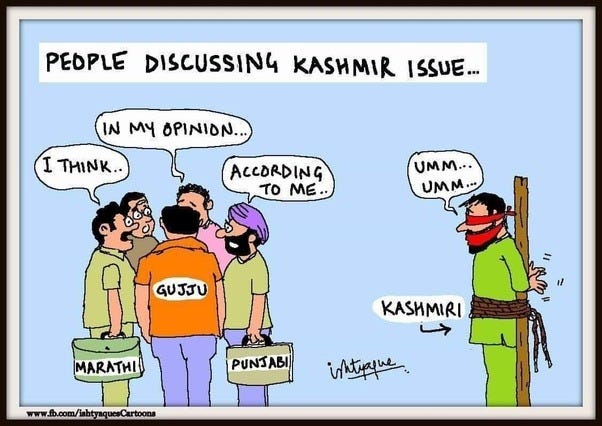
Some common misinformation spread
- Kashmir became part of India only after article 370 was scrapped- No, it was an integral part of India for 70 years.
- You can now marry Kashmiri women now- There was no restriction on a marriage of Kashmiri women by non-residents even before the scrap
- Kashmiri pandits will get land- They were always domicile of Kashmir. They could have bought it even before itself.
- Kashmir was the only state with its own flag and Indian flag was invalid- There is no restriction for state flags unless the Indian flag is hoisted above all others. There are other states with their own unofficial flags.
- Terrorism was because of 370 and it will end- No it won’t.
Most of this information is spread through social media. Do refrain from forwarding these.
What's ahead for Kashmir and India?
With constitutional amendments, Pakistan and China have got angry as they are a party to the conflict. Pakistan went to a new low suspending the High Commissioners from both sides and stopping bilateral trade, train services, bus service etc. Even consular access to Khulbushan Yadav has also been stopped. Along with China, Pakistan has raised the matter in UNSC. Pakistan had already asked Trump to mediate a week before. The only support India may get will be from the Russian Federation (which itself annexed Crimea). This matches India’s stance that Kashmir is India’s internal issue.
No problem in Kashmir will be solved as such with this amendment. The govt cannot put territory ahead of people. That means govt will have to do some favours to the people to show that they will be treated apar with other Indians. The problem of terrorism needs to be cut by its roots. The territorial dispute with Pakistan and China still exists and doesn’t look that it will be solved anytime near. The law and order situation hasn’t been improved and it needs more effort. More care is to be taken to stop Pakistan’s influence in the region, to stop infiltration of militants and jihadis. Integrate youth of Kashmir so that they won’t join militancy, and take up arms. Basically, a localised employment generation is required. They also need to be given grants so that they will be allowed to studies to universities across India. Kashmiri Pandits who were under exodus by local militants and politicians are set to return, govt must take adequate measures for the same. Nothing has ended with this, it is just a new beginning. As per intel reports, mass protests and anger is still there in the valley and we will be witnessing it after curfew will be removed completely. Even today, curfew has been removed from Jammu, but it still exists in Kashmir.
Let us not judge too much whether this move was right or wrong, but as it already happened it’s time to move on. There should be- no more of claiming victory over something which has not yet yielded any result. More solutions to solve the problem and bringing Kashmir to mainstream needs to be our focus. Do make your own opinions on this and reply to us in comments. If you are so much interested in this topic, do explore more on the net and not just restricted to the points mentioned here.
Also read
Follow us on medium for more for similar stories. Follow us on Social media to stay in the loop. A new post is released on every Saturday! So stay tuned!!


