
Why Is It So Easy to Slip Back Into Bad Habits?
We won’t stop slipping back until we hate its outputs.
Even to the astonishment of the human being, the most incredible evolution has been to develop consciousness, aside from straightening up and walking on two feet. It is being able to rationalize and interpret our surroundings with the power of intelligence.
The hardest part for us, human beings, has understood ourselves, our emotions, and the effect it causes on our actions.
Philosophers and stoics from past ages have left a written set of rules to live orderly, based on their studies of human behavior — they even have a glimpse of what habits are.
We are what we repeatedly do. Excellence, then, is not an act but a habit. — Aristotle
If what we repeatedly do becomes automatic, a habit can apply in both directions, good or bad. It’s in our bodies’ chemistry where the reaction comes into action, the chemicals and electrical signals in our brain — ignited by our emotions and feelings.
Happiness turns on the dopamine chemical in our brain, giving a pleasant feeling. But other mixes of chemical reactions also turned dopamine on in the body created by our life experiences.
Alcohol turns on a depressant chemical, but it also numbs our cerebellum impairing our balance. It also affects our cerebrum, which enables speech, judgment, thinking and reasoning, problem-solving, emotions, and learning — other functions related to vision, hearing, touch, and other senses.
Now, drugs give a reaction of euphoria and cause addiction that finally takes control of our will. We continually want to feel the same euphoric effect — increasing tolerance and the risk of dependence addiction.
These examples tell us why people with substance use disorders use more and more of a drug to get the “high” they seek.
The more I research, I admire the human body’s biochemistry and that our response can be manageable.
Why is it so easy to slip back into bad habits?
They give us pleasure in one way or another.
I remember the great battle I had with alcoholism that almost destroyed me. Knowing the harmful effect, it was causing to my mental and physical health; I kept coming back for more.
Under its effect, a pleasure caused by alcohol blinded me to its destructive consequences in my life.
You have to be very determined to win the battle to defeat harmful pleasures.
Pleasure is something that the mind and body enjoy, and that is why it is so easy to slip back into them.
Now the question becomes more specific and absolute: how can we control our carnal desires? (Addictive pleasures).
We put ourselves at the mercy of The Habit Loop.
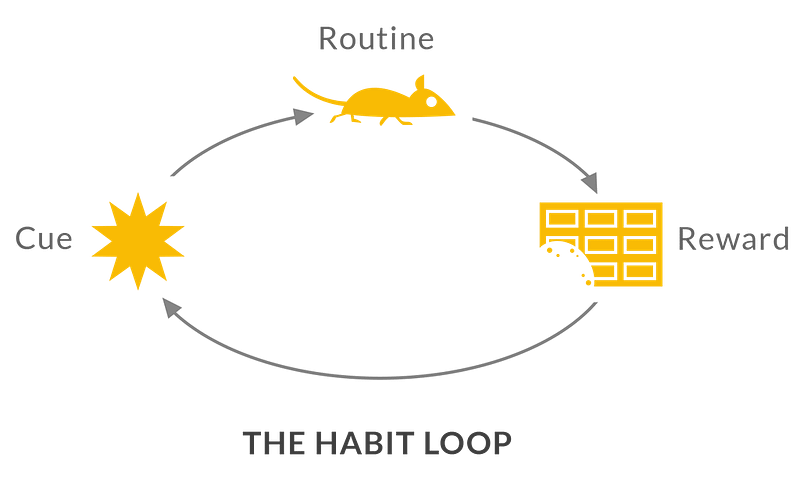
Over time, this loop — cue, routine, reward; cue, routine, reward — becomes more and more automatic. The cue and reward become intertwined until a powerful sense of anticipation and craving emerges.
Habits aren’t destiny.
Habits can be ignored, changed, or replaced. But the reason the discovery of the habit loop is so important is that it reveals a fundamental truth:
When a habit emerges, the brain stops fully anticipating decision making. It stops working so hard or diverts focus to other tasks.
Unless you deliberately fight a habit, the pattern will unfold automatically unless you find new routines.
Excerpt from the book: The Power of Habit — by Charles Duhigg
This response is the most significant to understanding the habit and how to control it because it seems that we can’t eliminate it from our minds — but replace it or ignore it.
It reminds me of how I defeated alcoholism by applying this same principle, ignoring everything related to drinking until it became automatic to think about other things that benefited me more.
We must deliberately change the thought of the reward that attracts us to the bad habit.
We need to change the carrot in front of us for a more delicious one.
Although it seems ridiculous to say it, a bad habit is difficult to remove but not impossible to ignore.
I hope you find the motivation and reason enough to remove bad habits from your path; since a habit is not a destiny but a deliberate choice.
Thanks for reading.
(I don’t have an affiliation to any link in this article)
If my articles have helped and inspired you, consider supporting my writing by…
SUBSCRIBING to “FINDING NEW LIFE” by Carlos Jeronimo
Discover and archive of articles like this at carlosjeronimo.com
And if you want to go the extra mile to support my work…


