
Why Is Connection Seeking Vilified?
One Consequence of Diagnosing Negative Emotions

One of my friends suggested that I write about why we vilify connection seeking by calling it attention-seeking. Since I have witnessed this term used as an insult so many times throughout my life, I decided to turn my attention toward it.
Seeking Attention
Throughout my childhood, I was accused of attention-seeking. I was extremely talkative and constantly wanted to make the class laugh.
When people said “you just want attention, and attempted to explain to me the logistics of why I was looking for attention, I did not understand in the slightest.
At those moments I definitely did not want any more attention. I wished they would stop paying so much attention to me so I could just talk again.
That might give the impression that a well-intentioned, kindhearted child was wrongfully shamed for their attempts to bring laughter, but I can see looking back that it was fairly annoying.
I was seeking attention. It was seen as something bad because it was disruptive to someone else.
Eventually, this type of handling primed me for a years-long path of being too anxious to speak in classes or talk to my peers. In my mind, the paranoia of the consequence of being poorly received arose. I thought others might see my behavior as attention-seeking.
Seeking Attention To Start Connection
Connection seeking explains my behavior in a more complete way. I was looking to make people laugh, really. I wanted to have fun.
I enjoyed when others found my jokes funny and the fact that they gave me positive feedback. The negativity in this case was in response to interrupting class and getting on people’s nerves by being too chatty.
What The Google Search Reveals
It Is All Connection Seeking
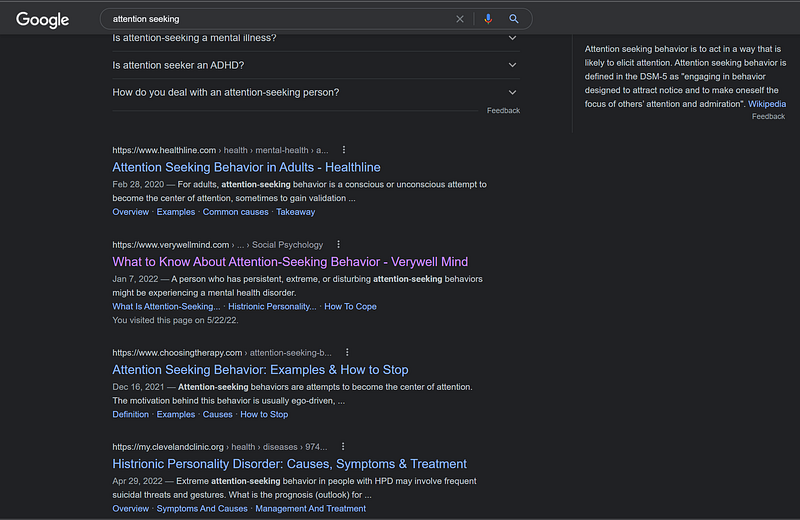
In the first picture we can clearly see that attention seeking has an ominous sounding diagnostic backdrop.
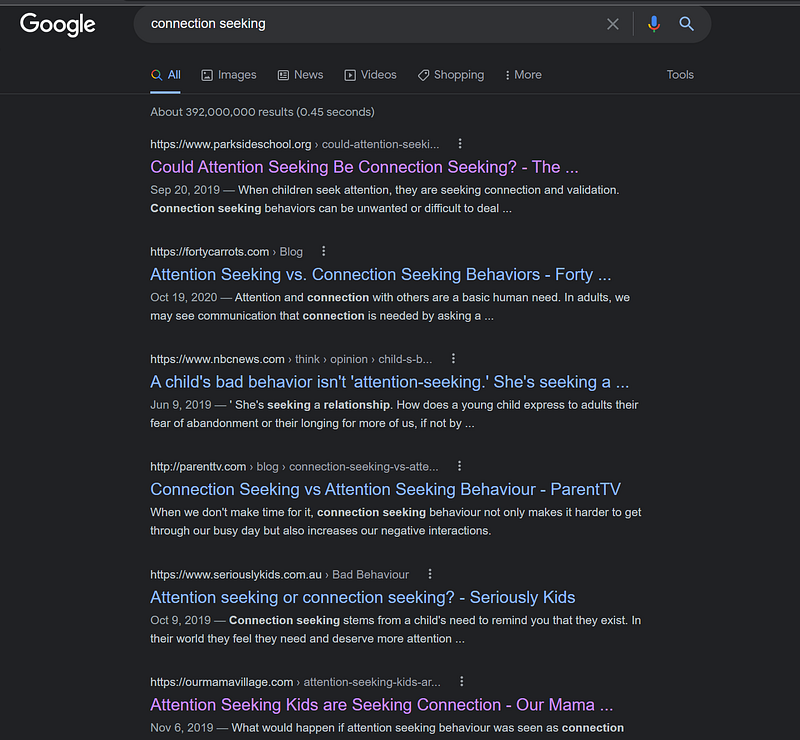
In the second, we see a fight to bring an understanding that attention seeking is connection seeking, not a sign of mental illness, or something to be stigmatized.
I skimmed all of the articles on the first page of results for connection seeking and they all seem to hit the nail on the head. They all kindly point out that traditional poorly received attention seeking behaviors are really an attempt to seek out a connection.
The seeker is not necessarily taking those actions consciously, they may not know any other way.
The Diagnostic Trap
One of the most useful things that I learned while getting my psychology degree is that there are many therapists today who see the disadvantages of behavioral and mental health diagnoses.
They openly acknowledge that in many cases, diagnosing someone can be more harmful than helpful. It can end up teaching people that they cannot meaningfully change their situation or behavior because they are suffering from an illness.
Many things that are diagnosed tend to become stigmatized. Especially when it comes to behavioral or mental health. Somehow these terms always end up as potent social insults.
Similar to attention seeking, how many times have you heard people say that someone is depressed, or bipolar in a diminishing tone. This social pressure tends to deepen a person’s identification with their diagnoses.
Conclusion
Attention seeking behavior as a term probably was not invented with the intention of vilifying the desire to seek out connection.
However, it has become a term used to describe a set of behaviors that we find distasteful.
As a consequence, attention seeking has become more of an insult that puts up a barrier to teaching healthier ways to seek connection.
What is your experience with attention and connection seeking? Talk about it in the comments!
Don’t be shy leave article ideas or requests in the comments.
I enjoy answering people’s questions, it makes it more fun to write.


