
Why is Bad Behaviour on the rise at Schools?
Episode #1: “Student is trashing a classroom; how do you de-escalate?”
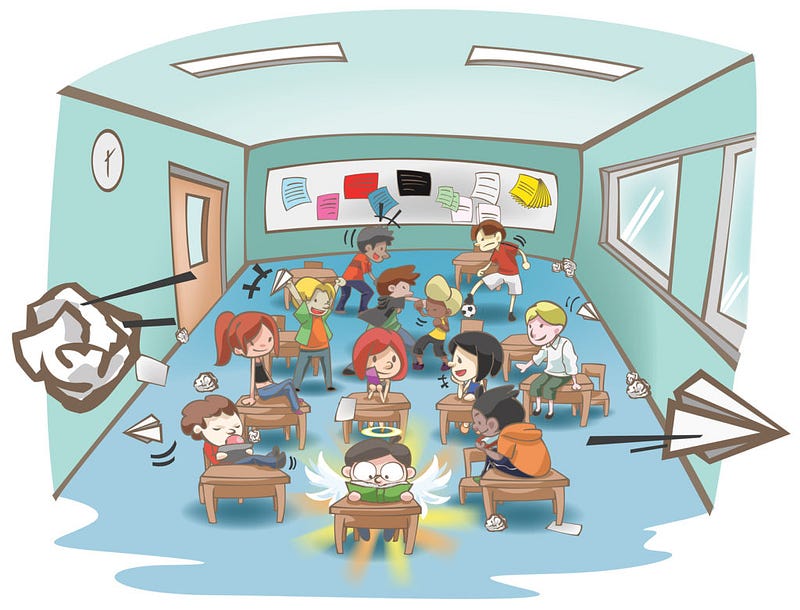
I was called into a kindergarten classroom for support where student N was in an escalated state of mind. He had trashed the whole room and was standing on one of the small tables. Thankfully before his escalation, teacher had evacuated the rest of the classroom to another safe area, where no objects flying around would hit a classmate by accident.
Student had access to all sorting bins on shelves, cubicles, centers…and had flexed his tiny muscles to dump everything on the floor. It was very hazardous to slip and fall on those puzzles, blocks, legos, beads, numbers or dinos. Three staff members and I were standing, observing and ONLY ready to intervene with CPI trained staff if student N was in danger to himself or a staff member.
While respecting his space, he told me to F*** off more than 60 times when I signaled to him to get off the bookshelf so he doesn’t fall and hurt himself. He referred to me as a bad a** every time I got a bit closer to him so he doesn’t fall. When I was ready to intervene he punched me on my mouth with two crowned teeth in the front.
It was not the first time his parents get a call from school to inform them about the incident. Dad became very furious upon learning about his son’s behaviour and seeing the mess his son has created. When dad questioned what has happened, his son told him to F*** off several times. Dad was not happy… with disappointment and embarrassment, he grabbed his son and left….
Despite what the diagnosis and label are, de-escalation strategies have to be applied in a subtle and good child management. Not all children are the same nor all strategies work their magic every time. The main thing to remember are those golden rules:
- Keep your distance = stay safe
- Stand sideways= less intimidating= hip in, head out
- Listen= don’t talk too much
- Tone of voice= assertive, gentle and direct
- Change of face= ask for/accept help
Was student N’ s behaviour de-escalated by the time he left school? Was dad helpful with the de-escalation knowing that parents know their children best? Our staff applied the golden rules but neither staff or dad had the luxury of time to wait for the student to calm down. The end of day bell has gone and dad’s exasperated his tool box, so no one achieved what they were supposed to do!
Staff who care to educate children of any age have difficulty managing students behaviour at some point in their careers including myself. Children with special education needs appear to have too many letters after their name illustrating their diagnosis lately… it looks like an honour list! Emotional Behaviour Difficulties (EBD) which I refer to as Every Bloody Day, or OCD, LD, ADD, ADHD, ASD, LDD, IMD, and you get the point. How do you differentiate the de-escalation strategies then?
Adults are put in a very tough situations where they need to be in control of their own behaviour and response.
“The key is not to make quick decisions, but to make timely decisions” — General Colin L. Powell.
In the upcoming episodes I will be talking about some of the following CHECKLIST!
Stay calm and be kind
Remain confident
Stay in the zone
Social space
Personal space
Intimate space
Sideways stance
Non-verbal communication
Eye contact
The importance of the manner in which we speak
Building rapport
Cross-over mirroring
Conflict and confrontation
Managing emotions
Insults
Internal representation
Empathy with the child
Self-reflection
Talk low, slow and allow processing time
What are the causes of disruptive behavior ?

According to nationwide children’s website:
- Heredity: If parents with mental health disorders, including: Substance abuse, Attention-deficit/hyperactivity disorder, A mood disorder, Schizophrenia, Antisocial personality disorder.
- Environment: At schools we see an increased risk for disruptive behavior disorders among children who were: Rejected by their mothers as infants, Separated from their parents, Recipients of poor foster care, Physically, emotionally, or sexually abused or neglected.
- Physical: There is a greater risk for developing disruptive behavior disorders among children who: Had low birth weight, Have suffered neurological damage.
- Psychological: Children who have suffered from attention-deficit hyperactivity disorder are at a higher risk for developing disruptive behavior disorders.
What are the causes for increased defiance at schools?
Here is a list of nonsense behaviour educators have been dealing with :
- Instant gratification. Kids want to have and get what their heart desires all the time and right now. If not! Boom…escalation
- Zero patience. If parents or educators do not stop whatever they are doing and get children's’ attention this second. Boom…escalation
- You say the daring word “NO”. Boom…escalation
- They slip on the hill …Boom…escalation
- They can’t find their hat…Boom escalation
- They have hiccups…Boom…escalations
Believe me, this is what we are dealing with on a daily basis. With the increased acronyms after student’s name, we have to be careful with how to react as this will have a huge impact on students’ behaviour. My initial response to the student would be to problem solve, problem solve, problem solve. Can we apply PS with every student? Of course not.
Please wait for episode two for more stories and de-escalation tips!
You can always email me directly @[email protected]
Ghada Sadaka
A Principal in Education