
Why is Asia Handling COVID-19 Better Than the Rest of the Globe?
Intercultural communication patterns can help explain how a society responds to crisis

Every first-year American University student at the School of International Service is required to take the course Cross-Cultural Communication. Although the course name has changed over the years, the requirement has stayed consistent. The idea is that any student interested in an international career should have a substantive foundation about different cultural communication patterns.
Now on track to get my Ph.D., few classes have transformed the way I think as much as Cross-Cultural Communication. I cannot help but look at the concepts I learned years ago for answers as the ongoing crisis unfolds.
While the world is mobilizing how to fight this novel virus, a major question on people’s minds is “why are some countries succeeding in flattening the curve while others are battling seemingly uncontrollable outbreaks?” Analysts talk about the authoritarian Chinese regime’s ability to mobilize faster than democratic institutions, in addition to lessons learned from SARS. Others point to varying degrees of infrastructure and technology to explain the disparities in responses. Some critics point out poor leadership hindering productive results in the battle against COVID-19.
And while there is certainly truth to all of those explanations on a governmental and top-down approach, I see a simpler explanation as to why populations are either adhering to or rejecting (good and bad) governmental advice. The responses to COVID-19 serves as a case study explaining the differences between high-context and low-context cultures.
Anthropologist Edward Hall founded the field of intercultural communication in 1959. In 1976 book Beyond Culture, he first introduced low-context and high-context cultures. Although his model has been criticized for lacking empirical validation, it is still upheld as the driving theory to explain different communication patterns in cultures.
Essentially, the high context culture and low context culture model is an exploration of how explicit the messages exchanged in culture are and how important the context is for various cultures. In other words, the value that cultures place on direct and indirect communication.
Hall and other anthropologists have explored these concepts through the lens of association, interaction, territoriality, temporality, and learning. High context culture or low context culture is usually grouped into language groups, nationalities, or regional communities.
In a high-context culture, the cultural association is group-oriented. Individual identity is rooted in family, community, and nationality. Social structure and authority are centralized, with the responsibility at the top (president, matriarch/patriarch, etc.). It is assumed that the person at the top of the social structure and working for the good of the people.
Territoriality is communal in nature. Families and individuals share space, people stand and interact closely with one another. It is common for extended families to live together in the same house. When it comes to learning, high-context culture prioritizes group learning and group problem-solving.
In a low-context culture, the cultural association is individually-oriented. One’s identity is rooted in their sense of self and their individual accomplishments. Social structure is decentralized and is not concentrated at the top of the social hierarchy (president, matriarch/patriarch, etc.). Responsibility is more individualized than low-context cultures.
Territoriality is privatized and space is compartmentalized in low-context cultures. Privacy is highly valued. When it comes to learning, low-context culture prioritizes individual learning, beliefs, and problem-solving. It is sometimes assumed that individual analysis is more accurate than group assessment.
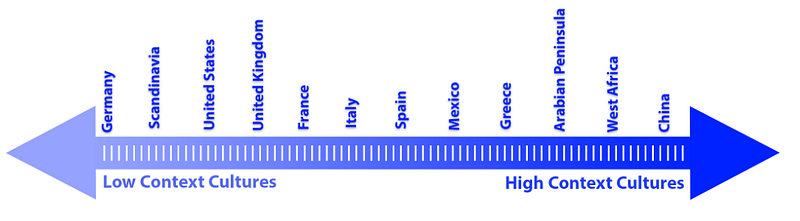
In general, Asian, Arab, African, and Latin American countries are considered high-context cultures. Collectivism is valued in these cultures. Whereas, Northern Europe, America, Australia, and Canada are considered low-context cultures. Individualism is valued in these cultures.
Although COVID-19 is an ever-evolving situation, it seems that Asian countries are having a higher level of success in tackling this global health crisis. From South Korea to Singapore, communities have been successful in flattening the curve and limiting exposure. Asian countries quickly enacted rigorous testing, social distancing policies, and strict quarantining measures. Additionally, these countries have been more successful in communicating the urgency of draconian policies and the communities seem to understand the severity.
More than a week ago the WHO announced that Europe is the new epicenter of the global outbreak. On March 19th, Italy officially surpassed China in COVID-19 related deaths. Europe and American responses have largely been too slow and far too ineffective. In America, every day there are reports of both authority figures and individuals ignoring scientist’s pleas for action. Florida’s Governor initially avoided the CDC’s recommendation of avoiding gatherings of 10 or more people by allowing beaches to remain open. College students hoping to enjoy spring break on those same Florida beaches were vehement in their right to party over growing concerns about COVID-19. Despite an increasing number of cases in the United Kingdom, pubs were filled on St. Patrick’s Day with Brits looking to celebrate the drinking holiday.
In the States and Europe, you’re seeing a lot of individuals adhering to what they think is the best course of action and ignoring the advice of the WHO, CDC, and even top government officials. People are breaking quarantine because they feel it is not necessary for them personally; perhaps they are younger and feel they will recover if they happen to contact COVID-19. The virus and response became individualized.
Whereas in Asia and other high-context cultures, COVID-19 has resulted in a community approach. The centralized social structure resulted in fast and wide-sweeping action that, so far, has slowed the progress of the virus. Of course, cultural disparities are just one part of this ever-changing puzzle. Individualism versus collectivism mindsets won’t drastically impact authoritarian policies that enable a state to erect hospitals in 10 days, but cultural differences do matter.
COVID-19 requires a community approach to best be effective. Even if an individual is not part of an at-risk population, the risk of exposure and transmission is high. This virus and the global response is unlike anything the modern world has seen. It is essential individuals look beyond themselves and work towards a collective goal of eradicating this disease as quickly as possible.
Thanks for reading! Please consider supporting my writing by signing up for my email list and following me here on twitter.