
Why insurers have found themselves in the perfect storm
Insurance is an activity dating back to ancient times, originating in Rhodes around 800 BCE, when people sought to protect themselves from misfortune in the form of crop failure, illness, disability or death. Over time, this protection evolved to include shipping and commerce, one of the activities that presented the most obvious risk due to storms, piracy, or other risks.
From there, modern insurance companies, created during the Enlightenment, evolved into a business that offered everything from insuring the life or health of individuals to protecting them or their heirs against sickness or death, including property, assets or contingency, such as liability arising from a specific event. The industry evolved, became more sophisticated and was regulated to transform it into a complex financial activity based on the assessment and consolidation of risks.
This idea, anchored in the concept of probability, grew as society moved away from the old principles of solidarity and mutual protection and adopted an increasingly competitive and individualistic mentality: your neighbors and friends are no longer going to protect you in case of disaster, so ask a company that specializes in it to do so.
Insurers are simply financial intermediaries who market a product, security, which they guarantee to all their customers, but which they provide to only a statistically small proportion of them. With a principle as simple as that, insurance has become an almost essential — or in many cases, mandatory — product in today’s world.
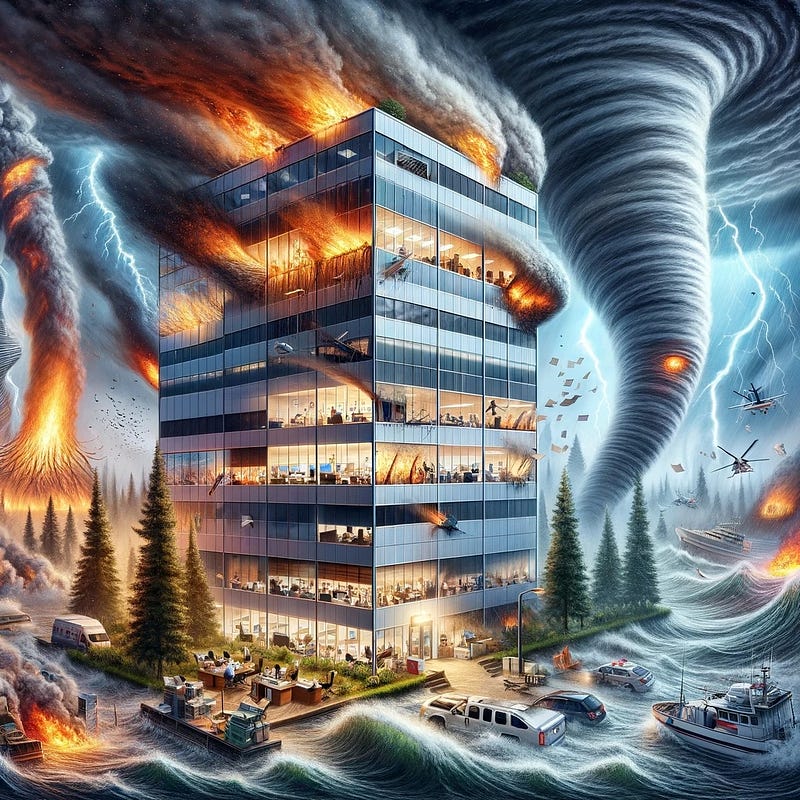
But as we all know, and as much as some deny it, the world is changing due to a climate emergency caused by human activity, and this is leading to a significant increase in the frequency and severity of so-called “natural disasters”, which in reality are now mostly the result of our industrial activity over the past couple of hundred years. The bill that insurers have to pay to compensate for the damage caused by these catastrophes is growing substantially every year, putting an ever greater strain on their bottom line, which is automatically reflected in the prices of their policies.
The consequences are immediate: the impact of extreme weather events on insurers means that, in the areas affected by them, policies are unaffordable for a growing percentage of the population, and car and house insurance are beyond the reach of many, which means an ever-increasing level of vulnerability to catastrophes.
In California, for example, some insurers are refusing to accept policies that cover potential fire damage to a growing number of properties, while in Florida others are dropping coverage for hurricane or flood damage, quitting the state or going bankrupt, leaving their policyholders literally under the rain.
The activity of the insurance industry provides essential guarantees to people and businesses, but the reality is that the bill for the climate emergency grows every year and is increasingly difficult to cover by relying only on probability. It is estimated that the damage caused could be as much as $23 trillion to the global economy by 2050, a cost the sector simply could not ever cover.
What future for a world where protection from extreme events that could end your life or that of your loved ones, destroy your crops or property, or ruin you completely, is becoming unaffordable for more and more people? What are we supposed to do in the face of a drift that turns life into an deadly lottery your chances of winning are increasing every year? The climate emergency is already much more than an absurdly politicized reality and is becoming a drama for more and more people. Quite simply, we can no longer afford the lifestyle we have grown used to. And yet, with the technologies available that would allow us to avoid catastrophes, the possibility of changing to protect ourselves seems more distant every day.
Insurance companies are not the problem: they are the symptom. The network that protects us when disaster strikes is disappearing or becoming inaccessible to more and more people. Nevertheless, for many people, the attitude is still “it doesn’t affect me.” Good luck with that one.
(En español, aquí)