
Why Instructional Routines Work
The Cognitive Science Behind Routines for Learning

Classroom Routines
Routines are a foundation of classroom management. Educators use routines to set expectations, minimize disruptions to learning, teach behavior, and make the most of instructional time. Students respond to routines because routines allow them to be confident in their understanding of what’s expected of them in class, they contribute to a sense of community, and for some learners, routines offer a sense of security. Many teachers spend years refining and perfecting their classroom routines to reach the perfect balance of structure and flexibility in a learning environment that matches their teaching style and their students’ needs.
Why do routines work?
It’s simple: routines are effective because they allow students to focus on what they’re learning, not how to go about learning it. From a cognitive science lens, here’s what that means:
Our working memory, or the part of our short-term memory that handles rapid perceptual and linguistic processing, has a limited capacity. Our working memory either discards incoming information or sends it to our long-term memory. So, during a lesson, students’ working memories are constantly taking in new information (and sifting through distractions and sensory information). Students’ brains manage this information by sorting information into existing schemas, developed from what they already know, adapting existing schemas, or creating new schemas. This is where the cognitive load theory comes in: the idea that by understanding how students’ working memory functions, we can avoid overloading the working memory with information.
Routines free up students’ working memory and reduce cognitive load so that instead of dedicating all of their focus to day-to-day tasks like sitting for attendance or standing in a line to go to the bus at the end of the day, or transitioning between activities, they can focus on learning (Leinhardt, Weidman, & Hammond, 1987).
Instructional Routines
However, routines aren’t just relevant in classroom management during downtimes, transitions, and non-academic procedures. They are also powerful tools when incorporated into instruction, guiding students through familiar, established steps for exploring new concepts and applying knowledge. Just as with classroom routines, instructional routines can help reduce cognitive load and help students get to the most meaningful parts of a lesson faster.
Think of routines as a tool for designing learning experiences. They should ease your workflow and set expectations for the class while also creating opportunities for all learners. Students should be aware of and involved in the learning process during routines and should have clear roles and expectations (Bulgren & Scanlon, 1998). Routines can be explicitly taught, modeled, or work through cues understood by students and teachers (Leinhardt, Weidman, & Hammond, 1987).
What do instructional routines look like?
Instructional routines in math
While instructional routines are useful in any subject, they are particularly popular in math. Many educators use routines to encourage number sense, strengthen mathematical language, or practice sense-making. For example, in the Notice and Wonder™ routine, developed at the Math Forum, teachers show students an image or scenario with no question or answer. Teachers then ask students to share what they notice and wonder about the image or scenario in a mathematical context.
Routines are a key pedagogical component of Reveal Math K-5, our core elementary math program. For more on instructional routines in math, watch this webinar with Jon SanGiovanni, a Reveal Math author and expert on sense-making routines:
Instructional routines in English Language Arts
Routines are also powerful tools in ELA and reading instruction. Routines can be used to practice foundational elements of reading like phonics and fluency or to differentiate for specific needs, like small group instruction with English Learners. Routines have long been a bedrock in our core K-5 ELA program, Wonders. Developed with Dr. Doug Fisher, the Close Reading routine in Wonders is carefully designed to provide students with opportunities to build schema while reading and rereading a text. Here’s more from Dr. Fisher on the relationship between building schema and close reading:
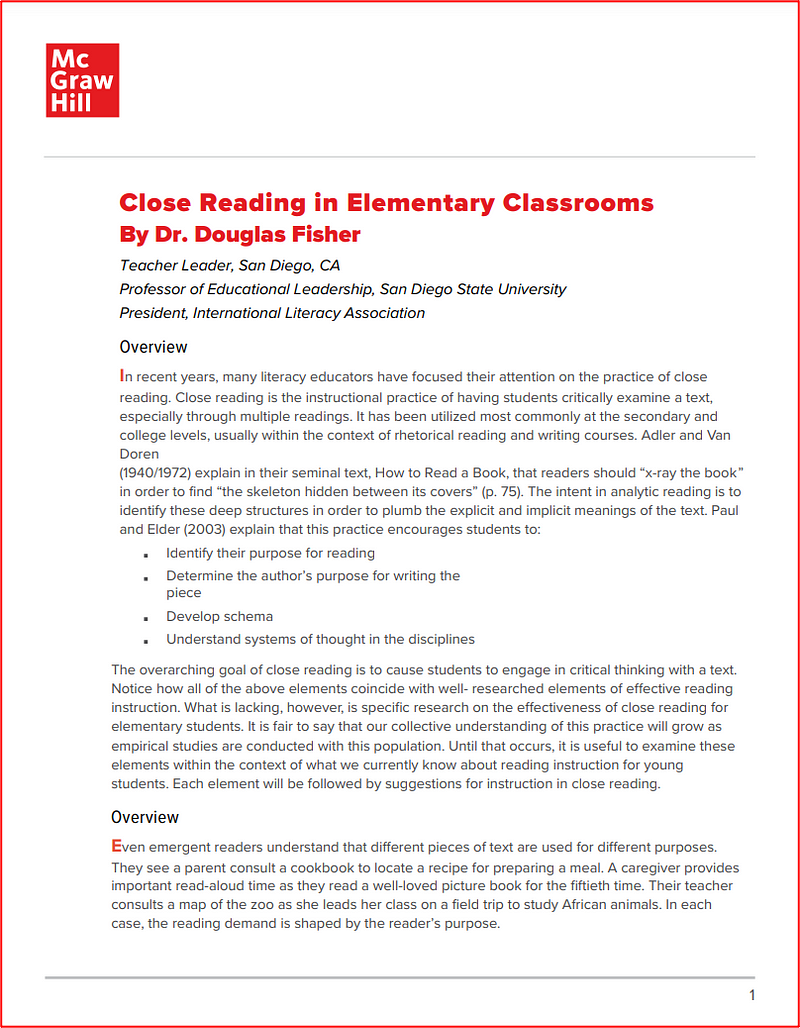
For the © 2023 edition of Wonders, we’ve incorporated a Build Knowledge routine, which again uses schema building, this time to encourage students to identify, synthesize, and apply knowledge and vocabulary across new texts and grades. Here’s more on the © 2023 updates and new routines:
Routines to foster student agency
In math, reading, and other subjects — even in basic classroom management — carefully designed routines can contribute to student agency. By giving students the tools to approach a new problem with a critical, open mindset (think, Notice and Wonder routines in math) and the ability to engage with new information by drawing from existing information (close reading is a life skill!) routines can arm students with a strong set of strategies for tackling learning challenges on their own.
Routines can also explicitly teach agency. In the © 2023 edition of Wonders, we’ve created routines that help students identify what they are being taught, evaluate how well they understand the learning objective, and reflect on what they learned. The routines enable students to articulate what they’ve learned to themselves and their teachers.
Instructional Routines in your Classroom
Truly, the foundational research around the benefits of routines isn’t new — in fact, some of it is decades old. For many educators, this is familiar territory! However, sometimes even the simplest principles and practices get lost in the daily challenge to cover everything on your daily checklist. Don’t let routines escape your teaching toolbox! Leverage them, and the cognitive science behind them, to ease your workflow and make the most of instructional moments.
For more on routines, see:
References
Bulgren, J. and Scanlon, D. (1998). Instructional routines and learning strategies that promote understanding of content area concepts. Journal of Adolescent & Adult Literacy, 41(4), 292–302.
Leinhardt, G., Weidman, C., & Hammond, K. (1987). Introduction and integration of classroom routines by expert teachers. Curriculum Inquiry, 17(2), 135–176.


