
Why I Was Terribly Wrong About My Financial Goals
The fulfillment curve changed my outlook on wealth.
“Lionel, you should always strive for more”
How many times have I heard this? Whether it was from parents, teachers, or managers. The common advice always seems to be you need more. Whether it is money, possessions, or likes. I was taught that if I want to win at life — I must be rich.
There is no such thing as enough.
The baseline of our society. Yet this constant race for more left me feeling empty. More = Happy right? I will be fulfilled the more I have. On the other hand, every new purchase makes me feel guilty.
I never understood this feeling before I read “Your Money or Your Life”. Vicki Robinson introduces the concept of the fulfillment curve.
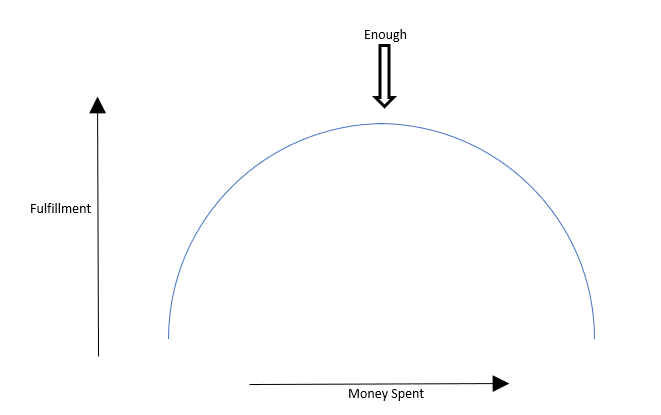
The idea is that fulfillment progresses along the curve before it hits a point of diminishing returns. It serves the idea that money=fulfillment no longer works. It works against us.
What happens after the peak?
Clutter strikes. Even though I have enough coats for 12 seasons… yet 1 more won’t harm me. It’s impossible to have too much money, right?
One thing leads to another, with more income comes more taxes, a larger house, and new “needs”. Yet at each upgrade, I feel less satisfied. I need to spend more to get a tenth of the thrill. As a teen, receiving a new phone felt exceptional. Last year, I bought the latest smartphone — the thrill lasted a day or 2. 1 thought was on my mind once I left the shop. Have I really spent this much when my previous phone was fine? The familiar guilt was creeping in.
All these new luxuries and must-haves ended up crowding my flat. I recently moved and was appalled by the things I bought and never used. I was ashamed. How much money had disappeared?
I don’t want to know…
Not only was I losing money. I quickly realized that I could replace “money spent” with “time spent”. I started looking at how I spent my time. Forgetting an item on my weekly grocery run meant an additional trip. When I get passionate about something new the clutter is never far. I enjoy running. You’d think a pair of shoes would suffice. I quickly add all “recommended” paraphernalia. Not only did it have a financial cost, but it also took a lot of research time.
The ideal amount of money is that which neither falls within the range of poverty nor far exceeds it. — Seneca
I realized that when I fix a problem. I don’t ask what can I do but what can I buy. Materialism is more than wanting shiny things. Vicki Robinson says it’s an easy substitute for problem-solving. I feel like I’m losing my resourcefulness.
Not only does “more” not lead to fulfillment. It has a terrible impact on the environment. Every purchase has an environmental cost. I decided that if I were to buy an unnecessary item it would be second hand. I’ll clutter my life but help the environment.
When is it enough?
Sorry to disappoint, I don’t have an answer. Enough is different for everyone. It’s also constantly evolving. What is enough as a single 25-year-old is not the same as a married 40 something.
Great isn’t it? Not only am I supposed to stop wanting more but it isn’t clear when. Vicki Robinson defines it as:
“It’s appreciating and fully enjoying what money brings into your life yet never purchasing anything that isn’t needed and wanted”
To figure out what my enough is. I had to get to know myself. More precisely my spending habits. I divided my monthly expenses by category (food, shelter, clothing, etc.). At the end of the month, I review my expenditure and assess whether it brought value to my life. It has led me to save money without guilt.
When I spend time/money — I wonder if it aligns with my values. Not only did this approach quickly make the need for a budget disappear. It took the shame away from shopping. Every purchase is meaningful. When it isn’t I learn and change my habits.
Consistently thinking about the fulfillment curve led me to understand my patterns. I found peace of mind. I realized a treat loses its value if bought every day. If I want my Matcha Latte to feel special I should buy it less often.
Am I fulfilled?
I’m getting there. Finding balance isn’t easy. Especially when you leave your home country. I had to find my financial “enough” alone. On the upside not having any l influence meant I could explore freely.
It led to me realizing — I don’t need to be rich. What is the point to have everything. What would I do with all of it? It’s liberating to have a new objective. I’m no longer aiming to be rich. My goal is to achieve an amount of wealth that lets me be true to my values.
Fulfillment might not be a given. Relearning what society teaches isn’t easy. Yet, this evolution feels wonderful. I feel lighter and the pressure has been alleviated. Join me on my journey to enough!