
Why I Say “Merry Christmas” Instead Of Happy Holidays
It’s the most wonderful time of the year.
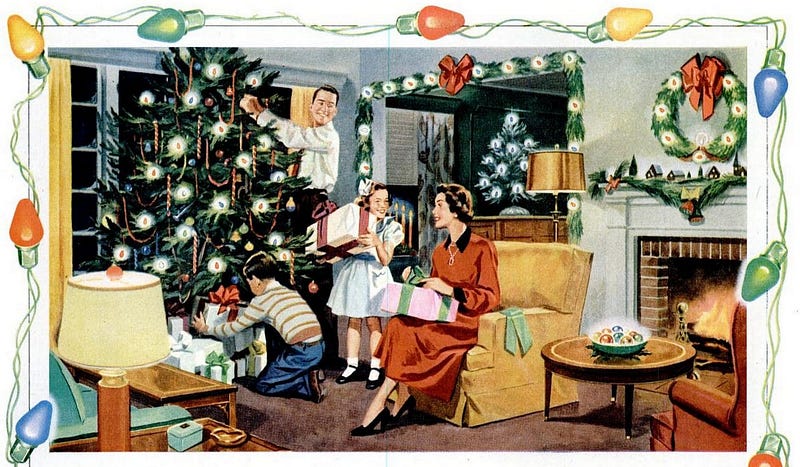
It’s that time of year again! That time of nostalgia and traditions, mingled with excitement.
A time of beautiful lights glowing against a backdrop of freshly fallen snow. Of wonderful scents carried in crisp winter air: fresh pine trees and wreathes, wafting alongside the sound of familiar musical jingles.
It’s that time when the spirit of friendly bonhomie settles over the land like gently falling snowflakes. The time of peace on earth and goodwill to men.
It’s Christmas!
Yes, Christmas.
And to celebrate this wonderful season, I say “Merry Christmas.” Not “Happy Holidays” or the even more ambiguous “Seasons Greetings.” For me, the month of December is the month of Christmas- and a merry one indeed.
Why do I say “Merry Christmas?” Isn’t the phrase outdated? Shouldn’t we proffer a greeting that is more inclusive?
For me, the answer is no. And I’ll tell you why.
The accepted wisdom today is that one must say “Happy Holidays” instead of “Merry Christmas” because the phrase is more inclusive. The latter salutation includes other holidays: Hanukkah, Diwali, Kwanzaa, and the Muslim holiday of Eid (when it falls in December).
But here’s the thing: I’m not wishing a Happy Hanukah or Diwali or Eid. I am wishing a Merry Christmas. It’s a greeting for one specific holiday that occurs on December 25th. (Hopefully accompanied by a decorated tree, presents, and a large dinner with all the trimmings.)
Merry Christmas means Merry Christmas. It doesn’t mean “Merry All Holidays.” To say that we should refrain from saying “Merry Christmas” because it is not inclusive is ridiculous. It would be like saying we should never wish anyone a Happy Birthday because other people have birthdays, too- so we must say “Happy Everyone’s Birthday” to be inclusive.
Those who demand the salutation “Happy Holidays” are resting on faulty logic. First, they assume that wishing one person a happy day excludes other people. It doesn’t.
To me, expressing goodwill on an occasion is the sharing of joy. It’s merely saying “I’m happy about this thing, and I want to share my joy with you.” It doesn’t exclude anyone. Wishing your grandparents a Happy Anniversary does not exclude the wedding remembrance of any other couple. We don’t wish “Happy All Anniversaries” any more than we would wish “Happy All Birthdays.”
Friends from Armenia and Bosnia and Brazil have shared their joy over their national independence days with me, and I am happy for them in the same way they are happy for our Fourth of July. One does not preclude the other.
Second, “Happy Holidays” assumes that the recipient of the Christmas greeting would be offended by it. This is the most ridiculous assertion of all.
For offense to be taken, malice must be present. The speaker must intend to offend. If the speaker did not wish to offend, no offense can be taken- about Christmas or any other subject. Nobody says Merry Christmas maliciously. They say it joyously. If someone is offended by that it’s a YP, not an MP (a “your problem,” not a “my problem.”)
I am not of the Hindu or Jewish faith. But someone wishes me a Happy Diwali or Happy Hanukkah, I would be very happy indeed. They are sharing their joy with me. They thought enough of me to share their special day. It’s an honor.
It’s akin to those times when you are invited to the wedding of a couple you don’t know that well, or the backyard birthday party of a neighborhood kid whose parents you only know in passing- but you attend anyway because you are pleased to be included in their special day of happiness and share in the joy of it all.
Ironically, the phrase “Happy Holidays” also undermines the very inclusiveness it purports to seek.
Holidays may be different- but all holiday greetings have one thing in common. They contain magic. The phrase has accrued an aura, because that customary greeting has grown rich with time and tradition.
For all holidays, the generic phrase “Happy Holidays” cannot compare with the richness of a traditional holiday greeting.
The traditional greeting Shubh Diwali warms the heart of any person of Indian descent. Literally translated as “Wishing you a bright and happy Diwali,” the phrase contains all the wonder and excitement of the sparkling holiday lights and general excitement of the Diwali season.
The same for Eid Mubarak, the traditional greeting of those celebrating the Muslim holidays of of Eid-al-Fitr or Eid-al-Adha. “Eid Mubarak” conveys a richness. It carries tradition, and goodwill, and the collective memory of a thousand years. The dry phrase “Happy Holidays” can’t compare.
The same goes for Merry Christmas. It’s a phrase rich in tradition. It conjures images of warmth and merriment. Of friends and family gathered ‘round, of brightly wrapped gifts under the tree, of the tantalizing aroma of turkey or ham in the oven, soon to be served with all the trimmings.
It’s a wonderful phrase.
The final argument against “Happy Holidays” is one of personal freedom. Dictating the speech of others is controlling behavior. It’s a form of bullying.
Of course, we should all do our utmost to avoid speech that deliberately offends. Polite society demands no less. At the same time, we should avoid those who deliberately seek to be offended. The offensive character of words should be plain on their face. If they require convoluted arguments to understand why they are offensive- well, that’s reaching.
If you wish me a Happy Hanukkah or Eid Mubarak or Shubh Diwali, I won’t be offended. I’m honored to be included in your special day, if only by salutation. If I’m lucky, I will be invited to the accompanying feast. If you wish me a Happy Yule on the Nordic holiday of Yuletide, I will thank you. (And I’ll hope to be invited to the Winter Solstice celebration, which I understand is quite a party.)
To anyone who would be offended by “Merry Christmas?” Bah, humbug! In the words of the classic poem, “Merry Christmas to all, and to all a good night!”


