
Fitness | Self-Improvement | Habits
Why I Mobilize, Not Stretch, Daily Towards Graceful Aging
5 reasons for an effective whole body mobilization
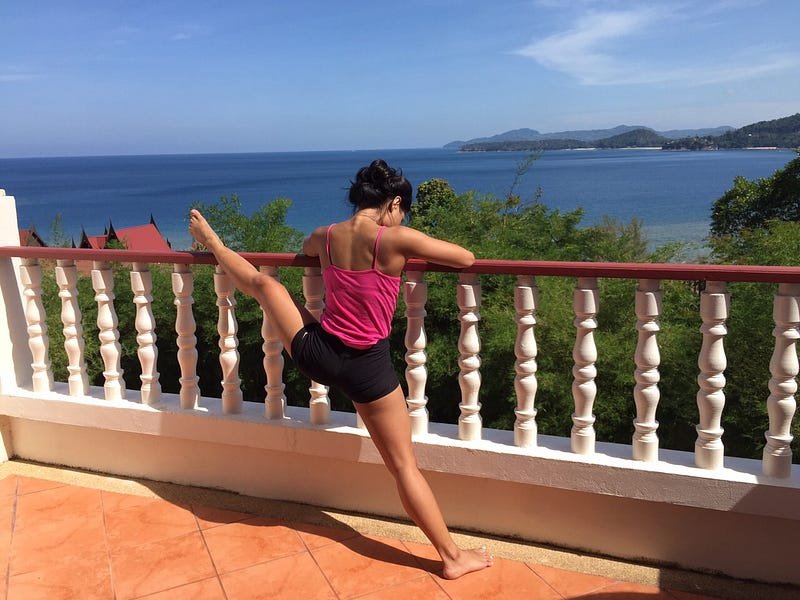
I didn’t exactly grow up living an active lifestyle, it was a combination of factors of nature and nurture. None of my family members live an active lifestyle so I wasn’t influenced much towards being active. Throughout my teenage years, I mostly led a sedentary adolescence, as a result of my triple “concoction” of chronic mild asthmatic, candida, and skin allergies.
I will never forget that feeling of constant skin itch, coughs, and cries; pleading with my late grandmother, “Please, I would love to have my lungs changed!”.
Not to mention, the “religious” activity of visiting the old TCM doctor reading my pulses on both wrists, watching my grandma brewed the various Chinese medicinal herbs the old-fashioned way — six long hours with a ceramic pot, into a perfect bowl of bitter dark-brown medicine every evening for me to drink.
All these changed for the better when I turned eighteen, thanks to the many years of meticulous care from my grandma, using an integrative holistic approach of both Traditional Chinese Medicine (TCM) and lifestyle adjustment. All of those illnesses just went away and never came back.
Along with that, I started getting active in fitness, bodybuilding, dance, and outdoor adventure. I discovered a side of me that I never knew existed — I could move! And boy, did I move every day at every chance I got!
Yet bodybuilding or building muscles didn’t quite fully satisfy me.
I wanted to move free and I caught the bug of being ultra-flexible, to represent the inner desire to be free wherever.
I was stretching every day in every possible way.
I yearn to be a walking epitome of both masculinity meets femininity.
After about two years, I suffered a lower back injury. It was frustrating because I couldn’t do many things I used to do, on top of that, it was a blow to my pride.
I then personally understood and lived true to this phrase - “Injuries humble the best of us”.
This experience led me to sought to understand better the human body and entered the world of functional movement.
Fast forward to my personal adventure into bodybuilding and later personal training, I started exploring the human anatomy and physiology.
At one particular workshop with kinesiologist Chuck Wolf, M.S. — I remembered he said this — “our human body has one sole mission in life — it will do whatever it takes to survive.” That opened my mind further into the world of movement.
So after nearly 10 years of falling and rising, today, my focus is to mobilize the body, not stretch, daily. Though stretching should be part of our mobilization routine, I place the latter as a priority.
My reasons are simple.
1) Tight is not the same as taut
When we say our muscles are tight, sometimes, we may confuse with it being taut. Tight muscles occur when they are kept in a shortened position for a long time, while taut muscles occur when they are kept in a lengthened position for an extended period of time.
How do we know the difference?
Let’s take for an example — the act of touching your toes comfortably. For most who aren’t able to do so, will say, “my hamstring/back of the thighs are tight, I need to stretch more.” While it is a possibility, notice that some of us who have been stretching our hamstrings often, never quite able to touch their toes comfortably.
So does that mean that stretching doesn’t work? Not quite, this is when we have to look at if we are actually stretching the right muscles. So going back to the toe-touch test. Take a look at your knees when you are standing upright. Are they both super straight, to the point, it looks hyper-extended?
If that’s the case, usually, it means your hamstring muscles are lengthened and because this is your natural state, this means your hamstrings are taut. So in this case, no amount of stretching will help you to touch your toes. We have to look elsewhere to get you to touch your toes one day.
Usually, we have to look at what joints are involved in this movement, and their joint range of motion. From there, you will be able to know what muscles are in need of more frequent stretching.
2) Flexibility is not the same as mobility
Flexibility is how much the muscle can lengthen from its rest position like that of a rubber band; while mobility is how much the joint can move around for its natural function, a.k.a. the range of motion of the bones to move around the joint.
An example is the ball-and-socket joint of our shoulder joint. Mobility requires both healthy flexibilities of muscles AND ligaments/joints.
3) Too much flexibility, without strength, leads to injuries easily
Having flexible muscles without a healthy range of joint movements can sometimes lead to injuries easily.
I am born with flexible hamstrings and because I didn’t realize the difference between tight and taut muscles, I often over-stretch them and under-stretch my quadriceps. This has caused much of my chronic lower back /hip pain that flares up every now and then if I am not patient or careful with my workouts.
4) Human movement is a symphony of muscles, joints, and ligaments working in harmony
Just pause for a minute and observe the people walking by you right now. (Okay, if you are observing people now, I do want to emphasize that you do it respectfully and not sheepishly, because you will look like a creep.)
Notice how the parts of the human body are working together to keep the body in motion or in stillness, from the head all the way down to the toes.
While sets of muscles are “actively contracting & relaxing”, the other sets are trying their best to be as still as possible, acting as stabilizers to the entire spine. Every movement is a beautiful performance of all the muscles coordinating and harmonizing together, just like in an orchestra.
By the way, if you notice “quirky” movements around their hips, arms, or neck, this could be a result of an immobile or limited joint range of motion, resulting in compensatory muscles-in-action.
It is interesting to start looking at our human movement patterns in sling actions, particularly the myofascial sling, a term coined in the late 80s, and one highly sought-after veteran in this field is Thomas Myers, LMT (licensed manual therapist).
5) Efficiency
I admit as life gets on, I want efficiency in my workouts. I want the best buck for the bang. There are only 24 hours in a day and much I want to do and achieve. Unless I am a professional athlete where I get paid and sponsored to train the whole day, I honestly do not have the means to train bodyparts two to three hours a day, daily. Besides, there’s more to life than just that.
I am sure like many of you here like myself, also love living the digital nomad lifestyle of being able to make a living out from anywhere. But I also want to feel good and look good.
This is when shifting my training philosophy as movement-based has helped me continue to build a healthy body, mind, and soul. A triple win!
Parting Thoughts
So exactly what is the aim we are achieving here?
We all want to age with grace.
And while we all know one of the keys to achieving that is to exercise often, we also have to be mindful of the way we move too.
Else we may set ourselves up for failure especially when injuries happen too often. Mobility-based movement can be one of those ways we can approach to embark on an active lifestyle.
Healthy mobility often equates to healthy flexibility. We want flexibility AND strength together — the ability to move and hold a stretched position. Just look at Jean Claude Van Damme or the 90-year-old woman splitting!
Hello there, Thanks for reading. I am honored and grateful for your time. I don’t claim to know everything, but I will always strive to share every single bit of truth with thought and humility.
Get inspired actions towards positive living in 3 minutes at The 3M Club.

You just read another post from In Fitness And In Health: a health and fitness community dedicated to sharing knowledge, lessons, and suggestions to living happier, healthier lives.
If you’d like to join our newsletter and receive more stories like this one, tap here.


