
Why I Hold Chopsticks Near the Top
It’s a wacky superstition. Or not.
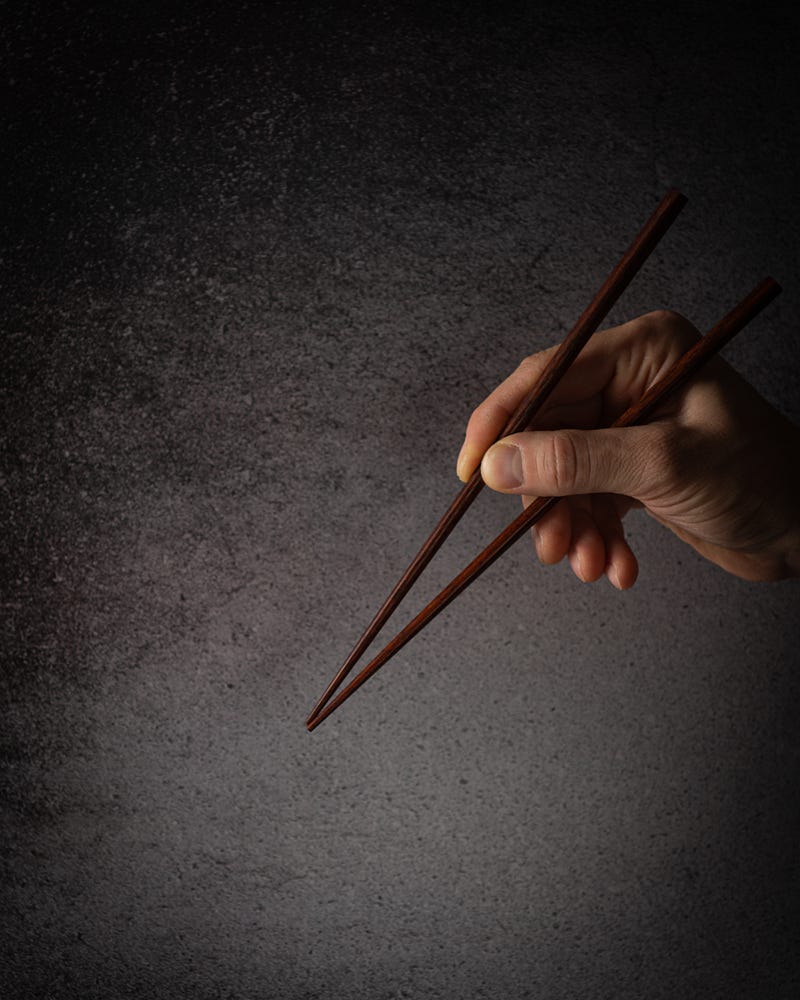
If I were going to stab someone, I’d use Japanese chopsticks.
If I were going to slap someone, I’d use Korean chopsticks.
If I were going as far as possible, I’d use Chinese chopsticks.
While studying abroad in Japan during university, I developed a preference for Japanese chopsticks. No, not because I have a daily proclivity to stab someone. Also while living in Japan, Korean American classmates, upon discovering why I held my chopsticks near the top, informed me that their culture shares the superstition. Growing up in Southern California, I found myself rather ashamed that only after a trip across the Pacific did I have an eye-opening conversation with my fellow Asian Americans about chopsticks. Surely there had been opportunities for such a thought-provoking exchange in high school.
Before I go further, please allow me to clarify what exactly I mean by “near the top.” Instead of placing the fingers of my right hand (sorry, not a leftie, I’m not special) between two-thirds and three-quarters of the way from the bottom of any given pair of chopsticks (as advertised by all those rectangular paper packets decorated with pictures of bamboo at your favorite Chinese restaurant), I grip my pan-East Asian eating utensils with between ten and fifteen percent remaining from the top.
Why?
Also, why is the rule of between two-thirds and three-quarters recommended in the first place? The point is to produce better leverage.
I don’t need that. I have a different point in mind.
One that is evidently present not only in Korean culture but also in Japanese culture (oh, I’m of mostly Chinese descent), which our local Japanese friends told us during one of the many dinners attended by representatives from all groups that believe this superstition. (Booze may or may not have made an appearance.)
Before we reveal the top-secret superstition (it’s not really a secret), let’s discuss the little-known (or at least unsung) differences among the three categories of chopsticks that opened this article.
Japanese chopsticks tend to be pointy at the end, gradually thickening as they reach the top, which is sometimes flat and sometimes convex.
Korean chopsticks tend to be flat and made of metal, which is why I’ve always found them the most difficult to use of the three (not difficult to use in absolute terms but relative terms).
Chinese chopsticks tend to be longer than both with rounded ends and pentagonal or hexagonal tops.
Minor unremarkable differences, really.
So why did I develop a preference for Japanese chopsticks in Japan? Was it some kind of euphoria? Had I gone native? Am I a closet serial killer aspiring to employ chopsticks as my weapon of choice? (This last bit is neither as unexplored nor hilarious as you might think as long as you watch enough kung fu flicks — okay, it’s still pretty hilarious.)
Because they give me better leverage when I hold them near the top (all right, I lied a little a few paragraphs ago). They’re shorter and pointier.
Growing up, I was told by all my elders that the closer I held chopsticks to the top, the farther I would be from home; the closer to the bottom, the nearer from home.
My cousins and I joked that when we were small, we held our chopsticks closer to the bottom. As we grew older, we held them closer to the top.
Guess what I did?
Dash Ip doesn’t use chopsticks as often as he did when he was small.


