Why I Gave up on Flying School
In my teenage years, I went through a phase in which I was enthralled with flying. This was fueled by flying school catalogues I wrote for by the dozen from schools such as Embry-Riddle Aeronautical University. The words they used to express the flying experience left you giddy for some. I couldn’t wait to fly one day!
That “one day” turned into more than five years because I first had to travel from Ghana, through the Ivory Coast, Mali, Senegal, Mauritania, the Canary Islands, Mainland Spain, France, Belgium, and Holland, all without the benefit of a passport. After working as a cleaner in Amsterdam for about nine months, I made enough money to fly from Brussels to Montreal.
After several years in Canada, I found myself living in Vancouver, where there were half a dozen flying schools within an hour’s drive from my home. The old memories of the Wright Brothers’ first flight experience at Kitty Hawk came flooding over me. Within a week, I had enrolled at the Pacific Flying Club at Boundary Bay Airport, near Vancouver, British Columbia.
Learning to fly was as much fun as I had envisioned. My instructor, let’s call him Allen, was a hard taskmaster and just the person you need to guide you on what could easily be a suicide mission!
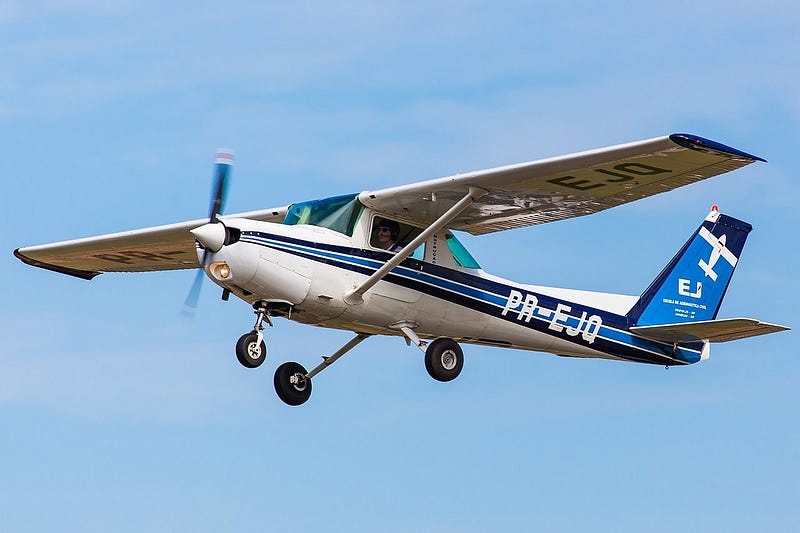
Allen taught me the importance of doing one’s preflight checks on the Cessna 152. Within two lessons, I had learned how to take off, and within a matter of a few hours, I was learning how to stall the plane and recover from it.
Slow flight was the most fun of all. If you had an oncoming windspeed of 20 knots and you flew the plane at a speed of 20 knots, you found yourself practically at a standstill. You could push your speed to 25 or 30 knots and crawl along while admiring the farmlands around or the beach if you found yourself near one.
The flight lessons were accompanied by classes on the theory of flight; you got loads of stories from the instructor on what to be careful about.
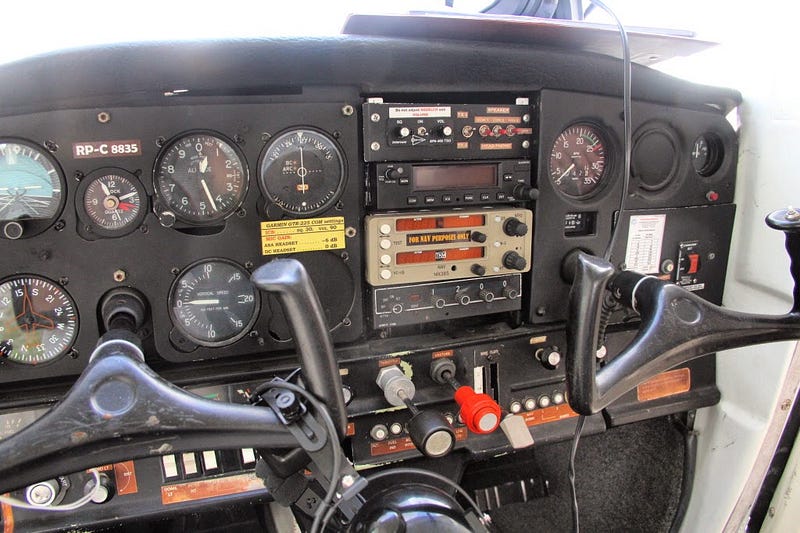
Soon enough, I was ready for my first solo. I went in early that day, checked the weather, plotted my trip, and hopped on the plane. During the flight lessons, one thing my instructor had drilled into my head was to rely on your instruments rather than your senses.
From Boundary Bay Airport I flew towards Hope, using the Fraser River as a rough guide. I also had my map on board. I did a touch-and-go at an airport in Abbotsford and continued to Hope, British Columbia, where I did a 45-degree turn with the view to turning back to Boundary Bay.
When I left Boundary Bay Airport that morning, it had been sunny and bright but by the time I had done my full turn at Hope, the sun had hidden itself and everywhere, left, and right, looked the same, like the sea.
Is Boundary Bay towards the left? Is it towards the right? Hmmm. Then I remembered. Rely on your instruments, not your senses.
I followed the plan that I had set and flew on for thirty minutes or so. And there, there…in the distance, I could see Boundary Bay Airport. I made my call to the Boundary Bay Tower and landed without incident.
I flew a few more times after that but the flight that gave me pause was one in which I had flown with my instructor.
On the way back to the Boundary Bay Airport, I called the Tower, “Zebra Alpha Bravo 2127, two kilometers west of Boundary Bay Airport at 3000 feet, coming in for landing.” Before we could hear a Roger from the air traffic controllers, we heard a voice crackle from another flight, “Tango Uniform Kilo 7123, two kilometers west of Boundary Bay Airport at 3,000 feet, coming in for landing.”
What? Another plane must be just on top of us, just below us, or just behind us. My instructor told me to maintain the same altitude while he craned his neck looking below… and above, to the left and to the right.
“There is the other plane,” my instructor finally said. We changed our course slightly to increase the distance between us.
I had read that there were more than 200 small aircraft accidents per year in North America. The above scenario could easily have ended in one.
Altogether, I logged 65 hours of flying time. There’s nothing like flying solo to realize that you have your life in your own hands.
But I also realized that it is not only up to you. You could accidentally end up in the same space as another aircraft, and as you tumble fast towards the earth, remain full of questions about what you might have done wrong.

I’m glad I learned how to fly, but as I sit in my room writing day in and day out, I never have to worry about accidentally bumping into someone and waking up in the next world because of that!