
Why I Felt Guilty After Summiting Mt. Kilimanjaro
My porters did the majority of the work, so what did I actually do?
It was October 2017 when I finally got on the plane to travel from Boston to Tanzania to conquer the largest mountain in Africa — Mt. Kilimanjaro.
The mountain is over 5,895 meters above sea level and is not a mountain to be taken lightly. Although not as technically challenging, say the Himalayas or the Andes, the one thing Mt. Kilimanjaro can get you with is altitude sickness which can be fatal if you ascend or descend too quickly.
I had been eyeing conquering this mountain ever since I climbed Mt. Fuji solo since I thought it would be a great stepping stone for my future mountain climbing. After doing extensive research, I decided to take the plunge and signed up for the experience.
However, this was the first time I decided to team up with a company that had porters that helped us climb. In fact, it was required by the national park.
I expected that I would be doing a lot of the heavy lifting, but little did I know all I needed to do was hike…and do nothing else.
The porters carry most of your gear
This is what most people who post their photos of their Mt. Kilimanjaro summit don’t mention.
They had help. LOTS of help.
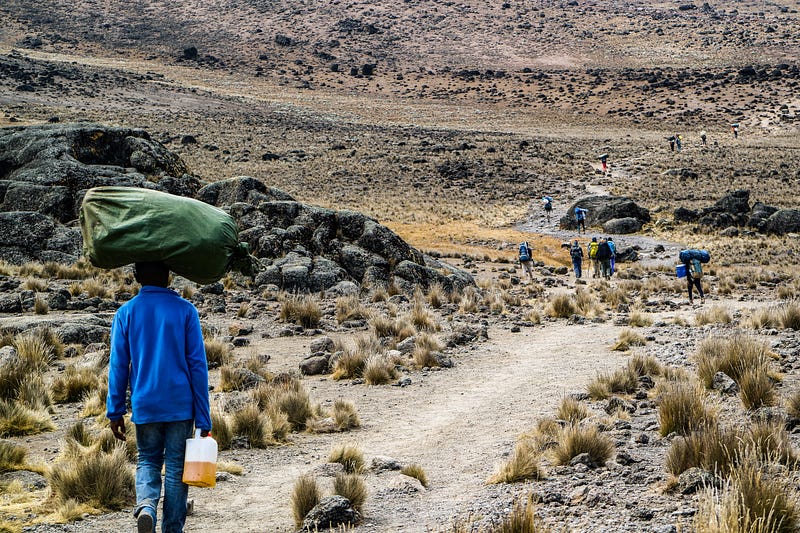
When I went with my group consisting of three hikers, we had 12 porters that carried all of our gear. We were required to bring a minimum of 90L duffle bag and all our clothes and food for our trip. So that’s what they carried in addition to food and equipment.
We did not have to carry any of it since our porters were the ones who carried the bags on their heads and arms.
What did we carry? We just brought a 20L backpack and two water bottles.
The porters cook and feed you
Every time we got to our destination point, our tent would already be set up for us. Food would already be cooked, including the chairs and tables were already set up. All we had to do was rest and come out for our food.
The funny part of all of this is that the porters would always start hiking later than us since they had to pack our tent and gear. However, usually in a couple of hours into our hike, the porters would easily pass us with such great speed that it just made us look like a couple of hikers walking in molasses.
In the morning, afternoon, and evening, food was cooked and fed to us. All we had to do was get up from our own personal tent and walk to the dinner tent.
The porters always track your health and keep you entertained
Whenever we got tired or were ready to sit down, our guide would say “Pole pole” which means slowly in Kiswahili. They constantly kept track of our health and also our oxygen levels at all times.
There were times when the hikers would be very tired and couldn’t carry their own backpack, and our guide would just pick it up and carry it on top of what he was already carrying. In the end, the hiker just had to walk without carrying any gear or water.
I also remembered when I was sleeping in my tent, I would hear the porters singing and dancing in their tents. I knew they were keeping it lively for their own group, but I also think they wanted to keep everyone in my group happy as well.
The porters always clean up after you
You never have to worry about throwing your food away (they did that) or even finding a porta-potty (they also carried that).
When you are about to leave your campsite, you need to take your backpack and leave everything on the floor. The rest of the tent and gear will be cleaned up after you.
What I actually did
Now, I don’t want to say that climbing Mt. Kilimanjaro is easy. It is not.
Personally, climbing Mt. Kilimanjor was very difficult for me, and it was one of the most challenging climbs I have made.
Two days into the climb, I felt massive headaches because I was getting altitude sickness and was about to call it quits. On the last day of the trip, I had a total of 10 hours of hiking. That included 5 hours for the summit and 5 hours of descent in a snow storm.
However, to say that I did the climb and not mention the porters help always feels like a lie to me.
I had twelve humans help my group hike up the mountain.
Every step of the way, they were there carrying the gear, cooking, and sacrificing their bodies for us 3 hikers to make it to the top of the mountain.
Because of that, I always say it wasn’t just me who climbed Mt. Kilimanjaro, but the amazing porters as well.
They were the support that helped me conquer Mt. Kilimanjaro, and I will forever be grateful for that.
For more information about the welfare of porters at Mt. Kilimanjaro, please watch this video that talks about the current plight of porters in Tanzania and how you can help.


