
Why I Do Not Drink Alcohol
And why it often is a point of conflict at parties

Years ago, I decided for myself that I will no longer drink alcohol.
It’s not because I had a drinking problem. And it is not for health reasons either. Even before that, I had been drinking moderately at best.
I spent most of my teenage years in Denmark. For those that don’t know, danish teenagers have a rampant alcohol culture.
If you wanted to fit in with the crowd, there was hardly a way around it. Especially if you didn’t have enough confidence to stand out. Which I didn’t at the time. I felt quirky enough as it was.
But I never enjoyed partying. I still don’t. My idea of a nice social event is sitting down with some good people over a cup of coffee and having interesting discussions about things like philosophy, arts, and politics. Not listening to deafening music and trying to pretend that you can actually dance.
When I became a teacher and started working with special needs students, I had some deeper realizations on the matter.
I was working at a school center, where you would find care homes and a school for children who had been placed outside their biological families by the authorities and had left the public school system.
There was also an adult school for training international volunteers doing development work.
There was one important rule on the campus. No drugs, no alcohol. And for good reason.
Many of my students came from families where alcohol abuse was one of the reasons that they could not live with their families. They needed a place where this was not something they would meet.
As for the adults training to do development work, few realized how rampant alcoholism is in rural areas of developing countries and how much damage it does to livelihoods.
Suffice to say, not all could respect this rule. And I do not blame them. Funnily enough, if some did try to break the rule in silence, it was usually some of my students who would figure it out first.
Because they grew up with alcoholics or drug addicts, they knew all the signs. They could tell from far away. And if they happened to have an addiction of their own, they would always find their peers even in the largest of crowds.
It is through these experiences, I started to understand how ingrained in our culture alcohol consumption is.
In Denmark, you can hardly visit a friend without the mandatory “Do you want a beer?” The same holds true in Germany, my birth country.
All advertisement of the alcohol industry has one common theme. People having fun. The suggestion is that it is simply impossible to enjoy each other’s company without alcohol being involved. Many buy into it. Especially teenagers and young adults.
Sometimes, when I shop, I try to pay attention to how much sales area in a supermarket is reserved for alcoholic beverages. It is a lot. My visual estimate usually says something like one-fifth to one-third. I haven’t measured, of course, but I was thinking about doing an investigation like that with my students.
Sports events would always have some alcoholic beverage brand as a sponsor. And any TV advertisement block in primetime would always have at least one ad for alcohol.
And the problem is bigger than we think. The Danish health authorities estimate that 585.000 citizens have harmful alcohol consumption, while approximately 140.000 are classified as addicts.
Currently, Denmarks’ population is estimated to be 5,823,686 million. That means that
10% of the danish population has unhealthy consumption habits. And 2,4% of the population are alcohol addicts.
Those numbers could be even higher because many will never register in the system. After all, it is rarely the substance abuser, who thinks he has a problem. It is usually the people around him, who notice first.
As I said, many of my students were part of that statistic as well. Either because they were family members to those 140.000 or because they were among them.
I decided at some point, that I did not want to support or be part of this culture. And I try to do everything I can in my capacity as a teacher to instill change in my students as well.
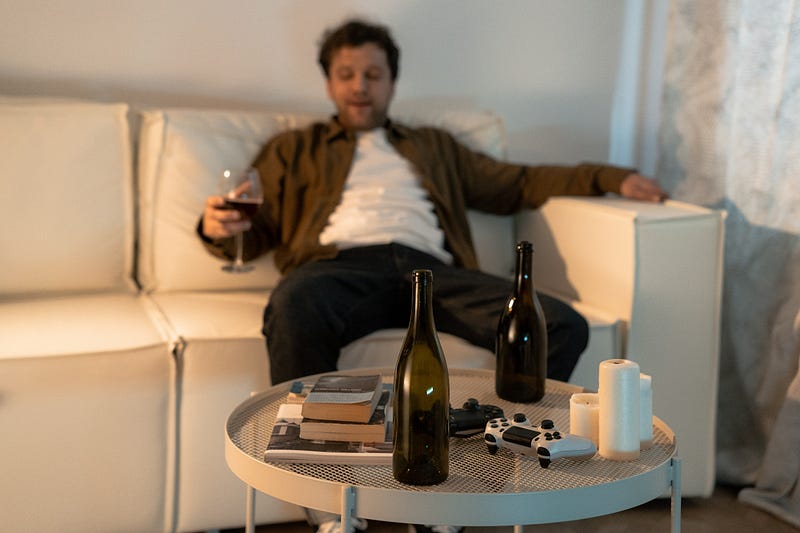
The flip side of this coin is, that it gets me into arguments, even with family. At family parties, I have often been called a fun spoiler, because I would not toast with alcohol. Or drink the mandatory champagne on New Year’s Eve. It has taken years to make family and friends accept my choice. Which by the way only proves my point.
Alcohol is so ingrained in western culture, that we cannot possibly imagine or even tolerate that someone can make a conscious choice to not drink, especially when he or she is not a recovering alcoholic.
But I did. And I do it with pride. And I think those children growing up in households with alcohol and substance abuse deserve to find an environment, where alcohol is not the norm, but the exception.
Alexander Benesch is a passionate teacher who writes about himself, pedagogy, and teaching here on medium and on his blog at https://akoa.info.