
Why I Did 56 Push-Ups at My Age
A few weeks ago I did 40 push-ups in a row for the first time. Then I saw a study that spurred me on.
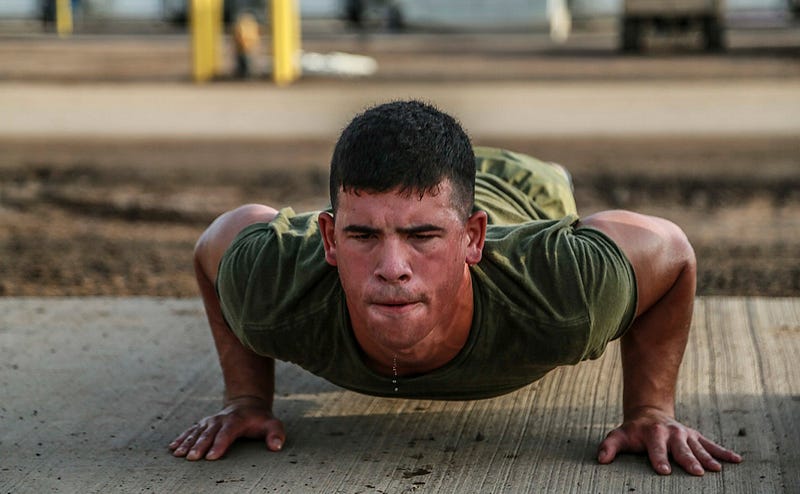
I’m 56. Today, I did 56 push-ups, all in one go. It wasn’t just a stunt. Here’s why I did it;
Sometime in my early 50s, I started trying to get back in shape after another in a series of sedentary spurts. Yes, I’m bad that way. To my great disappointment, it quickly became clear I would never run another sub-5-minute mile (4:54 to be precise) or slog through another 3:59:59 marathon (those last 59 seconds, finish line in sight, were the easiest, but the previous 14,340 were really, really hard).
Forget even attempting another triathlon. My back and knees just don’t want to.
What I could do was hit the gym and engage in more controlled, lower-impact workouts. I’d lifted before, usually just as part of a broader fitness scheme (I’m not a gym rat), and after a couple of years on this latest go-round, I realized I was on the verge of doing more push-ups than I’d ever done before. Not Jack LaLanne numbers, but still.
So I got all methodical, intending to do 100 push-ups over the course of a workout session. First, I broke it down into five sets with a nice rest in between each one (if you see an old guy just sitting on the mat staring at his knees, it’s called a “recovery period”), or I’d work another body part and come back to the push-ups. Then I strived to do 100 in four sets.
All this was mixed with some traditional weightlifting and newfangled workouts that science has shown to be beneficial, from high-intensity interval training for aerobic endurance and improved well-being to really short but intense weightlifting workouts to build strength and also improve overall health.
Long story short, a few weeks ago, I did 40 push-ups in a row for the first time ever.
A few days later, I ran across this scientific study: A bunch of firefighters — who were, on average, 17 years younger than me and who could do 40 or more push-ups in a row — were found to have a 96 percent reduced risk of cardiovascular disease (CVD) over a 10-year period compared to other firefighters who couldn’t muster 10.
(Seriously? Firefighters who can’t do 10 push-ups?!)
The link was stronger than results related to “submaximal treadmill exercise tolerance.”
While this does not prove that push-ups will save your life or that they are better for you than running, it does say something about fitness (beyond the fact that if you must be saved from a burning building, ask for a firefighter who can do more than nine push-ups).
“The findings suggest that higher baseline push-up capacity is associated with a lower incidence of CVD events,” the researchers wrote Feb. 15 in the journal JAMA Network Open. “Although larger studies in more diverse cohorts are needed, push-up capacity may be a simple, no-cost measure to estimate functional status.”
In short: Push-ups look to be one measure of fitness and health prospects. No surprise, as they are really good exercise. They’re like doing planks and bench press at the same time, and then some.
“The push-up engages your body from top to bottom,” says Matthew Solan, executive editor Harvard Men’s Health Watch. Sloan recently did 50 push-ups but admitted having had to split it into two sets, but I’m still viewing him as an expert on this topic by virtue of his title. “It works several muscle groups at once: the arms, chest, abdomen (core), hips, and legs.”
The late Jack LaLanne, nearly immortalized on his eponymous black-and-white TV show that I watched as a kid, once did 1,033 push-ups in 23 minutes. He died some years later — at age 96. Mr. LaLanne knows a thing or two about push-ups (and yeah, I absolutely cannot do this type):
So anyway, I geared up to see how far I could take this push-up thing.
A week ago, I managed to do 50. That’s when it hit me: I’m going to do my age. If it kills me, that’s what I did today. I lived through it, though my form was atrocious on the last two, and I pushed harder on that last one than I’ve ever pushed a push-up before.
Soon as I collapsed, I realized that now I have a new goal. In a couple of months, I’ll turn 57…
UPDATE, May 24, 2019: I turned 57 recently, and on my birthday, I tried but failed to do 57 push-ups in a row. I think the wakeboarding the day prior sapped more strength than I realized. After a couple of weeks tweaking, building back up, and then easing off the past two days, I managed to do it today. Now I’ve got 11+ months to work on 58…
Related


