Why I Created My Own Parody Turkish TV Series

I have just finished grading about a hundred projects, and I have an upcoming batch of grading projects to be done.
I have been overwhelmed with the volume and demands of online meetings, online teaching, and online grading this semester. It has been a very tough period and I have felt stressed out by everything that was online.
I feel as if we have been trapped in squares for months. Computers, phones, laptops, screens, rooms, houses, study desks…. All of them are squares that trap us. We are like genies trapped inside squares. We have been stuck in our homes during the pandemic period. Our homes became our offices and we started spending more than 8 to 10 hours in front of our screens. Hence, we are all trapped in cages — square screens became our cages. We do have wild spirits, alas, we are limited by the frame — we cannot get out of the frame. The name of the frame might be Skype, MsTeams, Blackboard, Zoom, etc. As soon as one meeting finishes, another one starts.
In the midst of all these, I wanted to escape from the boredom, the anxiety, and the stress of it all. How could I find a freedom space for my play, curiosity, imagination, creativity, and adventure in the cages of responsibility I am imprisoned in?
My solution was to use improvisation and theatre to create fun for myself. I love watching Turkish dramas — this has been a mindless escape for me for years. A typical Turkish drama episode is 2.5 hours long and it does not require much focus or attention, so I tend to listen to an episode or two while I am working on my laptop. In fact, as I am writing this very article, I am listening to one of my favourite Turkish TV dramas.
So, I ended up creating my own parody Turkish drama series and I started publishing them on my YouTube channel. The name of the series is ‘Asalet Paçalarımızdan Akar’ which is difficult to translate. I asked Google Translate and it gave me: ‘Our Nobility Flows From Our Troops’. It signifies a paradox of some sorts: “We are so noble that our nobility is as common as dirt” might explain it a bit, but not quite.
Although it is in Turkish, you can watch the videos to get a bit of flavour:
In the first episode, Civanşah, who has inherited rich assets from his father challenges his relatives who each demands a piece from this rich inheritance. Mansions in Bosphorus and rich families who are divided by inheritance wars are very common in Turkish dramas and I wanted to satirise these.
In the second episode, Cihanşah dreams of her mother, whose dead body was mysteriously found in the mansion last year. In this meaningful dream, Ms. Dilruba gives important life advice to her son Cihanşah about how to maintain the family inharitance: Save, invest in gold, protect the family assets, and make sure you issue a marriage contract before you marry.
In the third episode, Cihanşah is experiencing double happiness. First, he got rid of his relatives who wanted a part of the inheritance. Second, he saw a mysterious woman and fell in love with her. This woman has red hair. Who is this enigmatic charming woman? :)
I had great fun shooting these episodes. I did not have any script and I improvised on the go. I used the background music to get into the mood of these characters.
In the fourth episode, we learn more about how Cihanşah fell in love with this woman. Cihanşah sings about the charms of this woman. Her name is Suzan. The song used here is Orhan Gencebay’s famous song “When the season becomes the spring, love is born in the heart.”
Cihanşah’s eyes see no one but the mysterious red-haired woman Suzan. The mentor of Cihanşah, Uncle Remzi, sees this state of him and realizes that the situation is bad: It looks as if rationality has jumped out of Cihanşah’s brain. Cihanşah pulls back from his marriage contract requirement, as he completely trusts Suzan. Suzan is a very common evil character that appears in Turkish dramas. Her goal is to get rich through marriage. She is always plotting.
So, here I am. I do not know if I will continue this series. I do not have any script or any plan for going forward. This is pure play and will remain so. I will do whatever I feel like doing.
Why did I create something so stupid? Because I had great fun! I would not get so much fun if I did these videos in English — it would require serious planning and work. This, however, was the perfect escape for me. I laughed to myself, I felt like a mischief, and I shared my terrible acting and plotting skills with everyone else.
More importantly, I returned to my childhood. I was always creating, playing, daydreaming, improvising, and being foolish when I was a kid. I remembered these when I found my childhood diaries. I created my own theatre and performance events when I was 12. I had created my own logo when I was 13 (you can see below). I created my own cartoon and comic magazine titled “Kazikci Zipcik” when I was 14. I created four imaginary TV channels and their programming when I was 15.
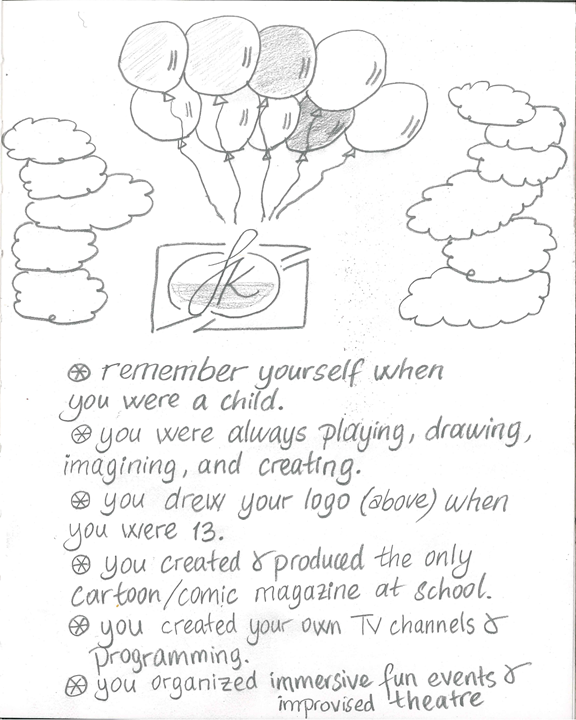
If you think about your own childhood, you will also find activities like these. Think about it: What did you love doing? Remember the times you felt excited when you were a child. You were playing, exploring, and learning all the time, and all these activities brought you joy. However, you lost that sense of wonder, play, and creativity when you grew up. Life got serious, and you have got too many responsibilities and busywork, and you are just trying to keep your head above water. So, you need to go back to your childhood and reclaim your childhood.
You can reclaim your childhood and creativity by exposing yourself to novel experiences and playful activities. Try getting lost, traveling to new cities, learning a new language, writing a story, or playing an instrument. Do things just because you want to do them. This means getting a break from endless goals, worries, anxieties, busywork, and responsibilities. You can learn for the sake of learning if you are following your curiosity. When you are involved in creative activities, immerse yourself in the present moment, and truly experience the joys and wonders of exploration.
Another lesson from this experience is: You cannot learn and grow if you try to be clever all the time. It is much better to be naïve, hungry, foolish, playful, and curious. To this end, I have stopped taking myself so seriously. In my work, I have started experimenting with humor and self-deprecation. When you do not take yourself seriously, this opens up a whole universe of freedom and flexibility for you. You take all that serious baggage (you have accumulated over decades) off your shoulders.
Our lives are full of too much serious business. You need more spaces and moments for pure-play, foolish dances, horrible singing, and naive discovery. It is your task to open up these spaces and moments in your life.
It is not easy to scare yourself and set yourself new challenges and adventures — as this makes you vulnerable. But if you do it, you will be rewarded. You will be happier. You might appear stupid at times, but this is worth it. Your friends will still love you with your weirdness.
Why did I start this foolish adventure? I realized that I do not always feel creative and happy in my academic career. I feel a bit trapped by bureaucratic obligations, grading deadlines, article rejections, meetings, and never-ending tasks.
Whenever I feel trapped, I know that this is a signal for me: I need to make changes in my work and in my life. It means I need more pockets for joy in my daily schedule. How can I find more joy and meaning in my life? This question requires me to think and act differently. I decided to allocate more time to follow my curiosities, passions, and interests.
We are not robots. We need adventures. Sometimes, we need to relax, breathe, loosen up — just be. A wandering mind is not lazy — it is curious and exploring. We need more imagination and leisure in our lives to revitalize and refresh ourselves.
Therefore, I started to waste more time for fun just for the sake of fun. Time spent playing or dreaming or improvising is never wasted. Whether you realize it or not, you are making progress whenever you reflect, dream, or create. You need a bit more chaos, randomness, dance, singing, independent learning, writing, and creating in your life. Improvisation is magic — it improves your life instantly. Using props and humor will improve your creativity. For example, I brought a squash to my class and it transformed my teaching. I used it as a prop for improvisation. We ended up creating hundreds of ideas around the squash (to increase its value). It is not about the squash — it is about your way of thinking. This is all about creating possibilities and an imagination space.
Take-aways:
- Take more risks — it is OK to look stupid and try out new things.
- The world needs interesting, unique, weird people — like you!
- Pursue new experiences and incorporate adventure, change, and variety into your life.
- Treat every experience as a learning experience.
- Have fun! Do not take yourself too seriously. Life is short, and you should enjoy it.
- Tap into your childhood habits: Be open and be foolish. Dance, improvise, have fun, play, sing, or do whatever you like!
- Free yourself from the expectations of others. This will provide you a lot of fresh space for creativity.
- Reclaim your sense of wonder, play, and creativity.


