
Why I Choose They/Them Pronouns and the Power of Including Yours in Your Writing and Profile
And it’s not the reason you probably expect (hint: it’s much more than a social-conscience thing)
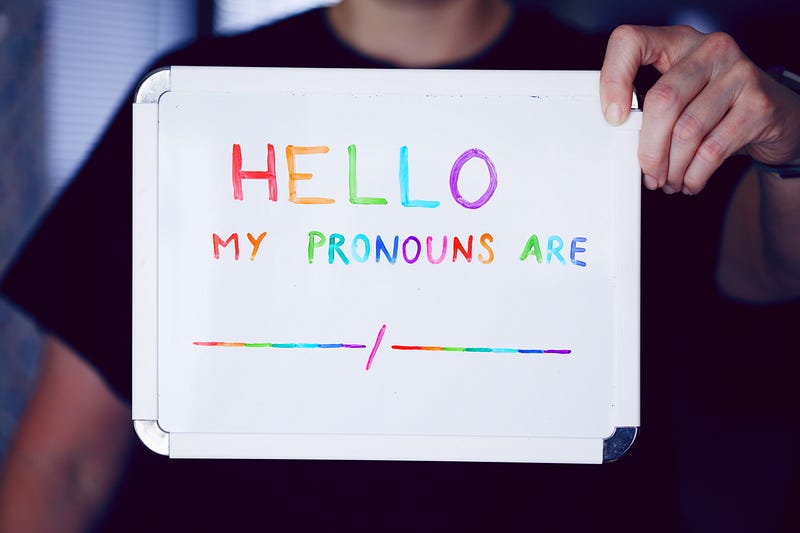
If this is the first piece you are reading on gender pronouns and you have no idea what this is about, thank you for even getting this far. When I first started exploring this a few years ago I had no idea what it was about and was even concerned I would offend someone with my questions or language.
I’m not suggesting you are in the same boat as I was, but I would like to say that this whole thing is a journey. Society’s understanding of and perceptions of gender are rapidly being reshaped, and this is a beautiful thing.
While I will share some basic facts, I am not writing here from a scientific point of view. I’m going to share my personal journey and why I feel this topic is important.
First, about me…
I was born with the physical and physiological characteristics of a male, and these are characteristics I still carry.
I was also brought up with socially-informed ideas about what it means to be a boy or a man. Some (or many) of these ideas were unhealthy and caused challenges for me in discovering myself and later coming out as gay. These social constructions around manhood have indeed proven toxic or limiting for many others, and dare I say, our entire society.
Sex and gender
While I don’t want to get all technical in this article, it’s important to know the difference between sex and gender:
Sex is biologically defined by physical or physiological traits, e.g., reproductive and sexual anatomy, chromosomes, and hormones (male/female/intersex)
Gender on the other hand is socially constructed and can include roles, behaviours, and identity expressions (boy/man; girl/woman; non-binary)
And as to the social construction of gender, this isn’t a passing fad made up by a bunch of post-modern liberals. Gender expression as separate from sex, including non-binary gender expression, is ancient. It has existed in indigenous cultures since our earliest records and still exists today. Even the world’s leading health institution, the World Health Organization, identifies gender as a social construct.
How I identify now
If you read my profile, I use the pronouns He/They/Them. I find most people are comfortable in referring to me as he, and it is often the default if people aren’t aware of my pronouns in advance of meeting me. I have a full beard and bald head, which gives the impression to people that I am male who identifies as a man (NOTE: this is a social construction).
My good friend Tom always calls me Girl (pronounced guuuuurrrrrlllll) and 90% of the time uses she/her pronouns when referring to me in the third person. I find it playful and I love it. It is actually quite common amongst gay men I know to use the she/her pronouns. It is a recognition of an important part of who I am — my femininity.
While Tom refers to me as Girl, and I do the same for her, I still don’t use this in my profile most of the time. My choice of adding they/them pronouns is different though.
Why visibility matters
I have spent a large part of my life in different spiritual and religious communities. I was brought up in the highly patriarchal religion of Catholicism. While there were no doubt positives that helped shape the person I am today (loving, charitable), I was also troubled by the church’s homophobia and misogyny.
In that church, if you weren’t straight or didn’t fit heteronormative roles and expectations, you were either marginalized or had to suppress your true self in order to be accepted. And while some Christian demominations and progressive spiritual teachings have made moves against this, they have also taken on its unhealthy opposite.
One common belief is that “we are all souls” or “we are all children of God” and our gender or sexual expressions don’t matter in the eyes of Spirit. While this is surely well intended by people who espouse this view, it is also a way of suppressing or discouraging the expression of one’s individuality.
I know people — even in spiritual communities that see themselves as highly progressive — who subtly discourage individual expression. I know of queer and non-binary people who feel like they don’t belong in these communities.
And to make matters worse, these communities look down on the use of pronoun expression as being trapped in the social consciousness. The idea is that, in the eyes of God, it doesn’t matter how you express yourself. For me, this is not only a distortion of deeper spiritual truths (the primary one being love), it is also harmful.
Why it matters
There is a small but growing number of people who identify outside of traditional gender roles, stereotypes, or expectations. Some of them are readers and writers on this platform, including your readers or potential readers.
Some people who identify as non-binary or not in accordance with traditional expectations choose to take on different pronouns. For example, someone who was born with the sex characteristics of a female may identify as a man or even non-binary. It helps in the expression of who they are in the world to choose alternative pronouns. In the case of someone born as female and identifies as a man, they may choose for example, he/him/his.
Being gender-aware as a writer is important in being able to reach and acknowledge people.
It’s also important to note, however, that there are no rules around which pronouns to choose. It’s a personal choice made by the individual to fit how they see themselves and/or how they want the world to see them.
Why I Choose They/Them
There are literally dozens of different gender identities one can choose from to express yourself. I choose to add they/them to my profile for these reasons:
- They/them felt easy to me. I also like some other gender pronouns like zhee/zhem, but felt that would be harder to explain. I felt like my use of they/them as a singular pronoun would be easier to understand. I could have also used he/him/his on that basis, but…
- While I am fine with people using he when talking about me, or even she for that matter, there is something uncomfortable about he/him/his for me. To me it only sums up half of who I am. They/them provides more flexibility and fluidity in how I express and experience myself.
- It is an easy thing to do. Even if only one of my readers or subscribers identifies outside of the social binary, my acknowledgement that being who you are is okay was totally worth it.
I also choose to use them/them as singular pronouns in my stories and articles when referring to others in examples. By doing so I am helping normalize the idea that an experience could be held by someone regardless of how they gender identify. Unless I know the chosen pronouns of the person I am referring to, it is safer and more respectful for me to use they.
Adding to your profile
Choosing to display one’s pronouns as part of a profile helps foster an inclusive and welcoming environment, regardless of gender. It can also help affirm other people’s choices.
And you don’t need to choose they/them. You could have been born a male and use he/him/his as a way of showing that support.
There is no one right or wrong way
As a way of encouragement, this is not about getting it right. In fact, if you are nervous about adding your pronouns (I was at first), there isn’t any way of getting it wrong. Making a sincere inquiry and effort towards understanding and compassionately supporting others is powerful.
And if it helps, I haven’t had anyone kick back against me doing so. Even if gender exploration is not part of your journey, I hope you can tell by reading this that I care about who you are as an individual.
Here’s a few other articles and perspectives on the subject by Insider, Phoenix Huber, and Anthony James William if you want to explore this topic further:
If you want more of a backstory as to who I am and what helped inform this, here’s a couple of other article that might help understand my perspectives.
Thank you for following me and reading my work. You can support my writing at ko-fi.com/roobenji. I’d love to hear your own stories and experiences. If you’re new to Medium, signing up is a great way to support fellow writers doing what they love. Plus, you’ll get great content daily.


