
Why I Broke up With my Horse
It wasn’t him. It was me.
For the first time in six years I cut up an apple and looked at the core, which I had always put in a bag to take to the barn, and remembered that I didn’t have a horse anymore.
It was an odd, empty feeling. I shoved the thought aside and went into the other room to watch Doctor Who.
I got my first pony as an adult. I wasn’t one of those kids in pigtails and pink ribbons on fat Shetlands. Because they were busy paying private school tuition for three kids, my parents’ budget didn’t allow me to get involved in horses when I was a kid, so I rode here and there until I could trade barn work for riding lessons between classes in college.
In spite of being largely untalented in sports, I somehow ended up on the University of Georgia Equestrian Team. Granted, I was in the Walk-Trot division, but still. I was on a team doing something that I was actually pretty good at doing. And it wasn’t easy. At shows, to make things fair, all riders had to ride totally unfamiliar horses whose names were drawn out of a hat. If I was lucky, I’d have a few minutes to warm up, getting to know how my ride moved and responded to the way I held the reins and leg position. Then we’d head to the show ring, follow the directions as announced while looking as perfect as possible, and head out. It was basically speed dating.
My first horse was Socks, who had been on a couple of equestrian teams in his extensive show career and was dubbed The Cadillac by everyone who rode him. His flashy white socks and face, as well as his uncanny ability to make pretty much anybody ride beautifully — or at least look like they knew what they were doing — made him a darling in the show ring. But he was getting on in years and deserved to settle down with one person. After I was able to raise the $900 it cost to buy him, I worked at the barn at least 4 days a week, cleaning 18 stalls and feeding horses and cleaning buckets, to be able to afford his care. I also delivered doughnuts and worked at another barn so I could continue to take lessons and afford horse show expenses. After college and my wedding, Socks went with me to North Carolina, then Florida, then back to Georgia, winning ribbons together at smaller shows and going on trail rides until he finally retired to a pasture in South Georgia, living out the rest of his years under the shade of the pear trees.
Fast forward to 7 years ago. After marrying and having babies and divorcing and marrying again and getting in and out of horses the whole time, I met who I thought would be my next equine soul mate.
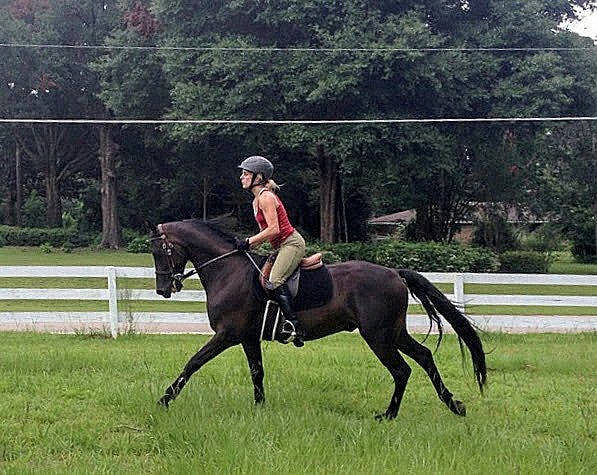
Parker was gorgeous, perfectly proportioned, incredibly athletic, and highly intelligent. He also loved to jump, which was important to me. I wanted to get back in the show ring, and he seemed like an excellent jumper prospect. Also, we seemed to get along well. I was athletic enough to be able to keep up with him, and when I was mentally on my game, I could stay one step ahead of his quick thinking.
When we weren’t working on honing our skills, he was fun to be around. He would give me kisses in the barn, and I would give him peppermints and would always save my apple cores for him.
But then things got complicated.
Over time I found myself riding less and less. Some of this was because my husband and I traveled a lot. And when I say a lot, I mean it. We traveled internationally at least six weeks a year. Most of that travel was during the summer. Also, my health started to get worse. I started getting worn out easily due to almost constant battles with sinus infections and UTIs and other ailments that were caused by a rare immune deficiency that I didn’t find out about until this past year. So Parker would have long stretches of time off while I was in London or recovering from surgery or feeling too exhausted to make it to the barn.
When I could get out there to ride, I was no longer as fit, physically or mentally, to be able to handle his strong personality. As I started to lose confidence in myself as a rider, he started to gain control in the relationship. He’d test me on just about everything, and if I gave an inch, he’d take ten miles. He had an extensive bag of tricks — from suddenly scooting sideways without warning to acting afraid of things he saw literally every day — and as he kept uncovering my weaknesses, he kept adding to his arsenal. I got more and more insecure as a rider, and I started making excuses not to go out there.
I knew we needed to get into couples therapy in order to save the relationship.
Unfortunately, by the time I was able to find a trainer who made house calls, I was two years into some very bad riding habits and far away from my dream of us going to a show. A good friend recommended a wonderful trainer who specialized in problem solving. I took lessons whenever I was in town and healthy enough, but unlearning was the primary subject matter. For both of us. And I had to work on my communication as well as my confidence.
Riding a horse involves constant two-way communication, whether or not you as the rider know the language. If you learn to speak French incorrectly, your sloppy vocabulary and totally wrong sentences are going to be heard regardless of your intent. When you are on a horse, when you’re walking beside a horse, when you approach a horse, you are communicating with your movements, your posture, and thousands of other components that make up phrases and sentences that speak to the horse.
Body language comes standard on horses — even the base models. When you are on a horse and one shoulder goes two inches forward, or if you close your fingers tightly on one rein, you’re telling the horse something. If you are confident or arrogant or don’t really know what you’re doing, your body language announces it. This is why so many people’s experiences with horses start and end with one trail ride.
Like with most relationships, proper communication is key. And, two years into the relationship with my horse, I sucked at it. And his patience was starting to seriously unravel.
Last May, after I moved Parker to a new, larger barn, things got worse. In spite of our excellent trainer, every ride continued to be a challenge. And since I was still dealing with my ongoing health issues, Parker was still not being ridden consistently. And this is what he needed. The problem was, he could not just sit down with me and tell me this in my language. If he could, he would have said, “Look. I love to jump. I love to work out with you. But I can’t do this just once a week. I don’t care what your reasons are. You’re throwing off my balance, you’re constantly giving me mixed signals, and you’re insulting my intelligence. I’m bored and frustrated and you don’t seem to notice. I really think we should see other people.
“And no offense, but it’s not me. It’s you.”
All he could do was say it in his own language, and it didn’t work. Eventually he got louder. In addition to the random scoot-and-buck combo that he had down to a science, he stopped walking up to me when I would go to his pasture. He started getting high handed when being led to and from the barn, whipping his head up when anyone would start removing his halter. And finally, he reared three times during a lesson.
That got my attention.
There had been no good reason for him to rear. He had spooked for a legitimate reason — a truck downshifted on the highway in the distance — but well after the sound had ended, he kept circling back around, bucking and rearing like he was auditioning to be one of The Four Horsemen’s horses in the upcoming Apocalypse. As my trainer put it, “That was just ugly.”
Bucking is one thing; lots of horses buck at some point in their lives. Rearing is in a whole other league when it comes to behavior issues. A rider who is inexperienced or caught off guard could accidentally lean back, causing the horse to inadvertently fall backward and crush the rider under his weight. Thanks to past experience and a great trainer, I stayed on, but knowing my horse’s history with me, I knew that he’d stick this act into his bag of tricks. I’d already broken helmets, torqued my pelvis, and bruised my tailbone coming off this horse. I didn’t want to take the risk anymore. I was also tired of always having to be on my guard, always having that element of anxiety that I know was the real reason why I kept putting excuses on my Reasons To Not Ride Today list.
I was just plain done. The second I got home from the barn, I started texting horse friends, telling them that he was on the market. I talked to people. I swore and ranted and was just so pissed. I thought about all those years of trying to get back into showing, dreaming of my horse showing off in front of the crowd, having his picture taken with a blue ribbon — or maybe even a Reserve Champion ribbon — on his bridle, of all the times I watched him chewing hay, the times I brushed his gorgeous long Barbie horse tail, the times when I shared my homemade apple oatmeal or banana ice cream. But I told myself not to cry and pushed those memories aside and continued on my quest to get him sold as quickly as possible.
This was a legit breakup.
As mad as I was at him and the whole situation, I knew he needed to get the home he deserved. So I messaged his first trainer, the one who had originally trained him when he was young. He would not go to a home until she approved, because she knew him and loved him as much as I did.
Within a week she had a buyer. Within a month he was in Tampa, being ridden most days of the week, jumping to his heart’s content. He’s able to use his brain. He’s getting the workouts he’s always wanted and deserved. He’s seeing other people. And he is happy.
Ultimately, that’s all that matters.
After all, horses don’t get to choose where they end up. Their fates ultimately lie in the hands of humans. And that responsibility is not to be taken lightly.
It was still incredibly painful to let him go. I felt like I failed him. I berated myself as a rider. I blamed myself for not listening to what my horse had been trying to tell me for so long. And, as what happens when relationships end, I hid photos of the two of us and put away any reminder that we were once a thing. If I saw a picture of him jumping with a new rider aboard, I’d swallow tears because it was another reminder that I had failed.
I didn’t eat apples for over two months.
I didn’t make any connection as to why I suddenly wasn’t interested, until I sliced up a lovely Cripps Pink apple and looked at the core, and it finally hit me that he was gone. Then the tears came.
He was somebody else’s dream horse now.
And I threw the apple core away.
It’s just as well, I told myself. We, like millions of other Americans who have suddenly found themselves struggling to pay bills due to the current onslaught of this terrible virus, would likely not be able to afford our mortgage soon, let alone a horse. Even though I’m doing very well selling on Etsy and eBay. Even though my husband’s YouTube videos are gaining some serious popularity.
Shoving things aside is in the Top 10 of my best talents.
Starting over, though, is in the Top 5.
Tomorrow I have a lesson on a horse whose owner is a thousand miles away. She used to get on him bareback and ride him around the property with just a halter and lead rope, which is something I never felt safe enough to do on Parker. The barn owner is happy that Winston — who has a sweet little face and perky ears — is getting some attention. Due to the virus shutdown and my own quarantine, tomorrow will be the first time I will be at the barn since Parker left.
Yesterday I had an apple and saved the core.


