
Self
Why Humans Cry and Its Essential Role
How empathy, biology, and evolution have brought us to tears.
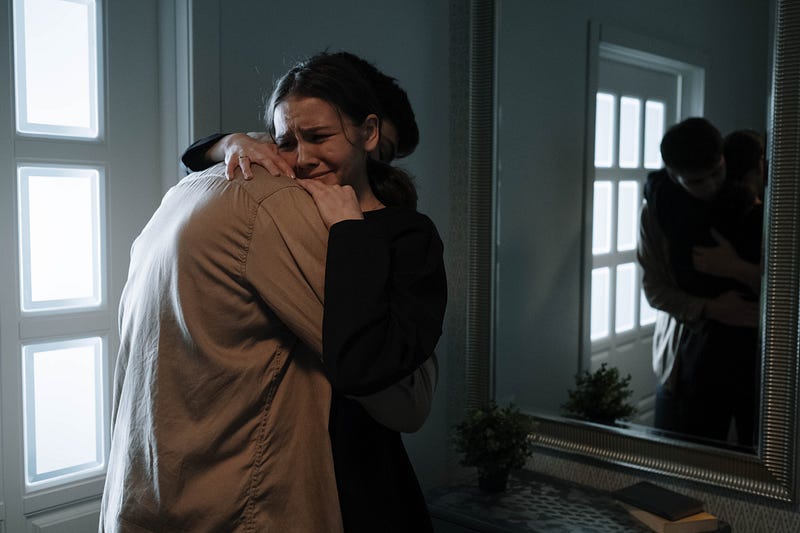
Can you remember the last time you cried? I came close about six months ago. I was watching a real-life video of two men wandering through a lush forest. They suddenly heard a baby crying, and ran to the noise, discovering a newborn abandoned by his mother.
I caught a lump in my throat at the inhumanity of the situation and a child starting life under such circumstances. And if I’m being honest, I also got wrecked by Marley & Me ten years ago, and would again with good movie involving a dog dying.
The role of crying is multidimensional and deeply personal. Understanding why we do it can help you process emotions and better connect with people.
The evolutionary biology of tears
Your eyes often squint when you cry because muscles are putting pressure on lacrimal glands to release tears. These glands are in the upper lateral quadrant of your orbital (lubricating tears are produced in the lower eyelid). You get a lump in your throat when you are about to cry because your body is opening your throat so you can breathe more clearly during the stress response.
Crying evolved to have several purposes. The first is to save us from harm as infants. Babies make noise when crying because it syncs with a visual signal which can go unnoticed. The sound of crying targets an action-oriented portion of the brain and triggers us to notice it more. This is partly why crying babies are so exhausting in public places. You can’t ignore them.
Infant crying also promotes and reinforces caregiving behavior in adults. Tears are the only bodily fluid that doesn’t elicit a revulsion response in a majority of adults.
In a testament to its evolutionary importance, the sound of crying has tremendous crossover recognition with other mammals. Scientists at the University of Winnipeg played the sound of a human baby crying in the woods near a deer. In every case, the deer bounded forward at full speed to inspect the sound. The deer also approached the sound of a crying infant marmot, seal, and domestic cat.
A baby’s crying has a melodic structure with peaks and valleys, followed by a “tailing off” that is unpredictable and which makes it distinguishable from other competing sounds. The melody of cries also differs according to the native language the baby is being raised in.
How crying changes as we age
We cry less as we age and also tend to cry quieter. This is because crying can attract unwanted attention from opportunistic predators. Which is why it takes more extreme feelings, such as grief, to induce vocalized crying from adults. One strongly held theory is that adult crying helps intensify communal relationships and spur on bonding.
It brings to mind an incident from 16 years ago. I was 24 years old, and leaving a gas station at 10 PM with a case of cheap beer. As I stepped outside, I noticed a young high school girl sitting on the street curb with her face between her knees. She was sobbing — hard. We were completely alone. I stood there with my beer under a street light, unsure of what to do. I walked over and put my hand on her back and asked, “Are you alright?” She was heaving and breathing hard. She wouldn’t tell me what was wrong but then when she looked up, I saw she had a black eye. It turned out she’d been beat up by several girls at some party. I consoled her and urged her to use my phone to call a friend (her phone was lost in the fray). Then I waited while her friend came to pick her up.
The incident shows the power of seeing someone in obvious distress. It has an immediate summoning effect upon you. Just as a parent is triggered to caretaking action by a baby’s cry, we are also triggered to have an empathetic response.
Crying also becomes therapeutic and needed in certain situations. It is a form of stress relief and especially useful for countering repressive coping — when you bottle up negative emotions (which can compromise your health). Crying is like a stress valve release. Per psychologist Meena Dasari, crying is healthy but only when done in moderation. It should be a component of coping, until you move on to other forms of relief, such as counseling.
It isn’t fully understood why we cry happy tears, but it’s suspected that the crying portion of brain can’t distinguish between surprise joy and sorrow. Happy tears are often preceded by a feeling of helplessness or anticipation. You can see great examples with surprise soldier-mother reunion videos on YouTube.
Some people rarely cry and it can seem alarming. My grandfather didn’t cry at the funeral for his only son who’d died abruptly. His response might have seemed cold and uncaring to an outsider. I knew it was because he was a strong and stoic man. He grew up in stark circumstances, learning to guard himself. Inside, I knew he was devastated. It highlights a cultural component that strongly influences crying.
The cultures of crying
In 2011, Dutch researchers surveyed countries around the world on how often people cry. In western countries, women cry two to four times a month. Men cry once every two to three months on average. Researchers anticipated countries with lower standards of living would have higher rates of crying than developed countries. Understandably, and with sympathy, they assumed people in these nations had more reasons to cry.
It turned out, the opposite was true. Crying was more common in democratic, developed countries with more civil rights. Extraversion and individualism as a cultural value also boosted the odds of crying. In short, people were more likely to cry when they felt they had the freedom to express emotion.
Women and girls tend to cry more for several reasons. First, women have more prolactin and estrogen, which increases your proclivity to crying. Women also score higher in empathy on average. Conversely, testosterone inhibits men’s emotional response. There are also socialization components, where crying is stigmatized in men.
And of course, exceptions abound and there is no shame in any them. It took E.B. White 17 takes to read the death scene of Charlotte in the audio version of his book Charlotte’s Webb. He had to step outside and come back to start over, only to break down again. He scoffed at himself for crying so much over a children’s book. But he had no reason to. Charlotte’s Web was a story for children, but her death symbolized the death of White’s own mother.
Just remember that, for all of our incessant bickering and fighting, humans are a magnificently compassionate and caring species. Do not fear having a good cry. It is a healthy and necessary stress release, that far outperforms bottling up emotions or drowning them in alcohol.
Remember that tears symbolize something of importance to a person, and often an unconscious signal that they need help. If you see someone in distress, do consider checking in on them.