
Why Having Too Many Choices Can Halt Your Decision Making?
Excess choices can lead you to great regret if you don’t know what exactly you need

I am sure that you can relate to the following.
When I was browsing the internet to buy my first smartphone ever, I was so overwhelmed by the options that I was unable to decide which one to buy under the set budget.
The specifications were just so confusing, the processor chipset, the camera setup, storage, RAM, looks, whether it has gorilla glass or not, all these things were creating a mess in my mind.
I was so confused that I returned the first order I placed from our doorstep (I canceled the order on the day of delivery, so he might not have got the message).
Finally, after a lot of “research”, I decided to buy one, but guess what, soon I started to generate thoughts like, “Had I bought that smartphone with a longer battery life, I would not have been charging the phone twice a day”, “Had I waited for some more time, I could have bought this new smartphone which has impressive specification under the same budget.”
You see, when we don’t have several choices, we definitely feel sad about not having enough choices and think that it would have been so good if we could have some more options. But we still stay satisfied with the choice.
But exactly the opposite can be the case with too many choices. Oftentimes in this case we regret our choice.
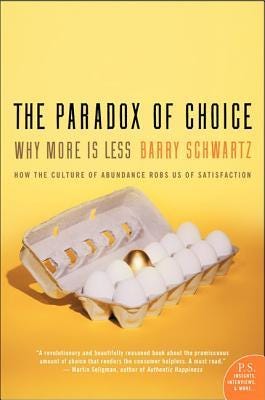
In his book The Paradox of Choice — Why More Is Less, the author as well as American psychologist, Barry Schwartz strongly argues that eliminating options for the consumer can heavily reduce their anxiety.
A major reason I feel why this happen is, as the number of choice increases our expectations increase, increase to such an extent that nothing seems to satisfy. As a result, the actual outcome seems to be frustrating.
For example, if that had been the feature phone days, decision making for me would have been quite easy, and I wouldn’t have regretted my decision as they don’t have a variety of options.
Analysis Paralysis
A major problem that’s common with people having a lot of choices.
Analysis paralysis (or paralysis by analysis) describes an individual or group process when overanalyzing or overthinking a situation can cause forward motion or decision-making to become “paralyzed”, meaning that no solution or course of action is decided upon.
— Wikipedia
One of the most common examples can be buying or renting a house. You need to compare the space size, price, location, interior, the infrastructure around the house, and much more.
The more variables you are comparing, the more likely you're going to be so overwhelmed that you delay the decision making as long as you can.
As far as I’ve seen, this type of problem is very common among those who want the best for themselves. And I am not against it, in fact, I too am among the ones who want the most out of their investments.
But the problem is they get so confused that they end up not doing or buying anything.
They end up not buying a house because they want to check out more houses as another one might be better than the current one even though the current one has all amenities they want.
They end up not reading any book because they can’t recognize which one’s going to be perfect for them.
They end up not going to the gym because they are confused among the types of exercises and can’t tell which one’s going suit them better.
They end up not investing their money because they aren’t sure which investment plan or asset can give them more returns.

The reality is, there is nothing like the best. You are always in a position of making “trade-offs”. You always need to analyze your needs first. I mean what are you going to do with a sports car when your requirements in a car are luxury, more legroom, and a bigger trunk, and if you don’t care how fast it can go.
Is the excess of choice really bad?
For someone who has clear and robust preferences or someone who is a professional in the given field, excess of choice doesn’t seem to be a bad idea at all. In fact, they love to have a variety of choices.
The problem arises when you don’t know precisely what you want. In such a case you just end up comparing items with items without knowing what you need. And that’s where the author of the book, Barry Schwartz, says choices can be bad for you.
But why is it so?
The answer is simple, people with clear and robust preferences can rule out unwanted specifications because they know exactly what they are looking for. As a result, they just need to check out what fits best according to their requirements.
When the what is clear, the choice is easy
For example, when I go to buy a T-shirt, I know exactly what I want, I am looking for something in black, grey or blue, which fits me perfectly, and has no logos on it (Ignore the one in my profile picture, that was gifted by my sister ;-)), so I don’t find it hard to buy a new T-shirt as I can eliminate the ones I don’t want quite easily.
In the end
When the number of choices is too few, there’s a high chance that none of them are good for us and we’ll feel unhappy. But if we have a ton of choices, analysis paralysis can come into play.
So, just be aware of the paradox of choice, know what you exactly need, and it will help you eliminate unwanted choices.