
Why Has it Become Popular to Be Hopeless and Negative?
I’ve been seeing more and more articles critical of a positive attitude. These writers, who are usually very popular, sound contemptuous of people who remain hopeful.
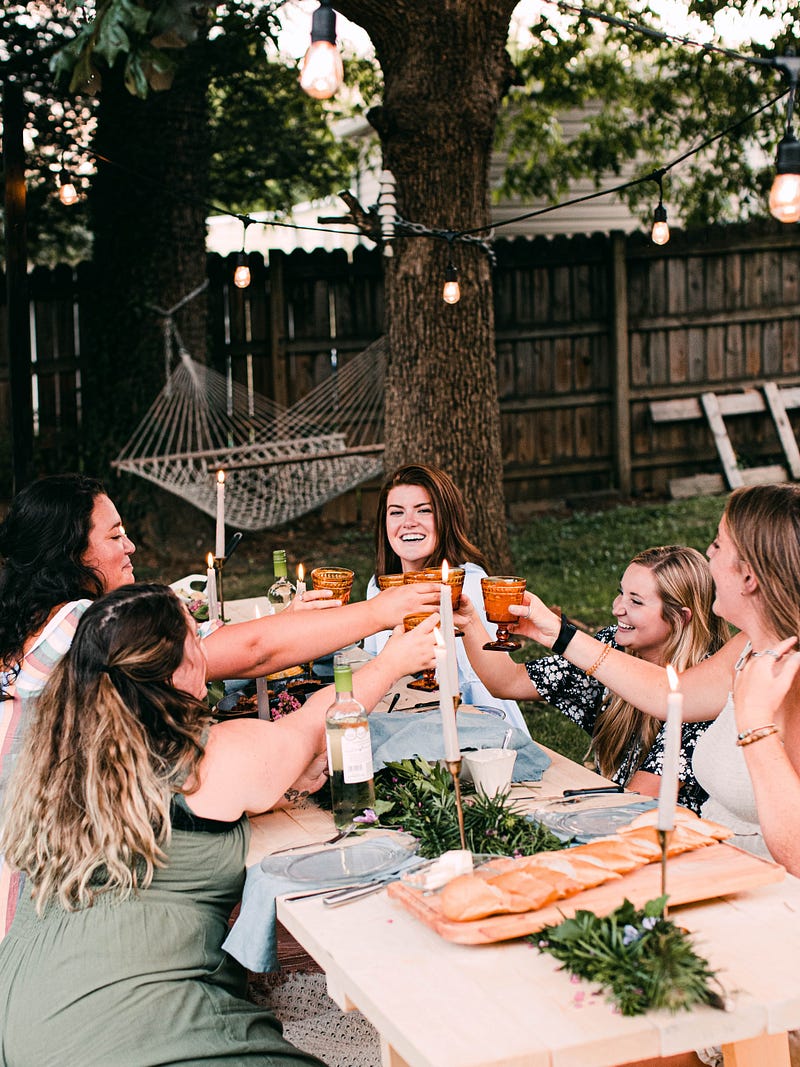
Yesterday we had one of our birthday lunches. There were five of us: friends who celebrate together when one of us has a birthday. These celebrations include modest gifts, good food, sometimes wine, and lots of laughter.
I’ve come to believe that laughter, joy, and friendship are tremendous antidotes to negativity in a world that so many believe is headed for disaster. They also buffer us against the problems and challenges of everyday life.
But lately, laughter and joy are viewed with suspicion. People who tend to be happy are accused of exhibiting a false optimism that denies reality. It’s much more realistic to be pessimistic, according to this world view.
I’ve been seeing more and more articles critical of a positive attitude. These writers, who are usually very popular, sound contemptuous of people who remain hopeful. And their comment sections are flooded with remarks from like-minded readers who believe positive people are nothing more than deluded idiots.
“I’ve always hated optimistic people,” one writer declares. Another one says, “It’s infuriating, because either these people don’t know how strenuous it is to remain optimistic, or they know and just don’t care.”
People must be obtuse, unaware, and privileged to be happy during times like this. Or so the thinking goes. How could people not succumb to despair when we have climate change, a pandemic, and Republicans?
These supposedly more worldly, more knowledgeable, and mostly younger people with their nihilistic outlook would probably view my lunch friends with derision. We belong to the despised baby boomer generation.
And we are hopeful.
How can we laugh like we don’t have a care in the world? How can we fail to realize the future is a black pit of hopelessness?
Joy is not a weakness
But I’m not having any of it. Joy is not a weakness. It takes more courage, strength, and endurance to be happy and optimistic than it does to succumb to despair and pessimism.
Because of the hopelessness I see in the words and attitudes that inundate me daily, I feel compelled to share a little more about these laughing, privileged, women in my lunch group.
I’ve changed their names for the sake of privacy, but everything else is true.
Their families are diverse, representing a variety of ethnicities. Some are fundamentalists and others believe it’s terrible when LGBTQ people are marginalized. Some have been divorced and others have been married for decades.
In other words, they represent a cross section.
Cindy is the most cheerful and boisterous of our group. She has a contagious laugh that springs from a place of true joy.
You would never guess she has a congenital illness with a poor prognosis and no cure. She probably, at the very least, will be on dialysis in a few years. That is what her doctor tells her.
She also has a son who is a drug addict. He sued his parents because they pitched in to take care of his infant daughter so his ex-wife could establish her career after he left her. He also sued them because they no longer allow him to live in on their property.
In the lawsuit, he said he was unfairly evicted, and his parents were “taking up for his wife.” The judge, seeing that this son/husband/father had not paid child support, gotten a job or undergone mandatory drug tests, dismissed the suit.
But if you have children, or even if you don’t, you must know this is a devastating thing, even if you win a lawsuit. The child you have loved, supported, and gone to hell and back for has once again spiraled down into drug addiction. And not only that. He has sued you!
There are many more stories I could tell you about the sorrows this family has endured, and the love and compassion they still exhibit. But I’ll move on to the next person in our group; a woman I’ll call Maria.
Hope does not spring from privilege
Maria grew up with an abusive, mentally ill mother and spent much of her childhood locked in a closet. Her father abandoned the family for another woman, and Maria was left to cope on her own.
She has numerous health issues. One of them is a debilitating illness that leaves her in pain much of the time. She is lucky to get four hours of sleep a night. An army of doctors and specialists have been unable to alleviate her physical symptoms.
Yet she is the funniest, most loving person I know. She has the rare ability to discover the best in people. Generous and kind, she has a diverse group of friends across the political spectrum. She is an empath, sensitive to the pain and problems of others.
My other two lunch friends, Lydia and Anne, have had their share of challenges, too, including parents with Alzheimers, divorce, children with addiction problems, and grandchildren with special needs.
My own problems are miniscule compared with my friends, yet I’ve experienced failure, job loss, rejection, and the death of loved ones. I used to suffer from an anxiety disorder, so I know how debilitating and horrifying panic attacks can be. My severely autistic grandson, a teenager, is nonverbal and still in diapers.
So are the five of us in denial? Are we foolish because we are optimists? Are we burying our head in the sand by not admitting everything is hopeless?
I don’t think so.
Why we are optimists
For one thing, adversity has taught us to be grateful. Instead of looking at what social media and news commentators tell us is happening in the world, we look at the world around us and realize that despite its troubles, life is a gift.
On the day of our lunch, the leaves are gilded with gold. A clear, blue sky yawns over a world stepping softly into autumn, and a bright sun warms our patio table.
We are grateful.
We aren’t climate change deniers. We are horrified by the prospects of fascism and war. We hate racism.
But when we were children, we practiced hiding under our desks in case of a nuclear attack. Our families discussed building bomb shelters.
As young adults, our boyfriends and brothers were drafted and sent to Vietnam. If they weren’t killed and they returned to us, they were spit on and vilified by people who disapproved of the war.
We aren’t oblivious in our optimism. We have some knowledge of history. We have lived long enough to know we reside in a world that has always been plagued by troubles.
Blacks used to be slaves. Women couldn’t vote. There is always a war somewhere.
Life is tough, but we help where we can, donating to causes, volunteering in our small arena of influence, and realizing it is never enough. It will never be enough. But we keep celebrating, loving our grandchildren, and laughing.
The greatest reason for our hope
We are women of faith, which is the greatest reason for our hope. We believe, as David said in Psam 138, “The moment I called out, you stepped in; you made my life large with strength.”
You’ll notice this verse does not say God eliminates problems. It says he makes our lives large with strength.
We gather strength and hope from our belief that God is in control, that his eternal plan is better than our temporal one, and that he is the source of our joy and our strength.
The nihilists can point to our faith as another example of our deluded, unworldly thinking. Professions of faith add fuel to the fire of their contempt.
But I prefer my optimism and joy over the depressing despair that characterizes pessimists and nihilists. I would rather my life be made large with faith as I face life’s challenges, than to live out my days mired in hopelessness.
Negativity and hopelessness will never be popular with me and my lunch friends.
To a believer, life on this earth will never be utopia. But it is a gift, and we have both the opportunity and the obligation to embrace that gift as fully, as joyfully, and as hopefully as possible.