
Why Freedom of Speech Will Kill Us All.
Isn’t it time for factual speech to be the legal bottom line?
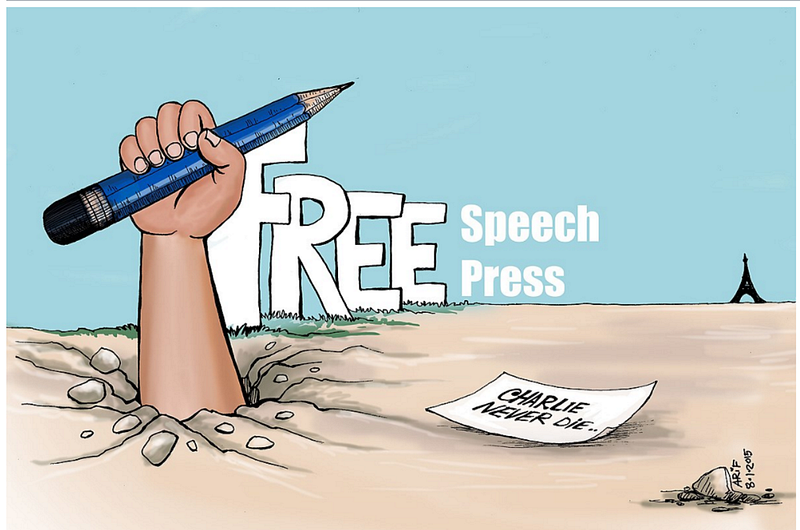

In my late father’s series of articles “Memoirs of a Jewish Journalist in Nazi Germany,” he explains the procedures while working as a journalist for a Jewish newspaper between 1933 and 1936. He was one of three Jewish reporters who had a degree in journalism (in Berlin) at that time, and the Nazis would not permit Jews to work as journalists — unless they had a degree in that discipline. The process for a Jewish newspaper to publish, however, was arduous. Before going to print, the newspaper had to submit all the articles to the local Gestapo for their approval. If the articles weren’t approved, then the journalists had to produce other articles before the paper could go to press. It was a stressful time. In 1936, the Nazis shut down the newspaper and sent the staff to Auschwitz.
During my years in apartheid, South Africa, we never had freedom of the press. In fact, many books were banned. I do, recall, however, a copy of Alan Paton’s book Cry the Beloved Country amongst my late father’s books, published in 1948, the year that South Africa adopted apartheid. South Africa came late to television as it was considered the instrument of the devil. It finally arrived in 1975, and I will tell you that I do not doubt the power of Bill Cosby in introducing an educated black man to the South African public. Less than a generation later, the strictures of apartheid had fallen. Certainly younger white South Africans no longer saw Africans as half monkey/half human, something my anthropology text book from the University of South Africa said in the same year.
France and Islam
French culture is both secular and humane. Some 92% of French people identify as either atheist or non-religious. At the same time, 5.8% of those living in France believe in a 7th century religion for which there is no evidence.That leaves just over 2% as practicing Christians.
Islam is not native to France, so by what moral right do Islamic fundanmentalists presume to tell the French they cannot mock their religion? Surely if one has immigrated or migrated to a particular nation or culture, then one must respect the mores and belief systems of that nation?
It’s a difficult question because France is the father and mother of the Englightenment, and with that movement came the right to believe and practice whatever religion one wished to. The State does not have the right to stop or punish those who believe in a particular religion. Yet no country has yet stated that a religion has no right to dictate to a country, and what Jean Jacques Rousseau did say in his book, The Social Contract, was that it was the will of the majority that must be followed. That means that the Muslims in France are not entitled to have a voice in how their religion is spoken about. What it means is that Muslims must go along with the culture and laws of France.
Irreligion in France has a long history and a large demographic constitution, with the advancement of atheism and the deprecation of theistic religion dating back as far as the French Revolution. In 2015, according to estimates, at least 29% of the country’s population identifies as atheists and 63% identifies as non-religious. Source.
Islam is the second-most widely professed religion in France (behind only Christianity). France has the largest number of Muslims in the Western world, primarily due to migration from Maghrebi, West African, and Middle Eastern countries. According to the Pew Research Center, Muslims make up 5.8% of the population of France, totaling 4.7 million people. Source.
Article 10 protects your right to hold your own opinions and to express them freely without government interference. This includes the right to express your views aloud (for example through public protest and demonstrations) or through: published articles, books or leaflets, television or radio broadcasting, works of art, the internet and social media. The law also protects your freedom to receive information from other people by, for example, being part of an audience or reading a magazine. Source.
Freedom of Speech and Freedom of the Press
I recall learning about the roots of freedom of speech in the 60s during my K-12 school years. For much of human history during the past 2000 years, if individuals dared to say anything against the church or the king, they were either executed or jailed. No criticism of either of these institutions was allowed. The king could tax the people as much as he liked, and if we-the-people said anything, the king could send his men, and that would be the end of that. If you recall, Sir Thomas More was executed for treason by Henry VIII because he wouldn’t support the separation of England from the Catholic Church.
The modern concept of Freedom of Speech had its origin from the Enlightenment. From there, the concept spread, with England legislating the first freedom of speech for individuals in 1689 — a hundred years earlier than that guaranteed by the American constitution. Freedom of speech guranteed that citizens could not be arrested, jailed, or executed for speaking against the government (king) or the church. It didn’t involve concepts like being free to defame others, for example, defamation of character. In other words, freedom of speech was not the liberty to say whatever one liked. It was simply the right to speak against government or church without fear of arrest and execution.
Freedom of the press arose somewhere around the same time, with Sweden being one of the first countries to legislate that the media has a right to publish without fear of arrest and death. It is commonly accepted that the press guards democracies by exposing corruption and tyranny.
New technologies, however, have created new challenges to media freedom. The Pentagon Papers exposed government knowledge that the war would cost more lives than the public had been told and revealed that the presidential administrations of Harry Truman, Dwight D. Eisenhower, John F. Kennedy and Lyndon B. Johnson all had misled the public about the degree of U.S. involvement in Vietnam. The government obtained a court order preventing The New York Times from publishing more excerpts from the papers, arguing that the published materials were a national security threat. A few weeks later, the U.S. government sought to block publication of the papers in the Washington Post as well, but the courts refused this time. In 2017, a U.S.-based nonprofit, Freedom House, found that just 13 percent of the world’s population enjoys a free press — a media environment where political news coverage is robust and uncensored, and the safety of journalists is guaranteed. The United States ranked 37 of 199 countries and territories for press freedom in 2017. Norway, the Netherlands and Sweden were the top ranking countries. Source.
Propaganda and the Right to Tell Lies
When the concept of freedom of speech and freedom of the press were first introduced, propaganda and the right to lie to the general public were not concepts that were covered.
It was Edward Bernays, Freud’s nephew, who first introduced the methodology for effective propaganda. One of his great success stories was Adolf Hitler who used his teachings to convince the people of Germany to elect him. The concept was simple, and it worked. Repeat small, short sentences over and over again until the people believe them. “Deutschland uber alles.” “Make America great again.”
To date, propaganda and advertising have been permitted because it has been thought that the positives outweigh the negatives. Interestingly, though, virtually all governments in the world are not upfront with their inner workings, and people constantly get arrested for revealing those inner workings. Chelsea Mannings and Edward Snowden being examples of exposing what governments did not wish to be exposed.
The conscious and intelligent manipulation of the organized habits and opinions of the masses is an important element in democratic society. Those who manipulate this unseen mechanism of society constitute an invisible government which is the true ruling power of our country. We are governed, our minds are molded, our tastes formed, and our ideas suggested, largely by men we have never heard of…. It is they who pull the wires that control the public mind. In the 1930s, he promoted cigarettes as both soothing to the throat and slimming to the waistline. But at home, Bernays was attempting to persuade his wife to kick the habit. When would find a pack of her Parliaments in their home, he would snap every one of them in half and throw them in the toilet. While promoting cigarettes as soothing and slimming, Bernays, it seems, was aware of some of the early studies linking smoking to cancer. Source.
How the Human Brain Processes Information
We evolved.
We evolved to take in important information that is relevant to our survival. So, for instance, in early tribes living in the jungle, if someone was bitten by a deadly snake and they died, that information was noted. If people always died from that particular snake bite, then that snake was considered deadly. If people were bitten by another snake, and they didn’t die, after many bites, it would be realized that snake bite wasn’t deadly. In the same way, if plants were discovered to have certain healing properties, over a period of time, if that plant always healed, it was accepted as a medication and a factual piece of information.
In other words, the human brain accepted repeated information as factual. Anything that was repeated over and over again could be relied on as truth. And the easier this information was to remember, the more likely it was to be accepted as absolute truth.
This is why rote learning is so effective. While students might hate rote learning, the reason we can recall our times tables with ease is because we were forced to learn them through repeating them over and over again.
2 x 2 = 4 2 x 3 = 6 2 x 4 = 8 2 x 5 = 10.
We remember the things we were taught by rote for the rest of our lives.
Edward Bernays used this information to explain to politicans and business owners (advertising) how they could get people to believe what they wanted them to believe. Just repeat what you want them to believe over and over again. He said that the shorter and easier it was to absorb, the more people would believe it. “Deutschland uber alles.” “Make America great again.”
The Downside of Freedom of Speech
Freedom of speech has been co-opted to mean one can say anything one likes to anybody one wants to. It has resulted in hate speech, increased deformation of character, libel, outright lies, and more. This is not what was intended when the concept of freedom of speech was introduced during the Age of Reason (Enlightenment). The intention was to ensure that people were treated justly, and that people didn’t get arrested or lose their lives for voicing valid criticism of government or the church.
Today the original intent of freedom of speech appears to be meaningless. Instead, a great many speakers and writers lie outright to the general public, and this has meant that climate change denial, holocaust denial, Covid-19 being a hoax, and that there is a shadow government in America , are all belief systems that are flourishing and endangering the common good. People believe this because these half-truths and untruths are repeated over and over again.
The result is that our civilization and the existence of the environment we need to stay alive has been endangered. Just as the corporations selling cigarettes during the 30s convinced people through advertising that cigarettes were good for your health, so oil companies have convinced a fairly large percentage of people that climate change is not man-made. Yet both the tobacco companies and the oil companies knew early on that their products were damaging. And Trump knew that Covid-19 was dangerous and deadly by January, 2020.
It has become clear, then, that the positives of freedom of speech do not outweigh the negatives of freedom of speech. When people are dying, and when the very existence of mankind is now challenged as a result of outright lies, how can we still defend the right of anyone to say anything they like?
The Need for Factual Speech
Freedom of Speech needs to be redefined. Anyone should be able to say anything — so long as it is factual. So many problems would fall by the wayside. There is a reason that lies have always been deemed unethical. They not only muddy the waters but have negative consequences. In addition, it is not possible to make good decisions if the information one is basing those decisions on is faulty.
Provision also needs to be made for that vast numbers of human beings who still believe in things that are not factual — particularly when it comes to religion. Legislating that only factual speech would be permitted would once more outlaw religion. It would also outlaw any political or economic theory as none of them are provable. So these finer points would need to be rethought.
The point is simply that when lies and myths become the guiding light of humanity, then humanity will once more enter the dark ages. And that is something, with our current technology in weapons of mass destruction, that could be a very dangerous thing. One could say that it has the probability of leading to an ELE — extinction level event. Then, again, that isn’t a factual statement either.
Of course, if factual speech were to become the basis of freedom of speech, advertising and public relations would be closed by 9 am. Pretty much, a lot of people would be left without anything to say — they would be speechless.
And now, so am I.