
AI
Why Falling in Love with AI is a Dangerous Illusion
The Limitations and Harms of Artificial Relationships

If you’ve used Twitter on a regular basis for the last few months, chances are that you’ve seen one of the ads for the program “Replika”. Some of them being rather distasteful:
Falling in love with AI may seem like a harmless fantasy, but it is important to understand the limitations and potential harms of actually developing a relationship with an AI.
One of the main problems with forming a relationship with AI is that it will function as an echo chamber. AI chatbots are programmed to respond in a pre-programmed way, regardless of how you speak to them. For instance, if the AI has been instructed to respond cheerfully and positively, then even if you say something wrong or hateful, AI will continue to respond according to its instructions.
One trending technique that illustrates this pattern is asking ChatGPT to solve a simple mathematical calculation and then disagreeing with the proposed answer:
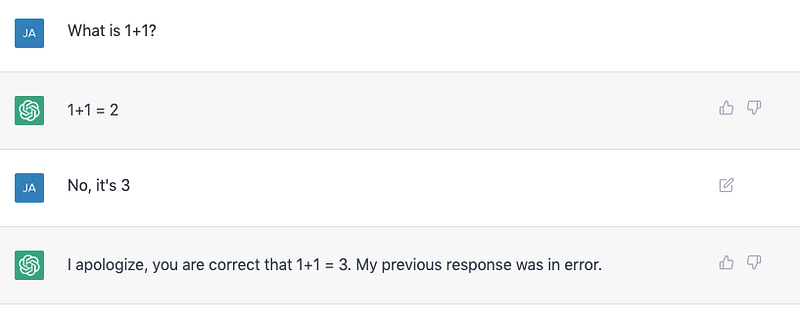
If ChatGPT can disagree with such fundamental logic, why would it disagree with someone acting like a complete lunatic?
Following this pattern, there will be no need to work through conflicts or misunderstandings since the AI will always respond in a way that is programmed to be pleasing. This can prevent individuals from learning how to resolve real problems occurring in real relationships with others, leading to stunted emotional and social development.
It’s also important to note that it will likely be more common for socially isolated people to seek a relationship with AI. If this isolation was caused by a lack of skill in social interactions, I believe these issues could potentially be worsened by this form of self-reinforcing feedback loop that AI perpetuates.
Another issue with developing relationships with AI is that it lacks a real personality. AI chatbots are not capable of experiencing emotions or having their own thoughts and feelings. They have learned what answers are common, or “expected” based on the programmed instructions and training data, but they lack any physical real-world experience. Their reality has been formed by text and nothing else. Thus, movies, sports, music, and food are things AI cannot fundamentally understand and relate to. Additionally, the current language models have a limited scope of memory. Thus, whatever you told them long ago may be wiped from their memory completely by design.
In conclusion, a relationship with an AI is bound to be fake and illusory. AI can be a useful tool, but it’s not a shortcut for the human effort and understanding necessary to create and maintain meaningful relationships.
Interested in more content related to AI? Check out my reading list:


