
Why Facebook’s new stable-coin might be a necessary evil
Virtual currency purists hate the idea. Facebook has a pretty terrible privacy record. Yet a new, properly backed stable-coin might be the tipping point, converting the masses to cryptocurrency.
From Facebook’s point of view, issuing a new stable-coin actually seems to fit quite well with their mantra of, ‘Facebook helps you connect and share with the people in your life’. With Facebook applications installed on smart devices around the world, creating a stable virtual currency backed by the financial clout of Facebook, seems like a real game changer.
However, like me, you might be wondering if this new virtual currency will help people to connect financially (particularly in countries with unstable local currencies), or is this just another tentacle prying into your personal data to be leveraged into more profits for Facebook? I think in the long run, the answer may not matter very much. Keep reading to find out what I discovered.
What I’ve learned so far
- Later this month Facebook is scheduled to release its white-paper detailing its newly dubbed ‘Libra’ project. News released so far is the virtual currency will be a stable-coin – meaning the value of this coin will be far less volatile than other cryptocurrencies. In fact, it will likely be backed by a basket of fiat currencies, which in theory should make Libra even less volatile than if it were backed by only a single fiat currency.
- We also know Facebook is in talks with third parties to negotiate node participation. Nodes are distributed computer ledgers that help to process and verify transactions to the blockchain. This will be by invite only, since the rumored price tag for operating a node will apparently be $10 million.
- Facebook has framed this new GlobalCoin as a way for the people of developing nations to protect themselves from volatile local currencies. However, it looks like the very countries Facebook is trying to help, already see virtual currencies as some sort of existential threat and are already putting plans in place to counter international virtual currencies. For example, India wants to make owning virtual currency a crime, punishable for up to 10 years in jail, … unless the virtual currency you’re talking about the new Digital Rupee!
The reasons I think purists hate the idea of a Facebook stable-coin
- Lack of privacy – Let’s get real – Facebook has had nothing but privacy scandal after privacy scandal. Mark Zuckerberg has been in front of congress to explain biased algorithms and Russian trolls. Headlines and blogs have complained about the shameless mining of personal data that people (admittedly) freely dump into the hands of Facebook.
- Too centralized – In fact, it is that centralized platform aspect that cryptocurrency purists most are at odds with. Of course this is understandable, since the Bitcoin platform was specifically designed to transfer money peer-to- peer without a third-party intermediary. If the new GlobalCoin were to be administered purely on Facebook servers, it would greatly detract from the purposes of using blockchain technology in the first place.
As mentioned above, Facebook intends to have multiple nodes in the overall system. I suspect this is primarily to improve transaction security, since trying to change transactions appended to a blockchain and distributed to multiple nodes a futile exercise. However, I think the real opportunity for Facebook here would be to leverage the distributed model by NOT mining the transaction data of every single user of the new currency.
Many experts have pointed out that Facebook (and other huge internet platforms) might be broken up in the future to protect smaller and newer developing companies and technologies. Mining the transaction data of a new GlobalCoin would only add fuel to the fire. I might be crazy, but I can’t help thinking, Facebook must also see this as an opportunity to show the world they can make money without violating the privacy of its users.
Technology comes with good and bad
I was watching David Packman last night on Joe Rogan’s show. David and Joe were talking about some of the terrible drawbacks of social media. David pointed out that even when human-kind developed agriculture, there were drawbacks. Sure, after developing agriculture we could live in one place, plant our crops, raise our livestock and not have to worry so much about starving in the winter. On the other hand, we didn’t get as much exercise and we increased the chances of catching diseases from the animals we were tending! Technology comes with unintended consequences.
I think it’s a really hard goal to come up with a technically difficult idea and get it right the first time. It takes many iterations to get a technology right. It took 15 years and 5127 prototypes before James Dyson was ready to release his first vacuum.
I know from my own experience in fin-tech, it is nearly impossible to sort out every detail in advance. One cannot predict how people will react and events play out in the future. New technology needs to be developed in cycles to test what works and what doesn’t, before moving on to the next phase.
Imagine talking to a futurist about the Internet in the mid-1900’s:
- They might well have talked about a world where ‘digital letters’ could be sent around the world to anyone in less than a second.
- They may have talked about eliminating the need for paper.
- Perhaps a futurist may have even predicted there being a computer in the hand of every single human being on the planet.
But would a futurist predict smart-phone and video game addiction? Could a futurist have predicted young Japanese men not leaving the house for years because they had all the social contact they wanted through the Internet?
The point is, there are always unintended consequences for any technological advancement that need to be worked out over time before the technology becomes ‘perfect’. To me, the new GlobalCoin seems to be another example of an imperfect solution on the road to an ultimate goal – world-wide adoption of virtual currency.
Why I think Facebook’s Libra might be a necessary evil
You might be thinking, ‘Hey, Edward – why should we care about a world-wide virtual currency? What’s wrong with my credit and bank cards?’ I’m afraid the answer is … ‘The rapid adoption of Chinese-based virtual currencies’.
You may have heard of Wechatpay and Alipay. These huge virtual currency platforms are widely being used all over China today. In fact, you can use either platform here in Japan at the convenience stores (If you‘ve seen either of these platforms being accepted in your country, please leave a comment below).
You may have heard about the Huawei controversy surrounding the issue of 5G. I feel like 5G, most countries are already far behind China in the adoption of virtual currencies. Like 5G, this is a battle over important international standards. Some experts complain that if China is allowed to develop 5G standards, the Chinese government might well have complete access to the browsing habits of everyone on the planet using this technology.
Alipay and Wechatpay might be considered a kind of virtual currency but they are absolutely not cryptocurrency. All transactions are completely transparent to the platform and therefore mineable and traceable by the Chinese government. Like the Huawei 5G issue, if these Chinese juggernauts start gaining world-wide traction, I fear the spending habits of the world will also be in the hands of the Chinese government.
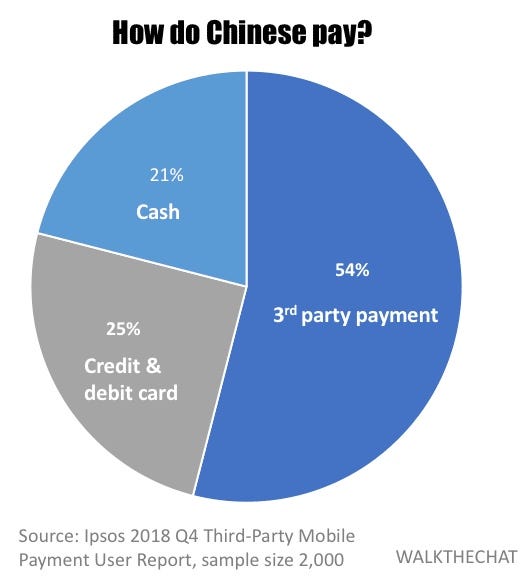
Electronic payments in China are already so dominant that less than 50% of transactions are being conducted in cash, credit or debit. It would be foolish to think these massive companies won’t try to market to the entire world.
Reasons for embracing Facebook’s GlobalCoin
- Although Facebook’s GlobalCoin might not be the perfect solution, it’s a solid solution to counter the ever-growing economic influence of Chinese companies, who in turn are too overly influenced by their own governments. If we don’t trust Huawei to avoid the influence of the Chinese government, why would we trust Tencent or Alibaba?
- We should also care about a global stable-coin for the sake of people not living in first-world economies. Many nations around the world have terribly unstable currencies and too many people remain un-banked or under-banked. A global stable-coin currency would allow the working poor a safe place to save hard earned money without the fear of their own government triggering hyper-inflation, rendering their fiat cash worthless. A global stable-coin will also allow businesses to transact with each other without a first-world platform acting as the middleman in transactions. This could bring great flexibility and reduce trade friction (trading costs, exchange rate risk, …).
- We should care about a global stable-coin because of the freedom and flexibility it would bring to average people. No more traveling with cash, trying to find a money changer. No more looking for the hotel room safe. No more trying to calculate the price of something in your own currency in your head. Instead, scan the QR code, see the price in GlobalCoin or maybe your own local currency, and click ‘buy’.
- GlobalCoin might be the technology we need to get average people to make the move from cash and credit into cryptocurrency. I believe this is critical if we want our economies to keep up with those countries already far ahead in adoption of virtual currency.
What happens if Facebook ends up using my data?
- As I mentioned above, evolving technology comes with good and bad.
So, what happens if Facebook doesn’t take this opportunity to do the right thing to protect the privacy of new GlobalCoin users and instead exploits it for even more data and profit?
- GlobalCoin will pave the way for other developers to create even more stable-coins and floating cryptocurrencies for users to choose from.
If it turns out Facebook is only leveraging this opportunity for more profit and not to improve their image, new decentralized currencies will simply look better and better to a new, technology savvy consumer. Ultimately, if Facebook does not decentralize and make privacy a priority, inevitably new market entrants will introduce viable, decentralized solutions and consumers will finally get the decentralized, safe, private virtual currency we all deserve.