
Why Extreme Heat Kills So Quickly
An overlooked force fuses with extreme temperatures to create dangerous, even deadly conditions. What to know and do.
This article is part of a Wise & Well Special Report: Extreme Heat and Human Health.
One recent summer morning, I checked off a bucket list item: I hiked the beautiful Paria Canyon in Arizona. Mesmerized, I wandered through its rainbow-streaked cliffs, sandstone arches, and red rock amphitheaters.
Before I realized it, the sun was high in the sky and my single hydration container was empty. Thirsty and fatigued, I began the long trek back — a shadeless, 3-mile slog through shifting sand. It didn’t take long for me to start feeling the effects.
I was sweaty and dizzy. My heart was pounding. Despite the searing heat, I felt freezing cold. The next thing I knew, I was facedown on the trail.
Fortunately, my hiking mates recognized the signs of heat stroke. They picked me up, carried me to the shady trailhead, and gave me cool sips of water. Their quick thinking — along with the fact that I was in good physical condition — helped me recover quickly, with no long-term effects.
Many people aren’t so lucky. In the United States, heat is the number-one cause of weather-related deaths. At least 600 and as many as 1,500 Americans die each year from heat-related causes. The deaths occur among older people indoors, displaced individuals without shelter, and overconfident hikers of all ages.
But scorching temperatures don’t tell the whole story. A twin force — humidity — plays a huge role in how we experience heat.
And recent research indicates that when combined with heat, high levels of humidity become dangerous or even lethal to the human body at levels much lower than previously believed. Though Southwest heat is often celebrated for being dry, in summer the humidity rises — as I learned on my fateful hike.
A deadly combination
The combination of dry air temperature and humidity is called wet-bulb temperature — a measure of stress on the human body that can cause heat stroke.
During heat stroke, higher body temperatures can interfere with signals from the brain to key organs of the body, W. Larry Kenney, professor of physiology and kinesiology at Penn State University, told CBS News. In turn, this process can set off heart, kidney, or liver failure.
Previously, based on a 2010 analysis published in the journal PNAS, scientists believed the safe threshold for humans to be:
- At 100% humidity, 95 degrees Fahrenheit (35 degrees Celsius)
- At 50% humidity, 115 degrees F (46 degrees C)
These estimates were theoretical, based on mathematical models. So 12 years after the PNAS study, in 2022, Kenney and his team at Penn State conducted a test on humans.
For the study, 24 participants each swallowed a tiny radio telemetry device that measures core temperature. Each person entered an environmental chamber and performed light physical activity, such as cycling or walking on a treadmill.
Researchers increased the temperature and the humidity inside the chamber until participants could no longer maintain their core body temperature, and analyzed the results.
The study, published in the Journal of Applied Physiology, found the thresholds of human heat endurance are significantly lower than previously believed:
- At 100% humidity, 87 degrees F (31 degrees C)
- At 50% humidity, 103 degrees F (39 degrees C)
The safe heat/humidity range Kenney and his colleagues determined for young, healthy people is shown in green and yellow below. For older people and those with chronic health conditions, the researchers note, the threshold is likely lower. In the red areas, a healthy person would not be expected to survive for more than six hours.
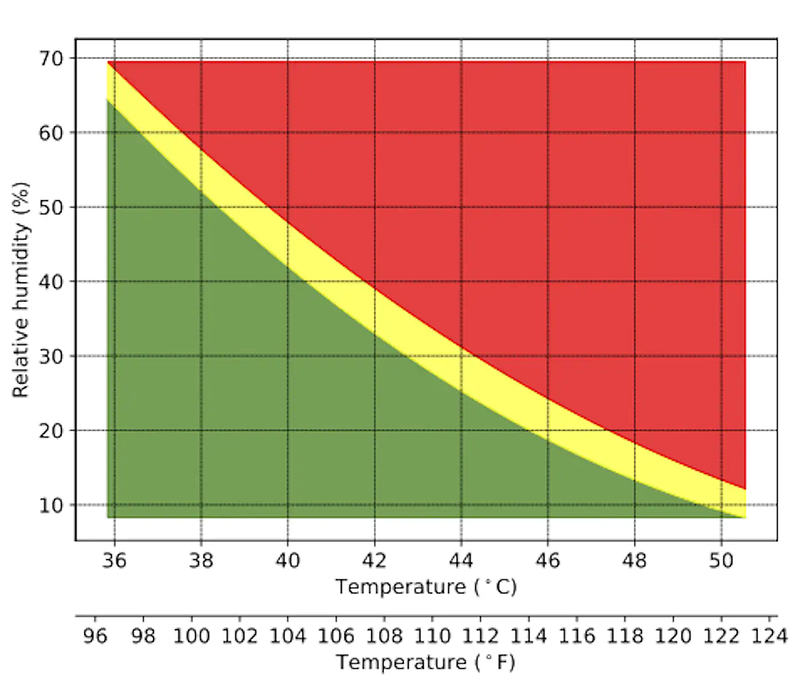
These study results could help people better plan for extreme heat events, which are occurring more frequently as the planet warms.
“If we know what those upper temperature and humidity limits are, we can better prepare people — especially those who are more vulnerable — ahead of a heat wave,” Kenney said in a statement. “That could mean prioritizing the sickest people who need care, setting up alerts to go out to a community when a heatwave is coming, or developing a chart that provides guidance for different temperature and humidity ranges.”
How the body overheats
Over thousands of years, humans have evolved to thrive within a tight body-temperature range of about 98–99 degrees Fahrenheit. Above that, the body begins to overheat and become dehydrated.
Sweating helps cool excess heat. But at a certain point, that no longer works, especially if humidity is high and perspiration cannot evaporate.
“Once your thermal stress or heat gain becomes too much, even sweating is not going to keep up with getting rid of the additional heat,” JohnEric Smith, an associate professor of exercise physiology at Mississippi State University, told Scientific American.
This can result in heat exhaustion — the condition that occurs when your body can’t cool itself through sweating. If unchecked, this can progress to the more serious level of heat stroke, where your body temperature climbs to dangerous or even deadly levels.
At high-heat levels, “the walls of your cells begin to melt,” Jeff Goodell, author of “The Heat Will Kill You: Life and Death on a Scorched Planet,” told WBUR Radio. “And the proteins that control the basic functions of our bodies begin to unfold and you literally kind of melt from within. It’s a horrific way to go.”
Despite the deadly nature of excessive heat, people commonly underestimate its strength, Goodell said, treating it like “a kind of playful summer force.” He pointed out that the media often covers heat waves by showing images of families at the beach or kids splashing in sprinklers. But underestimating its power, said Goodell, can have deadly consequences.
How to keep your cool
To keep your bright sunny days from turning into dark emergencies, it’s important to recognize and respond to the first symptoms of heat exposure — including muscle cramps, headache, dizziness, fatigue, confusion, and increased heart rate.
It’s also important to know who’s especially vulnerable. This includes infants and older adults, people with heart conditions or mental illness, and those whose bodies may not be adjusted to the heat (such as travelers to a tropical location).
The CDC offers a long list of suggestions for staying cool in the heat.
If you notice signs of heat exposure, quickly move to shade and drink water. Depending on risk factors, symptoms can appear quickly — in as little as 15 minutes, as I learned on my Paria Canyon hike. Excessive heat and humidity can be powerful and fast-moving forces. In my case, the beauty of the hike distracted me from the obvious dangers of dehydration and physical exertion in a hot and humid environment.
Paria Canyon was a bucket-list item for me. Looking back, I’m lucky the hike was not my last.
Learn more in this Wise & Well special report:
Thanks for reading! Your support makes my writing possible. You can sign up for emails when I publish on Medium, or join Medium to directly support me and gain full access to all Medium stories.


