
Why ‘Eat Less Move More’ for Weight Loss ALWAYS Works
A response to the fraud “Dr.” Jason Fung, who’s article is currently topping the trending tab.
Skip the intro if you want to know how to actually lose weight.
Be sure to follow if you like what you read!
Dear reader, I’ve been absent for quite a bit. I got busy, then got really busy, then had the smallest touch of a mental breakdown. I’ve been meaning to come back to Medium and finally decided today was the day I was going to start writing again. I went to the top of the site for inspiration and found this garbage article:
What kind of junk is this?
Skeptical, I gave it a read.
Aaaaaaand it’s BS
Why do I care? One of my most successful article is about how to actually lose weight. It matters to me because I used to really struggle with my weight and am a serial yo-yoer. I know how easy it is to be strung along by false promises and it’s ridiculous how simple the reality is. If you want to read that article, you can do that here:
Otherwise, keep reading to find out why this guy is full of it.
The First Law of Thermodynamics
The gist of how weight loss works all boils down to the First Law of Thermodynamics. If you don’t have that memorized, don’t worry! I’ve got you!
Between any two equilibrium states, the change in internal energy is equal to the difference of the heat transfer into the system and the work done by the system.
When we’re talking about our bodyweight, to can be boiled down to this:
Any change in weight is determined by the difference between calories in and calories out.
If you eat more calories than your body is using, you’ll gain weight. Similarly, if you eat fewer calories than your body is using, you’ll lose weight. Funnily enough, our lovely article contains this lovely infographic:
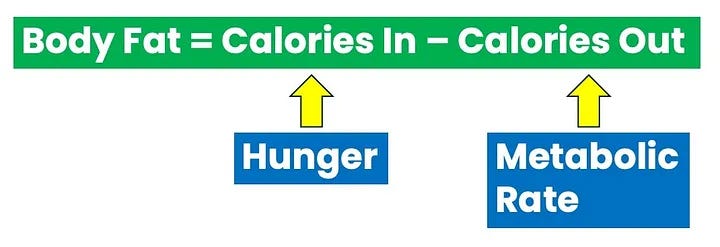
Okay, let’s see what we have here…
Body Fat = Calories In — Calories Out. Great! I couldn’t agree more. Except… what’s this blue stuff?
Hunger
First, he says that hunger leads to more calories.
This is a half-truth.
If you’re hungry, you’ll eat more food. If you eat more food and change nothing else, then you’ll increase your calorie intake. Let’s try to push this a little bit with a hypothetical.
Let’s say that we have two people, person A and person B. Person A is really hungry. Person B is fine. He could wait, but we’re forcing them to eat.
We give person A a giant plate of steamed green beans and we give person B a turkey sandwich. Guess who will eat more calories? That’s right! Probably person B. In fact, if we tell person A to eat as much as he can, right to the point he could puke, he probably still won’t eat as many calories. A turkey sandwich I might make at home would have maybe 450 calories (150 for two slices of bread, 150 for a large amount of turkey, 50 cals for about half a tbsp of mayo, 100 for a slice of cheese, and mustard is a wash). To eat that much in green beans, we’d need to have eaten over 3.5 pounds of prepared green beans (according to Wolfram Alpha).
Am I saying the solution is to only eat green beans? No, that’d be crazy. The point is that hunger isn’t the only factor to calories in, but Dr. Fung won’t tell you this because it hurts his narrative.
Metabolic Rate
His next strange implication is that metabolic rate influences your calories out.
Again, this is a half-truth.
What he’s referring to is your Basal Metabolic Rate, or BMR (He uses “Resting Metabolic Rate” or RMR but it’s basically the same thing). Your BMR is essentially how many calories your body would passively burn if you sat and did nothing. It’s your theoretical coma-expenditure.
Many things can influence your BMR, but 99% of it is your age, sex, height, and weight. It can be calculated with numerous equations simplified into free online calculators relatively accurately.
It makes sense, right? Of course different types of people require different amounts of energy to sustain! But that’s far from the only factor. Let’s try another hypothetical.
Person X has a BMR and activity level leading to an average burn of 1800 calories per day. Person Y has a BMR and activity level leading to an average burn of 2100 calories per day.
Let’s say that both Persons X and Y consume 2200 calories in one day. Person X does enough cardio to burn 500 calories (a little over half an hour running, again based on Wolfram Alpha estimates) and Person Y does nothing. In this example, Person X would slightly lose weight, while Person Y would slightly gain weight. Interesting… almost as if your metabolic rate isn’t the only thing that matters!
Except it doesn’t fit the narrative.
“The Body’s Fat Thermostat”
This is included in the offending article’s title and indicates it’s part of a series. This “thermostat” is the secret weapon you need to lose weight! That’s why you need to keep reading! That’s why you need to follow him! Eventually he’ll tell you all about this and it’ll turn your life around for the better!
You read through the article. He has studies and examples! He must know what he’s talking about!
Yeah, he does. He also knows he’s being dishonest. Fung uses studies out of context and completely anecdotal examples to distract you from the fact that his whole argument is ignoring the factors you experience in every day life. He wants you to believe that all that matters is hunger and metabolic rate, and that his “thermostat” is the solution. It’s not. It’s marketing. It’s a ploy. Don’t be a victim.
The Sunk-Cost Fallacy
You might have heard of this, but what exactly is it?
The Sunk-Cost Fallacy is the cognitive bias to continue pushing forward with something when it isn’t worth it because you’ve already invested so many resources into it. This can be any kind of resource, but here, it’s time.
That’s the reason this is a series. It’s the reason we’re on part 4 and the reason we’ll have more to come. At the end, when he gives you a solution, I can almost gurantee it will require a purchase or a subscription. Typically you would never go for this, but after following a series for a month straight? You don’t want to admit to yourself that you’ve been duped, so you’re going to click the button.
Don’t do it.
Who is Dr. Jason Fung?
Let’s look into the author’s accolades to find out what his angle might be!
A quick Google search shows that he is in fact a doctor. Both Wikipedia and his website agree that he finished medical school at the University of Toronto. What you’ll find before his Wikipedia page is that he’s also an influencer and an author. He’s written several books and has a YouTube channel with over 1 million subscribers.
His website says that he’s been able to help people reverse type-2 diabetes. If that’s true, that’s great and I’m not qualified to talk on it, but regardless, an undeniable truth is
He wants your views. He wants your clicks. He wants your attention.
And who am I to talk? I’m doing the same thing, aren’t I? I’m writing on Medium. I benefit from your read. I benefit from your clap. I benefit from your comment. I benefit from your follow. The difference is that I’m not stringing you along with garbage content. I’m telling you how it is.
His “Technique”
What exactly is Fung’s secret? What do his books and videos teach? How will his thermostat work? What’s the key to weight loss?!
Fasting and cutting carbs.
There! I saved you hours of content consumption. The trick that Dr. Fung teaches is fasting and cutting carbs.
Let me tell you something crazy…
The Real Secret
The real secret is that any fad diet — any dieting or weight loss technique or strategy — all revolves around lowering your calories.
If you only give yourself two hours to eat, you physically cannot consume as much as if you’re snacking all day long.
If you only eat proteins and fats, YOU’RE CUTTING OUT A WHOLE MACRONUTRIENT! Of course you’ll in all likelihood be consuming fewer calories.
Why These “Fads” Don’t Work
All these techniques you’ve tried that have failed all did so for the same reason. You were taught that the strategy of choice was the silver bullet and that nothing else mattered, but you CANNOT escape the First Law of Thermodynamics. It is still possible to eat more calories than you’re burning with any strategy. All it takes is high-calorie drinks and desserts.
Dunkin’ Donuts has a drink that’s over 1000 calories and can be easily consumed over ten minutes. High fat Keto desserts can be found at any grocery story. Vegan cake exists.
No matter what system you’re using, there’s a way to break it, and if you think there are no rules outside of your system, there’s a good chance you’ll find a way to break it.
How to ACTUALLY Lose Weight
If you want more information on losing weight for real, I’d again like to recommend that you read my article below:
If I came across as aggressive, it’s because I can’t stand misinformation, especially when it’s done knowingly. I hope you can forgive my righteous anger.
If you liked what you read, please give me a follow so I know to make more content like this. Let me know what you thought, and your claps are always appreciated.
Peace ✌