
boot camps and online courses are valuable, but developers still need to put in the work to continually improve their breadth of knowledge
Defining Your Ecosystem to Experiment Across the Web Development Spectrum
Drupal, Lando, GitLab, and Platform.sh

According to Course Report, there are now over 120 coding boot camps in the US, supporting over 25,000 graduates — a ten-fold increase since 2013. In 2020, the online learning platform, Udemy increased its valuation by $1billion. Class Central provides a breakdown of Udemy’s catalog and enrollment numbers since its 2010 launch, showing 425 million enrollments against 157,000-course offerings. The largest percentage of enrollments belongs to the Software Development category, specifically Web Development.
It is incumbent upon developers to continually improve their skill set and knowledge. The proliferation of boot camps and online courses seems to reflect this activity. As mechanisms for entering the web development profession and for up-skilling, boot camps and online courses provide structure and depth in exchange for a commitment of time and money. However, depth is not always needed — and time and money may be limited.
With the wealth of topics across the web development spectrum, it is not realistic to gain expert-level proficiency in all areas. However, a breadth of knowledge across the spectrum, even at a superficial level, is important for many reasons; professional development, staying relevant, and being innovative among them.
While boot camps and online courses support depth in learning, self-directed experimentation is a more pragmatic route for continual learning across a breadth of topics. To support this experimentation, having a defined and readily available end-to-end web development ecosystem is beneficial.
The combination of Drupal, Lando, GitLab, and Platform.sh provides a springboard from which to explore many aspects of web development. This may not be the preferred starting core for everyone. The bigger point is to define a starting point, have it at one's fingertips when inspiration strikes, and ensure that it is sufficiently stable and flexible to support learning in all directions.
There are many reasons why Drupal, Lando, GitLab, and Platform.sh provide a valuable environment for experimentation. Each component has its own strengths, and there are advantages to using these particular components together. Before touching on those, however, it is important to gain a little more context on why self-directed, deliberate, and frequent experimentation is becoming more important.
The Full-Stack Developer
Whether considered a front-end developer or a back-end developer, over time everyone will certainly need to pick up skills outside of their area. All developers, front-end and back-end, are on a natural progression towards full-stack, whether intended or not. The progression might be a slow burn for some or a fast track for others.
This might be intentional for the perpetually curious or for those that view becoming a full-stack developer as a professional goal. It may also happen out of necessity to fill a temporary gap in resources or to help meet a critical deadline. Gaining a reputation as a “utility player” on a team — where a developer can pick up tasks outside of the remit tied to their job title — signals movement towards full-stack.
The definition of “full-stack developer” varies, as do the responsibilities and expectations of the role depending on the employer. If or when enough skills are acquired to comfortably use the “full-stack developer” label, one might be qualified for a full-stack position with some employers, but not with others. The label of “full-stack developer” is wonky and inaccurate and will become more so as new stacks enter the picture or more things are piled on existing stacks.
If the full-stack title continues to be embraced, then developers should embrace it back. If the focus instead shifts to specific qualifications, rather than lumping developers into general categories (front-end, back-end), then developers should be ready. Regardless, do not self-limit to one end of the spectrum or the other.
For a good article on the need to emphasize applicant qualifications over job categorization, read Full Stack Pronounced Dead.
Whatever core set of solutions is leveraged for experimentation, they should support exploration from the front to the back, as well as the holistic stuff that affects decisions in multiple areas; DevOps, performance, security, compliance, project management, product management, etc…
Workplace Satisfaction
A Forbes listicle from September 2020 provided 13 reasons why developers leave their companies. Two main themes bubble up from those 13 reasons:
- Developers leave if they do not feel they are being creative or innovative.
- Developers leave if they do not feel they are contributing or being productive.
While those reasons are motivators to seek employment elsewhere, the reasons should also serve as motivation to find other avenues for creativity and productivity. Continuing to work in an environment that is not engaging will atrophy existing skills, especially if they are not being exercised elsewhere.
Creativity and productivity are the responsibilities of a developer, not an employer. The core set of solutions supporting experimentation should provide abstraction enough from underlying complexities to nurture creativity and to promote “quick wins” that will continue to motivate.
Imposter Syndrome
Burnout and cases of Imposter Syndrome proliferate in the developer community. For anecdotal evidence, explore the wealth of articles, tweets, online discussions, and self-help books on the subjects. Or, consider that one of the first sessions at DrupalCon 2021 was entitled Debugging the World’s Most Powerful Computer: Our Brains, which was a well-attended session that discussed developer burnout, anxiety, and Imposter Syndrome.
For a touch of data-based evidence, Google Trends shows a positive relationship between interest in Imposter Syndrome and interest in various developer positions. The following scatter matrix was generated using Google Trends data on the search terms, “Full Stack Developer”, “Back End Developer”, “Front End Developer”, “Imposter Syndrome” and “Coding Bootcamps”:
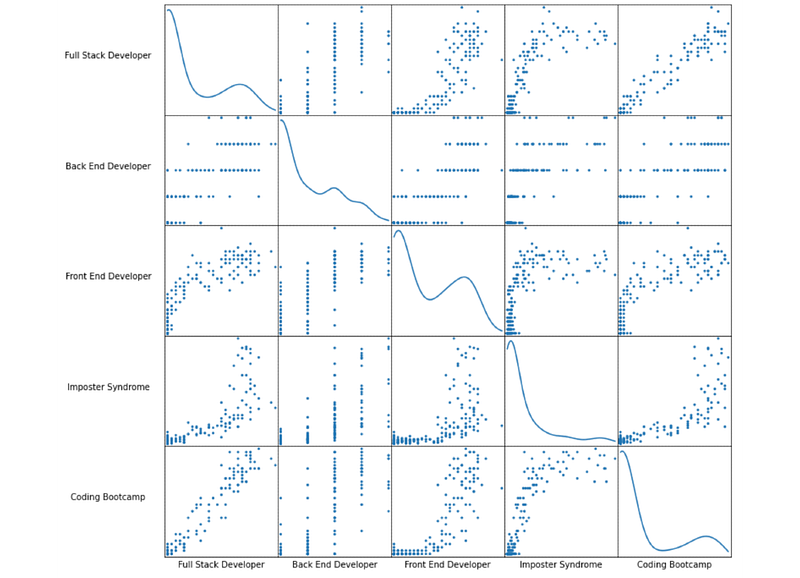
A glance at the scatter matrix suggests the existence of relationships between some terms that may be worth exploring. Plotting out the data provides a view of the interest levels in these search terms over time going back to 2004.
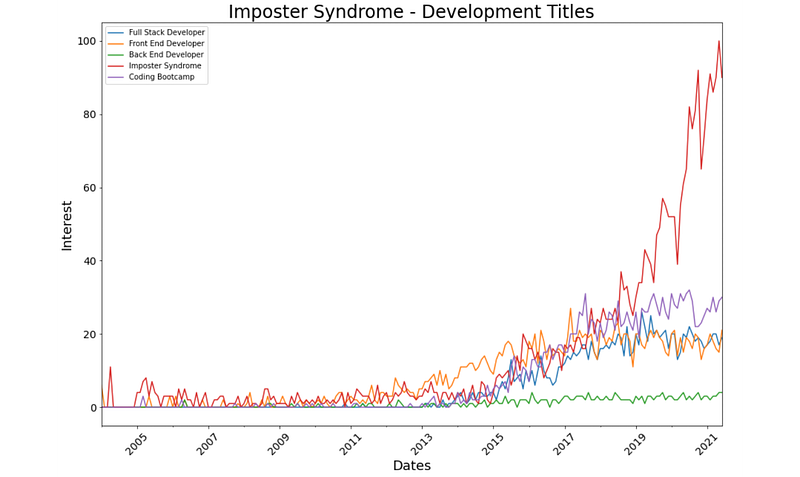
Looking at the plot triggers a few thoughts:
- The “Imposter Syndrome” term had a stronger signal earlier on, while the developer-related terms barely registered.
- The rise in popularity of the term, “Imposter Syndrome” appears to begin roughly around the time that interest in the “Front End Developer” position increased and even more so once the “Full Stack Developer” position started registering.
- Around 2019, as interest in the developer positions leveled off, the interest in “Imposter Syndrome” continued to rise.
One possible takeaway from this is that while the developer community did not birth the term, “Imposter Syndrome”, it was part of the village that helped raise it. There is a wider audience to which the “Imposter Syndrome” term may be of interest than there is for developer title terms. The plot hints at the possibility that the developer community helped bring the “Imposter Syndrome” term to that wider audience.
Narrowing the time frame to focus on the rise in interest — roughly 2010 to 2018 — provides a clearer view:
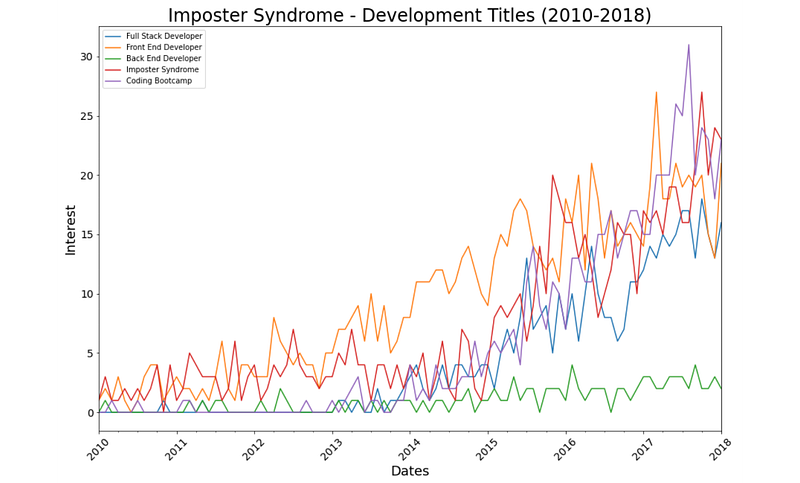
Within this time frame, the interest in the “Front End Developer” position almost presents as a leading indicator of the interest in “Imposter Syndrome” up until the “Full Stack Position” gains traction. At this point, interest in all of the terms rises steadily, although at a lesser magnitude for the “Back End Developer” position.
The “Full Stack Developer” and “Front End Developer” terms have strong, positive relationships with both the “Imposter Syndrome” and “Coding Bootcamp” terms based on covariance calculations. The direct relationship between “Imposter Syndrome” and “Coding Bootcamp” is the most positive.
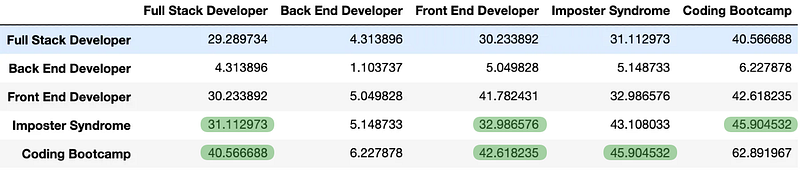
Looking at the correlation calculations, the “Full Stack Developer” term shows the strongest correlation to both the “Imposter Syndrome” and “Coding Bootcamp” terms (88% and 95%, respectively). Although, the other developer terms show fairly strong correlations as well. The “Coding Bootcamp” and “Imposter Syndrome” terms also have a high correlation at 88%.
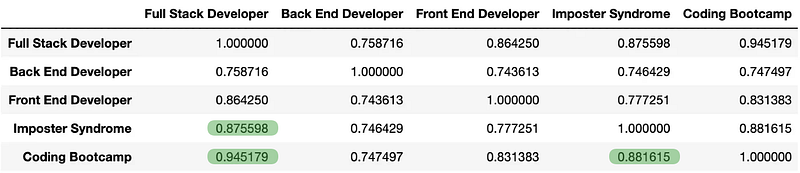
It is fascinating to see that most of these terms surged in popularity along a similar timeline and that there are some high correlation values, especially with the “Full Stack Developer” term. All this data really does is provide a bit more evidence that Imposter Syndrome proliferates through the web developer community and that coding boot camps are popular. The ‘why’ behind the proliferation or the popularity is not explained by this data.
The data also doesn’t speak to a solution or offer insight on how to mitigate the onslaught of Imposter Syndrome. It is difficult to view boot camps as an antidote because while they are proliferating, interest in “Imposter Syndrome” continues to rise. The best mitigation may just come down to putting in the work.
Boot camps and online learning can offer depth on a subject in exchange for a commitment of time and money. But having an approach to keeping up with and understanding the breadth of web concepts avails itself to quick study and experimentation — enough at least to be able to create and continually fill in a personal visualization of the web development landscape. Having the tools at the ready that can help create this picture over time will help ward off that feeling of self-doubt, now rebranded as “Imposter Syndrome”.
End-to-End Ecosystem
On par with the wealth of reasons supporting purposeful and self-directed experimentation is the wealth of tools available to support this endeavor. Defining an end-to-end ecosystem, and having it at the ready is important to lower the barriers to consistent and frequent experimentation.
Together, Drupal, Lando, GitLab, and Platform.sh provide a solid option (not the only option) for a personal end-to-end ecosystem. Some of the reasons are as follows:
- All four components are well-adopted, actively evolving, accessible and affordable.
- Each solution abstracts underlying complexities, while still making them accessible. It is possible to be creative and productive quickly while deepening knowledge over time.
- Learning is enabled in many directions. Delve deeper into concepts, code, and configuration, expand outwards with integrations or replace any of the solutions outright to try something completely different.
- Collaboration is supported end-to-end with both developers and non-developers.
There are plenty of solutions that can be used depending on preference and interest, but it is important to define them, have them available, and actively use them. More information about the features and strengths of Drupal, Lando, GitLab, and Platform.sh can be found on their respective websites. Still, to flesh out the above reasons a little more, it is worth touching on at least a few specifics of each component.
Drupal provides the means to quickly create a website with significant functionality through the use of core and contributed modules. Drupal can also be used in a headless architecture, exposing APIs that can be consumed by a variety of clients. Using Drupal provides a solid foundation from which to create and be productive quickly, while also providing an opportunity to work on coding skills or develop clients using any number of technologies.
Lando abstracts Docker, making it easy to set up local development environments using containerization. The environments can easily be replicated by other developers, making collaboration efficient. Docker is completely accessible if there is a desire to explore it directly.
GitLab can be leveraged simply as a Git repository, where it can nurture collaboration and provide separation from a hosting environment. GitLab is also a single application CI/CD solution. This provides an effective and convenient means of exploring CI/CD concepts in one place, without negating the opportunity to integrate external tools into the pipelines if desired.
Platform.sh provides containerized hosting, integrates well with GitLab, recommends Lando for local development, and was founded by the company that created Drupal Commerce. Because of its integration capabilities and lineage, this solution simply made the most sense in conjunction with the others. However, Platform.sh offers plenty to explore with its support of many frameworks, templated approach for setting up sites and apps, and ability to automatically create new test environments based on pull/merge requests.
Going back 10 or 15 years, access to a personal toolset aligned with enterprise-level solutions was sometimes difficult. Between open-source and the wide range of online services, the opportunity for exploring a breadth of concepts and the efficacy of self-directed learning has improved.
Boot camps and online courses are great resources, but despite their proliferation, developers are stagnating in work environments and struggling with Imposter Syndrome and burnout. It is important to experiment in a way that keeps the creativity flowing, provides immediate gratification, and allows visibility of the ever-expanding full-stack. Setting up an environment to lower the barriers to exploration and being deliberate about that exploration is invaluable.
Read Setting Up a Basic End-to-End Web Development Workflow for details on connecting and using Drupal, Lando, GitLab, and Platform.sh together.