Why Doth One Man’s Yawning Make Another Yawn?
A Wider View
Y-A-W-W-W-W-W-N!
“Go out and come back only after you’ve washed your face!” I guess most of us have been through this quite often during a class lecture or a meeting at the workplace. I empathise with you. It is indeed a moment of embarrassment for anyone; more so because yawning publicly is considered rude. It sends out a clear message that the speaker is boring you to death and you’re feeling stuck under circumstances, seemingly obliging everyone else with your ‘sleepy’ presence.
I suppose each one of us can fondly recall the face of that particular teacher or professor in whose class we seldom yawned. ‘Fondly’ because trust me, most of us, fighting our reluctance, crawl out of our beds early in the morning because we do want to listen to something inspirational that can help us sail through the day. It’s just that very few among us are gifted orators — someone who can hold your attention powerfully with his/her diction. So, once your patience has been tested and your body gives way, flinging open your jaw in that big, infamous ‘yawn’, your gesture will be deemed unwelcome. And ‘DISRESPECTFUL’! I reiterate.
I recently came across a very amusing quote — “It is always dullest before the yawn.”
So true that. I mean c’mon chap! Truth hurts. Or maybe, the speaker is taking your ‘yawn’ a bit too personally. After all, it remains one of the least understood, intriguing and fascinating human behaviours with an obscure etiopathogenesis. Did you know the study of yawning is known as ‘Chasmology’? I bet you didn’t!
A yawn is a very deep inspiration, taken with jaws wide open which ventilates all alveoli (not the case with normal quiet breathing). Yawning is characterised by a long inspiration followed by shorter expiration of air. One of the frequently overlooked behaviours in the study of human behaviour, yawning is virtually ubiquitous among all vertebrate species. A human yawn is one of the best examples of a fixed or modal action pattern in our species. The study of yawning, particularly in humans, is important because (1) it is a behaviour pattern that we share with all vertebrates (2) it occurs in several different contexts in essentially the same form and (3) it is contagious.
Stretching and yawning simultaneously is known as ‘pandiculation’. Yawning is involuntary. Only humans seem capable of altering its occurrence for cultural or social reasons. It is highly stereotypical because no environmental input changes the sequence of movements.
Yawns have an average duration of 6 seconds, are difficult to stop midperformance and are infectious, stimulating yawning in other humans that observe or even hear the yawner. One of the most interesting characteristics of human yawning behaviour is its high degree of contagion. Even observing, hearing, reading, or thinking about yawning evokes a yawn. Yawning has been shown to have a true circadian cycle. Human beings yawn with a frequency of up to 28 times a day.
Even Hippocrates was intrigued
The causes and consequences of this intriguing phenomenon have defied the human mind for centuries.
The most ancient theory on yawning was described in, “a treatise on the wind” written by Hippocrates in 400 BC. He observed: “Yawning precedes a fever, because the large quantity of air that has accumulated ascends all at once, lifting with the action of a lever and opening the mouth; in this manner, the air can exit with ease. Like the large quantities of steam that escape from cauldrons when water boils, the accumulated air in the body is violently expelled through the mouth when the body temperature rises”. This idea persisted until the 17th century.
Santori Santorio was a physician in Venice and a student and friend of Galileo. He mentioned that the urge to yawn and stretch the limbs upon waking stems from the abundance of perspirable matter, creating an inclination to perspire.
Johannes de Gorter, a prolific Dutch author in all areas of medicine in the early 18th century attributed yawning “to a need for faster blood circulation and to cerebral anemia.” This gave birth to the idea that persisted for two centuries, repeated by almost all authors: yawning improves brain oxygenation.
Yawning opens the Eustachian tubes and therefore ventilates the tympanal cavities. This led Laskiewicz, in 1953, to propose that yawning may be a “defence reflex” to equalise air pressures in the ear, triggered by altitude changes or other conditions leading to air trapping in the middle ear.
Surviving the twists of time — an evolutionary perspective
Charles Darwin recognized that yawning occurred in several different contexts. He noted that, “… baboons often show their passion and threaten their enemies in a very odd manner, namely, by opening their mouths widely as in the act of yawning … Some species of Macacus and Cercopithecus behave in the same manner.”
The most compelling characteristic of human yawning that calls for an evolutionary explanation is its contagious nature coupled with the absence of this contagion in other yawning species. These observations suggest that yawning in humans has evolved as a fitness-enhancing behaviour pattern.
Yawning is a phylogenetically old and an ontologically precocious behaviour. Ultrasonography reveals its onset between 11 and 15 weeks of gestation. The fact that yawning has survived without evolutionary variation suggests its importance in terms of developmental need.
TYPES OF YAWNING
The triune brain hypothesis is a model of the evolution of the vertebrate forebrain and behaviour proposed by the American neuroscientist Paul D. MacLean. The triune brain consists of the reptilian complex (archaic brain), the paleomammalian complex (limbic system), and the neomammalian complex (neocortex), viewed as structures sequentially added to the forebrain in the course of evolution.
- Universal yawning, which is seen in nearly all vertebrates, is associated with sleep and arousal or with hunger and satiety and appears to be generated by the reptilian brain.
- Emotional yawning, which is only seen in some mammals is generated by the paleomammalian brain. This is the yawn that helps to pacify after stress.
- Contagious yawning is observed only in great apes and humans who display theory of mind. As a neocortical activity (frontal and parietal lobes, insula and amygdala), communicative yawning is a sign of involuntary empathy.
Your neurons are firing even when you yawn!
In 2014, Walusinski proposed a new hypothesis which lays down the neurophysiological basis of yawning. The default-mode network is a set of interconnected brain areas identified in functional neuroimaging (fMRI) that exhibit spontaneous physiological activity during the normal resting state. There is a high level of activity in the default-mode network when the mind is not involved in specific behavioural tasks and a low level of activity during focused attention. fMRI has demonstrated that different levels of the neuroaxis, including the brainstem, prefrontal cortex and subcortical regions, may be involved.
Earlier, in 2010, Collins and Eguibar had hypothesized that there are three main neural pathways involved in the regulation of yawning.
Two of these are formed by groups of oxytocinergic neurons projecting from the paraventricular nucleus of the hypothalamus to the hippocampus, pons, medulla and spinal cord. The other is formed by ACTH and melanocyte-stimulating hormone-activated neurons projecting from the paraventricular nucleus to the hippocampus via activation of cholinergic neurons. There is also direct activation of hippocampal cholinergic neurons and a serotonergic-cholinergic pathway.
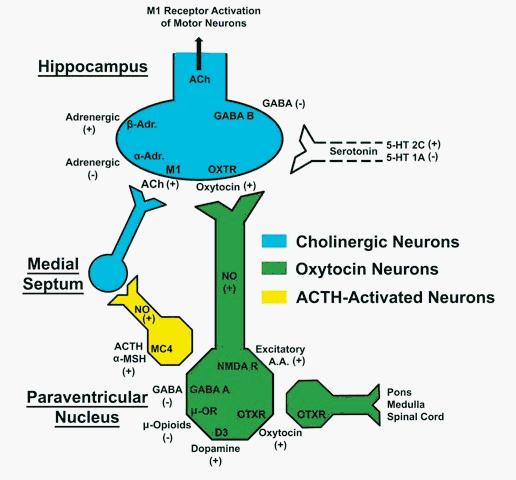
Dopamine activates oxytocin production in the paraventricular nucleus of the hypothalamus, and oxytocin, in turn, activates cholinergic transmission in the hippocampus and the reticular formation of the brainstem, resulting in acetylcholine induction of yawning via muscle muscarinic receptors.
Dopamine and its agonists trigger yawning. Opioid peptides and GABA reduce its frequency. Yawning is used as an indicator of dopaminergic and oxytocinergic transmission. In Parkinson’s disease, it is an expression of therapeutic dopaminergic activity, particularly as a marker of D3 dopamine receptor activity.
Contagious yawning is due to activation of a complex network of brain areas associated with imitation, empathy and social behaviour. In 2005, activation of the left periamygdalar region was observed on fMRI, suggesting a connection between yawn contagiousness and amygdala activation. In 2009, Nahab et al, also using fMRI, demonstrated activation in the ventromedial prefrontal cortex, suggesting that mirror neuron networks play a role in yawning. Recently, Provine stated that contagious behaviours such as yawning have mirror-like properties.
We still agree to disagree — Different theories persist
- The Arousal-sleepiness Hypothesis — Monotonous circumstances lead to yawning, such as idle waiting, public transportation and long periods of motorway driving. A correlation exists between the degree of sleepiness and increased yawning frequency. It is more frequent following sleep and is associated with stretching. The physiological function of yawning is to stimulate vigilance rather than arousal, together with muscle tone, through sensory feedback. One of the main arguments for this arousal enhancement is derived from the observation that yawns are followed by a significant increase in motor activity.
- Pandiculation in Interoception and the Body Schema — Arousal is essential to consciousness, and requires the ability to integrate sensory information about the outside world as well as our sensations concerning our internal physical state. Autonomic, somatic and limbic integration makes it possible to extract bodily perception, which may, in turn, lead to a sensation of pleasure. Thus, muscle tone variations in peripheral anti-gravity muscles, transmitted by these pathways, may trigger yawning and pandiculation which, through the powerful muscular contractions that accompany them, may activate vigilance systems.
- Auto-regulation of the Locomotor System — Pandiculation with its specific and vigorous muscle activity, might be a means to compensate for the mechanical signals delivered by rest periods and sub-optimal movements. Yawning might be considered a feedback mechanism resulting from stiffness. If the body tends to stiffen, pandiculation can serve to restore the limb to an original (homeostatic) state.
- The Thermoregulation Hypothesis — According to this model, the increased facial and brain circulation that follows yawning acts as a radiator by eliminating calories from the blood in the brain via the face and head, and by introducing cooler blood from the extremities and lungs into the brain.
- Yawning and the Cerebrospinal Fluid System — Jaw kinematics, together with inhalation, have been shown to alter intracranial circulation. We can consider jaw kinematics together with the lateral pterygoid muscle as a venous trigger as they act as the starter for the alternating musculovenous pumping action that takes place in the cavernous part of the pterygoid plexus. It would thus appear that the large inhalation and maximal opening of the mouth accelerate the circulation of CSF. Prostaglandin PGD2, a hormone produced by the meninges, when binds to a specific receptor, transduction occurs from the leptomeninges to brain parenchyma through the activation of adenosine production. This induces sleep in the ventrolateral preoptic (VLPO) nucleus of the anterior hypothalamus. Yawning and pandiculation may accelerate clearance of PGD2, thus reducing sleepiness.
Sunnyside up, please!
Ethologists call it displacement activity. In humans, athletes yawn repeatedly before competitions, as do parachutists before jumping, and actors before making their entrance. In these cases, yawning has a calming, anti-stress effect.
A related type of yawning is that associated with sexuality in dominant male macaques, who yawn repeatedly before mating as if to make their status within the group known.
Therefore, through evolution, a behaviour can be recycled for different purposes according to the increasing complexity of the central nervous system, correlated with the richness of social interactions. Yawning is closer to a behavioural stereotype than to a reflex. It is a curious behavioural display and is a beautiful example of an involuntary expression that is pleasurable and that we, as humans, use voluntarily to communicate boredom deliberately.
Well, take it with a pinch of salt. “A yawn may not be polite, but at least it’s an honest opinion!”
References :
- Yawning: An Evolutionary Perspective | E.O. Smith |Department of Anthropology |Emory University Atlanta |GA 30322 Human evolution |1999
- Yawning in neurology: a review | Hélio A. G. Teive, Renato P. Munhoz, Carlos Henrique F. Camargo, Olivier Walusinski | Arq Neuropsiquiatr 2018
- Why Do We Yawn? Past and Current Hypotheses | Olivier Walusinski |Brou, France |Hypotheses in Clinical Medicine | Editors: M.M. Shoja, P.S. Agutter et al | 2013 Nova Science Publishers, Inc.