
Why Don’t I Provide Specific Steps in My Articles?
Self-Reflection | The Human Being as a Biological Species
Ever since I embarked on this blogging journey, a recurring query keeps bubbling up from the audience:
Shouldn’t you infuse some specific steps from personal experience?
In this piece, I want to elucidate why I opt not to, even deeming it somewhat unethical to do so.
Part 1: Marketing, Templates, and Duplicitousness
You can likely fathom the multitude of authors attempting to navigate the same waters as I do.
To compete or, more aptly, to coexist, I inevitably immerse myself in their content, tuning into the collective professional pulse.
On one hand, it’s riveting because, along the way, you encounter numerous talented individuals, occasionally touching upon the same topics but through the lens of their worldviews.
This offers a fresh angle, refining your craft based on a new perspective.
At these moments, competition fades, replaced by a semblance of global team synergy.
I earnestly hope that someday, these authors might find inspiration in my work too 🙏
However, quality content is scarce.
Most tread the beaten path, adhering to a template. Sometimes, it even begs the question if AI generated the content. While certain techniques might bear efficacy, such as utilizing numbers in headlines to establish a proof base — “I wrote for 5 consecutive days and here are 5 lessons I learned” or “X things I realized by age Y”.
It may have been innovative once, but now, with every other article seemingly employing the same tactic…well, draw your own conclusions
To draw people in, these articles frequently feature actionable steps. And here’s the kicker: having read one, you’re almost 95% acquainted with the contents of all subsequent reads.
While brevity is zealously advocated these days, these articles often parrot one another, redeploying the same canned phrases with mere synonym swaps.
I grasp the rationale behind it. They leverage certain techniques to capture the reader, crucial when you’re a fledgling writer carving out an audience.
But let’s ponder the true value of such articles.
To me, they resonate as popcorn in the readers’ world — merrily and mindlessly you consume one after another, skating on the thin ice of procrastination with minimal cognitive engagement.
I perceive an article and a reader as companions.
Ask yourself, do you converse with friends in succinct extracts and bullet points? Highly unlikely.
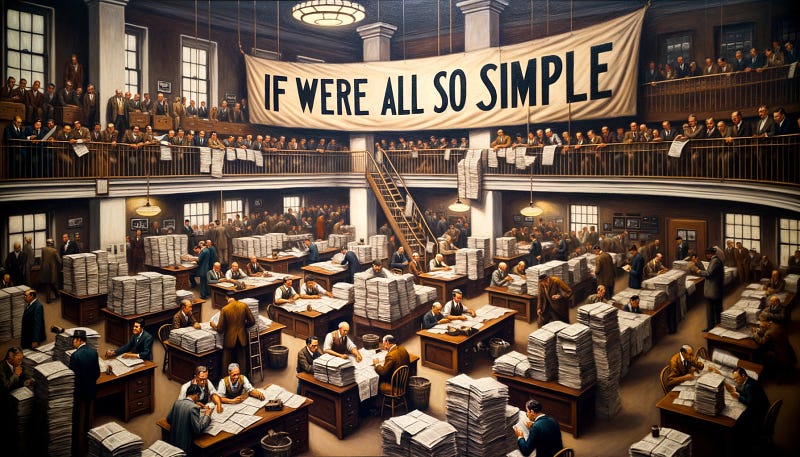
If it were all so simple, these articles wouldn’t be emerging by the thousand every day.
As I’ve previously addressed in this article, humans have existed for several hundred thousand years. People, far more intelligent than us, have already penned profound works about how to live this life.
Nevertheless, it remains one of the hottest topics today, possibly even more relevant than ever before.
And no… the absence of mobile phones back then did not render Plato or Aristotle any less wise than us.
Somewhere here lies a veiled meaning. Humans, like any other living organism, seek simpler ways to achieve what they want.
The easiest and most banal routes are typically tried first. In this context, some complex paths, as well as unusual trivial ones, may not even be tested.
Reading thoroughly, with full comprehension — this is, without jest or exaggeration, a tremendous effort that requires endurance.
I’m willing to wager that if, since ancient times, humanity had devoted more time to reading and understanding the works of the sages of their era, we’d now be inhabiting an entirely different world — a better world.
An intriguing nuance is that many of the aforementioned articles advise overcoming obstacles, in contemporary terms — stepping out of the comfort zone and embracing “challenges”.
But somehow, allocating time for reading valuable materials is no longer presented as a challenge 🤔
It’s not advertised, not trendy.
Our beloved “double standards” in action…🤡
But I don’t aim to do what’s trendy
🔹 First and foremost, my goal is to express myself, to free my mind from unspoken thoughts, thereby achieving even greater tranquility and balance.
🔹 Secondly, my experience has aided at least a few people in close circles, and I genuinely believe that this experience can be beneficial to a much larger group of people.
🔹 Thirdly, I simply want to do what I like. To write about topics I like, in a style that resonates with me.
Surveying the materials around me, I see that my perspective certainly warrants consideration.
What sense is there in mimicking others? Isn’t it better to bring something new, something unique, something soulful to the table?
Will such a tactic work? Who knows… But one thing I do know for sure is that no successful startup ever took off with a trite and unoriginal idea without bringing something new of their own.
Let this blog be my startup.
I haven’t launched one yet, so the likelihood of it burning out is extremely high. I am prepared for that.
After all, it is precisely experience, the analysis of one’s mistakes, that enables a person to bring truly incredible things into this world.
Part 2. Primum non nocere © Hippocrates
First, do no harm.
I genuinely do not understand how one can make calls to action in philosophical materials.
I share my unique path, based on my personal life experience, which I have traversed thanks to the limitations and obstacles that arose in my life.
These nuances may not be present in the reader’s life, and they cannot replicate this experience.
However, over the past years, based on personal experience, I have managed to isolate certain patterns, tools, and general techniques that I try to share.
I am not the pioneer of these tools, but studying the materials around me, I understand that:
Some important nuances have been overlooked by other authors.
This void is what I try to fill.
Anyone can “skim” the surface of a topic. But not everyone dares to delve deeper and REALLY understand the issue.
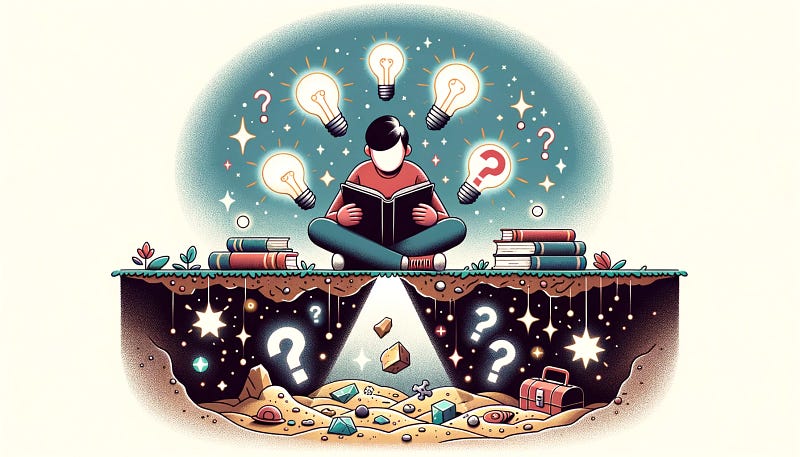
Curiosity is what I try to awaken in the reader.
The desire to dig deeper.
Yes, a shovel will be needed: you will have to push, exert effort, and sometimes it will even be painful…
But our “new level” is not here, under our feet, but there… what people call “stepping out of the comfort zone”.
A fun example from the gaming industry: playing a game, if you never leave the current area, and keep beating the same monsters, you literally won’t level up 😎 yet there… new abilities, a new storyline, a new world await…
I must emphasize once again that I am considering tools that can not only bring benefit but also cause harm to oneself and loved ones if used improperly.
It’s like pills from a doctor. Under no circumstances should the same pills, in the same dosage, be used for different patients, despite the similarity of symptoms of the presumed disease.
Any philosophical material needs to be processed critically.
The reader needs to think, navigating through such a work.
Not simply go and act according to the instructions like a machine. As we’ve said, that’s too easy, and it doesn’t work like that.
An Example from the World of Programming: I recently made a joke — I asked my wife to put on water to cook pasta.
- She did exactly as I asked, like a real “junior” engineer, precisely, smoothly, and according to instructions.
- But it would have been good to first clarify whether we even have pasta, right? That is a question for the so-called “mid-level” engineer.
What comes next is exaggerated, but nonetheless, it fully reflects the essence of the shift in thinking that is necessary at different positions in the development world. For moving to a new level, decent companies increase their employees’ salaries by 50% and more ☄️
- A senior engineer will ask: “Shouldn’t we choose an alternative, since pasta is not the healthiest food after all?”
- A principal engineer will suggest: “Let’s compose a balanced weekly diet, considering the characteristics of our body, the daily calorie intake, allergies, and taste preferences.”
Do you feel the difference in approach?
We need to get away from this habit where we are taken and led by the hand through all the most difficult places.
Experience does not accumulate like that.
It only happens when you face your fears head-on.
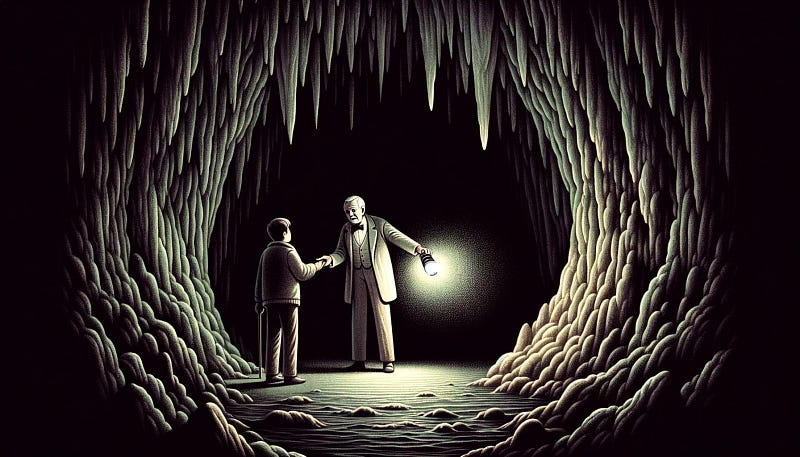
My task is to bring the reader to these fears, provide a flashlight, and maybe even push into the abyss 🔥
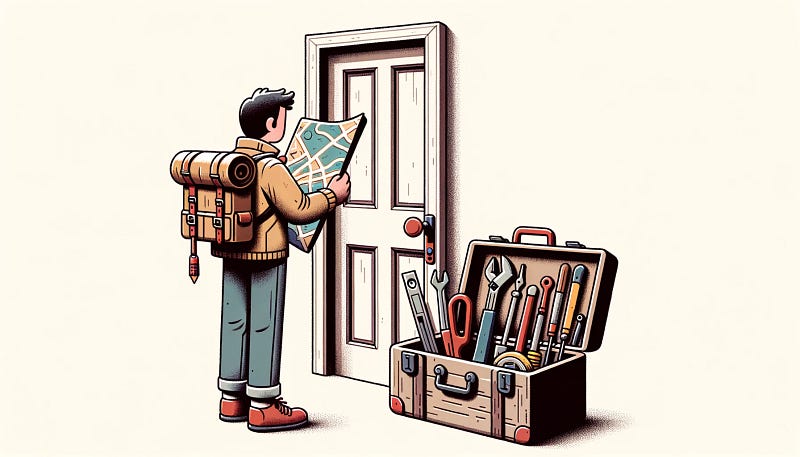
- A map will merely guide you to a closed door, yet opening it demands tools.
- The map guides you to a single door, while with tools, you can open any door you encounter, anywhere — and additionally, select precisely how you’ll unveil it.
In summary, it is necessary to ask questions to oneself, analyze, understand how tools can be applied to one’s own experience for good.
And this process is unique for each of us. Life is not popcorn, to swallow and move on.
Part 3. Addition
️Despite the active promotion of the idea that difficulties must be overcome, whether they are problems at work or learning philosophical material, another important concept is the idea that:
There is no need to create additional difficulties, neither for oneself nor for anyone else.
This paragraph, dear reader, I dedicate not only to you but also to myself, as a reminder that my duty is to make the material accessible.
I should not create additional difficulties for its assimilation. However, the absence of additional difficulties does not mean the absence of a minimal set of them.
A book or an article is a revelation of the creator. Every reader connects with the author. Connection is already a relationship. And, like any relationship between people, it cannot be played solo.
It is a two-way flow, where each party needs to be interested, or the magic won’t happen.
I view my blog like a TV series.
You could take a single episode and evaluate the rough plot, the actors’ performance, the quality of editing, and graphics.
But you won’t be able to understand it 100% unless you watch all episodes from start to finish.
I don’t want to go mad and “film” my “Supernatural” with 300 episodes, asking the reader to thoughtfully master all of it. It’s unrealistic.
I’m more in favor of a modern format of 8 or 12 episodes.
This is, of course, conditional, but I want to provide some orientation to the ultimate goal.
I’ve mentioned it before, but I’ll repeat: I try to ensure that each article carries 90% of its value in an independent form.
However, to understand the whole story, to uncover the entire plot, to know exactly how everything was connected…
You can only do so by reading this story from beginning to end.
That’s why I plan to eventually shape it into a book, where there is its own exposition, climax, and resolution…
And, of course, a teaser for season two 😏
If you liked the article, you can follow me here as well: LinkedIn: https://www.linkedin.com/in/dmitry-potylitsyn-723b30163/ Twitter: https://twitter.com/Naararouter


