
Why Does the Full Moon Look Freaking Huge on the Horizon?
This moon illusion is all your head, and you can prove it with a simple experiment. Or you can just enjoy the awesome effect.
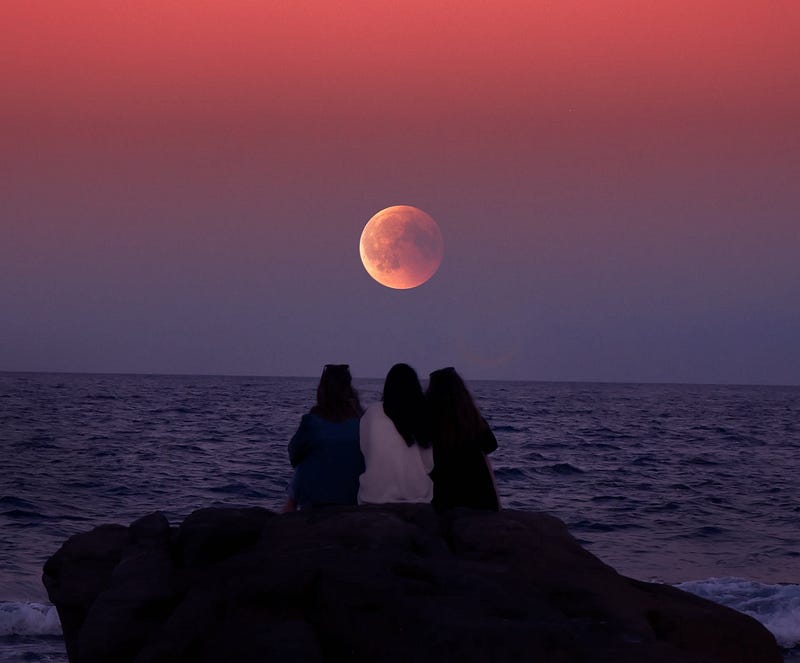
When a full moon lifts off the horizon, it can seem much larger compared to later, when it’s high up and teeny tiny. Many swear it actually is larger on the horizon. Others say that some sort of magical atmospheric lighting effects make it appear bigger (Aristotle apparently thought so, too).
Nope. It’s just an illusion created by the human mind.
In the graphic below, both moons are the same size, but at first glance, what did you perceive? I know, right?
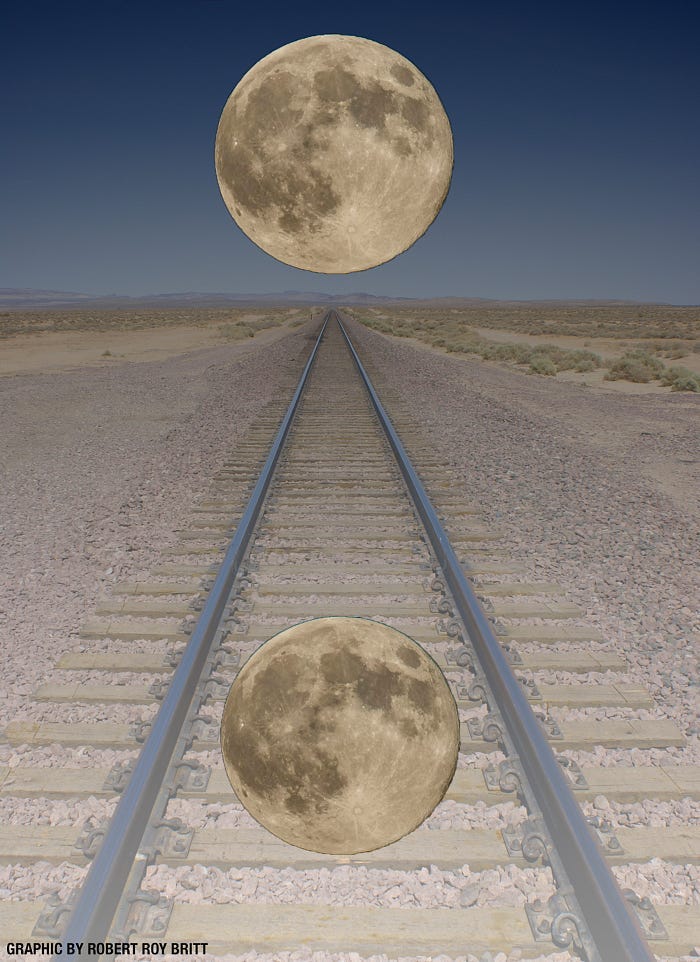
To prove this illusion, you can do a simple experiment next time the full moon rises.
First, let’s figure out what’s going on. This mind-bending effect is known as the Ponzo illusion, related to our perception of perspective. Here’s a dumbed-down example that helps me understand it:
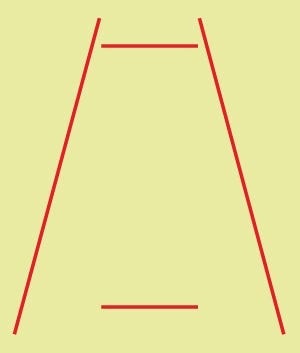
If the top horizontal line appears bigger, you’re victim of this Ponzo scheme, too. Both lines are the same length. I know this is true, because in creating this little graphic, I copy/pasted the top horizontal line and dragged it to the bottom.
But that’s not the only thing going on.
With a seemingly gargantuan moon on the horizon, there’s another factor messing with your mind:
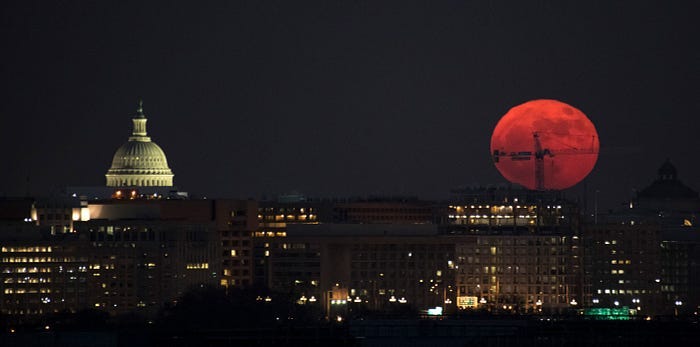
Scientists say our brains are trained to assume objects on the horizon are farther away than things overhead, because, for example, when we see clouds overhead, they are in fact just a few miles away, whereas clouds near the horizon can be hundreds of miles distant. When your brain assumes something is farther away — such as the moon on the horizon — but it really is no farther than when it’s overhead, then you’ll interpret it as being bigger when it’s on the horizon.
Try this experiment…
Here’s how you can impress friends or family when the next full moon rises:
Take a small object, such as a pencil eraser, and hold it out at roughly arm’s length as the moon rises. Compare the size of the moon and the small object. If you’ve chosen a roughly right-sized object, they’ll be the same (or you can bend your elbow to adjust your “arm’s length” to make it so).
Then do the exact same test later when the moon is higher up and appears smaller. This is science! You and your amazed friends or family will see, if you did the test even reasonably accurately, that the moon is still the exact same size in relation to the object held at arm’s length.
… or this one
If you want to get all fancy, you can do this with an impromptu moon measurer. Roll up a piece of paper, put the big end to your eye, and tape it off when you get it to the right size to just barely reveal the moon’s full glory through the small end. I made and photographed one of these sophisticated scientific instruments myself:
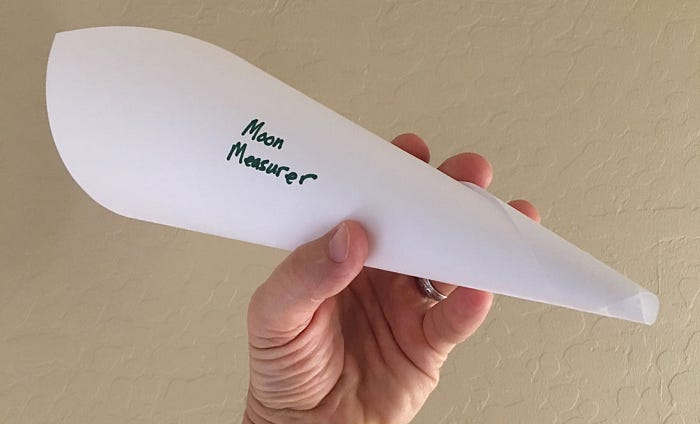
You don’t have to label your Moon Measurer, but I think it adds an air of professionalism to the experiment.
Need photographic proof of the illusion? Some time ago, Harvey Leifert, a freelance science writer and a man who used to give me a lot of advice when I was cutting my teeth as a science writer, offered this suggestion:
“Photograph the moon, just above the horizon, then without changing any camera settings, photograph it again when it is overhead. Print the images on plain paper, then hold them up to a strong light and superimpose one moon image over the other.”
With either method, the test will show that the supposedly giant moon on the horizon is the same size as the disappointingly small moon later on.
Or, and I highly recommend this less scientific approach: Don’t do any of the above. Just go out when the next full moon rises and exclaim, as I do every 29.5 days or so, “Damn that’s huge!”
When’s the next full moon? Find details for your location at the Time and Date website.
Thanks for your support, which makes my reporting and writing possible. To make your days better, check out my book: Make Sleep Your Superpower. And if you’re a writer, sign up for my Writer’s Guide newsletter. Note: Portions of this article were published previously.


