
THE POLITICS AND ECONOMICS OF HAPPINESS
Why Does the Declaration of Independence Refer to the “Pursuit of Happiness,” not Property?
Thomas Jefferson had his reasons — and we ignore them at our peril
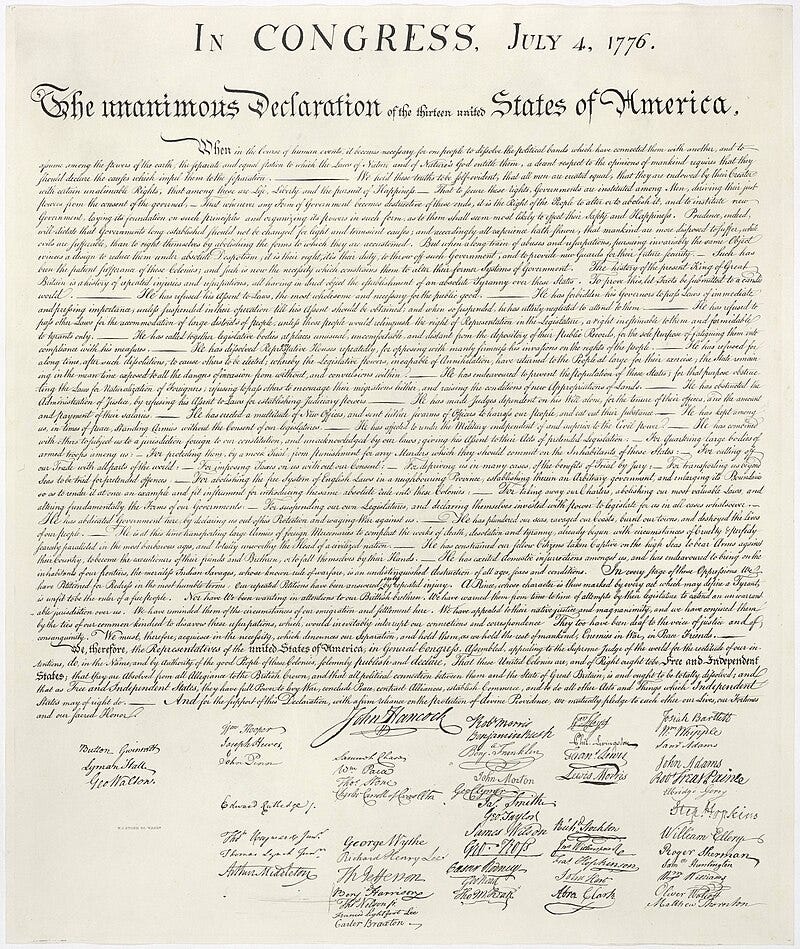

In 1776, one of the most influential political documents ever written was published to justify the American Revolution against the British crown. The American Declaration of Independence was a guiding work for people and places as varied as the leaders of the French Revolution and authors of the French Declaration of the Rights of Man and of the Citizen (1789), as well as the Decembrist revolt against the Russian Empire.
The Manifesto of the Province of Flanders (1790) was the direct first foreign derivation of the Declaration, as was the Venezuelan Declaration of Independence (1811), the Liberian Declaration of Independence (1847), the declarations of secession by the Confederate States of America (1860–61), and the Vietnamese Proclamation of Independence (1945). Sections have been copied verbatim in the Declarations of the Haitian Revolution (1804), the United Provinces of New Granada in 1811, the Argentine Declaration of Independence in 1816, the Chilean Declaration of Independence in 1818, Costa Rica in 1821, El Salvador in 1821, Guatemala in 1821, Honduras in 1821, Mexico in 1821, Nicaragua in 1821, Peru in 1821, Bolivian War of Independence in 1825, Uruguay in 1825, Ecuador in 1830, Colombia in 1831, Paraguay in 1842, Dominican Republic in 1844, the Texas Declaration of Independence in March 1836, the California Republic in November 1836, the Hungarian Declaration of Independence in 1849, the Declaration of the Independence of New Zealand in 1835, and the Czechoslovak declaration of independence in 1918.
Even the South Carolina Declaration of Secession from December 1860 mentions the U.S. Declaration of Independence, though it takes care to omit any references to “all men are created equal” and “consent of the governed”.
The post-World War II Universal Declaration of Human Rights grew from the universalist principles articulated in the American Declaration of Independence, and it was promoted by Eleanor Roosevelt as a way to make the “four freedoms” articulated in the war the basis of a lasting peace.
The most stirring phrasing in the Declaration is without doubt the phrasing of the first statement in the Declaration’s second paragraph:
We hold these truths to be self-evident, that all men are created equal, that they are endowed by their Creator with certain unalienable Rights, that among these are Life, Liberty and the pursuit of Happiness. — the Declaration of Independence (1776)
But there’s a minor mystery here. Most people believe that Thomas Jefferson, the primary author of the Declaration, replaced the final word of the phrase “life, liberty, and property” coined by John Locke in the Two Treatises of Government (1689) simply as artistic license. To be sure, Locke influenced Montesquieu and the development of classical liberalism. In fact, the phrase “life, liberty, and property” was used verbatim in The Boston Pamphlet (1772), the Declaration and Resolves of the First Continental Congress (1774), and the Virginia Declaration of Rights (1776).
So why the change?
Thomas Jefferson was a complicated man. He was a slave-holder who claimed that “all men are created equal,” who sponsored legislation in the Virginia House of Burgesses to limit the right to enslave others and promote the right of slave owners to emancipate their slaves, and who represented slaves pro-bono in cases where they sought their freedom.
His common-law “marriage” to a young slave from Monticello, Sally Hemings, was downplayed, but five of their children were eventually emancipated in his will. He was a man who didn’t always live up to his own standards. But there is one thing Jefferson was not. Jefferson was not stupid. If he changed that critical word, he must have had his reasons.
It would have been easy to retain the “life, liberty, and property” formulation. But Jefferson’s personal philosophy was Epicurean, “rightly understood,” and he knew Locke better than most. Locke did write of “the pursuit of happiness,” but it was in the 1690 essay Concerning Human Understanding. There, in a long and complicated passage, Locke wrote
The necessity of pursuing happiness [is] the foundation of liberty. As therefore the highest perfection of intellectual nature lies in a careful and constant pursuit of true and solid happiness; so the care of ourselves, that we mistake not imaginary for real happiness, is the necessary foundation of our liberty. The stronger ties we have to an unalterable pursuit of happiness in general, which is our greatest good, and which, as such, our desires always follow, the more are we free from any necessary determination of our will to any particular action, and from a necessary compliance with our desire, set upon any particular, and then appearing preferable good, till we have duly examined whether it has a tendency to, or be inconsistent with, our real happiness: and therefore, till we are as much informed upon this inquiry as the weight of the matter, and the nature of the case demands, we are, by the necessity of preferring and pursuing true happiness as our greatest good, obliged to suspend the satisfaction of our desires in particular cases. — John Locke (1690) [empasis added]
Jefferson didn’t just make the phrase because it rolled off the tongue. This defining phrase, “the pursuit of happiness,” was not invented by Jefferson, nor is it not native to our shores.
Furthermore, as the quotation from Locke demonstrates, “the pursuit of happiness” is a complicated concept. It is not merely sensual but engages the intellect. It requires the careful discrimination of imaginary happiness from “true and solid” happiness. It is the “foundation of liberty” because it frees us from enslavement to particular desires. True “happiness” is the farthest thing from “pleasure”.
What is happiness?
Eudemonia, the Greek word for happiness, also translates as serenity, contentment, and subjective well-being. Aristotle called it “the meaning and purpose of life, the whole aim and end of human existence.”
It is not something you can buy, although money may provide the freedom to make choices that lead to a happier life. It is not something you can stockpile, like beer or diamonds or reputation. Each moment of happiness is transitory, a reminder (or a warning) that you are (or are not) on your path. But a pursuit of happiness leads to a habit of happiness that leads to a life of happiness: a life of contentment and well-being.
On the contrary, pleasure is a transitory reward that leaves you wanting more. While there is no profit in happiness, pleasure can be bought, and its pursuit serves those who commodify it. To get technical about it, happiness is related to serotonin, which, in conjunction with therapy, has proven to be a useful tool in reducing depression.
Pleasure, however, is linked to dopamine, another neurotransmitter, which gives an immediate “hit” or “jolt” that activates a reward center at the same time it deadens the capacity of the brain to feel a similar response without a greater hit in the future. Pleasure is addictive in a way happiness is not.
In the Nicomachean Ethics, Aristotle wrote, “the happy man lives well and does well; for we have practically defined happiness as a sort of good life and good action.” Happiness is not equivalent to wealth, honor, property, or pleasure. It is an end in itself, not the means to an end. This philosophical lineage of happiness can be traced from Socrates, Plato, and Aristotle through the Stoics, Skeptics, and Epicureans.
Jefferson admired Epicurus and owned eight copies of De Rerum Natura (On the Nature of Things) by Lucretius, a Roman disciple of Epicurus. In a letter Jefferson wrote to William Short on October 13, 1819, he declared, “I too am an Epicurean. I consider the genuine doctrines of Epicurus as containing everything rational in moral philosophy which Greece and Rome have left us,” and at the end of the letter, he made a summary of the key points of Epicurean doctrine as he understood it:
- Happiness is the aim of life.
- Virtue is the foundation of happiness.
- Utility is the test of virtue.
This is a philosophical tradition in which happiness is bound up with the civic virtues of courage, moderation, and justice. Because they are civic virtues, not personal attributes, they implicate the social aspect of eudaimonia. The pursuit of happiness is not merely a matter of achieving individual pleasure. This is also why Alexander Hamilton and other founders referred to “social happiness,” much like modern-day Americans refer to “social justice”.
Jefferson slipped civic virtue into the Declaration of Independence
Thomas Jefferson was one of the youngest delegates to the Second Continental Congress in 1775. There he sought out John Adams, an emerging leader.
They became close friends, and Adams supported Jefferson’s appointment to the Committee of Five, which included Adams, Jefferson, Benjamin Franklin from Pennsylvania, Robert R. Livingston from New York, and Roger Sherman from Connecticut. The committee was charged with writing the Declaration, and Adams persuaded the committee to choose Jefferson to write the first draft.
Jefferson consulted with his fellow committee members over the next 17 days but mostly wrote the Declaration of Independence in isolation. Other committee members made some changes, and a final draft was presented to Congress on June 28, 1776. It is noteworthy that Benjamin Franklin was in agreement with Jefferson in playing down property rights as a goal of government. Franklin believed property to be a “creature of society” and thus it should be taxed as a way to finance civil society.
In a sense, Franklin was anticipating Henry George’s writings, which sparked several reform movements of the Progressive Era. What came to be known as Georgism held that people should own the value they produce themselves, but that the economic value of land (including natural resources) should belong equally to all members of society. George famously argued that a single tax on land values would create a more productive and just society.
The draft Declaration was introduced and Congress began debate over its contents on Monday, July 1. This resulted in the loss of roughly a fourth of Jefferson’s original draft, including an “anti-slavery clause” which criticized King George III for importing slavery to the colonies. But in all the debate, the “pursuit of happiness” slipped through.
Perhaps some delegates, like so many Americans today, failed to recognize the difference between “happiness” and “property. “To be sure, the Declaration was the product of men of property, and the Declaration was intended to serve their interests. But clearly many, like Franklin, recognized the novel and radical notion Jefferson had slipped into the document.
Consequences for today
The American Declaration of Independence is one of the most influential statements of political philosophy ever published.
Unlike the U.S. Constitution, which was the result of extensive compromise among politicians who were careful to undermine the commitment to the “general welfare” to protect local interests, the Declaration was first written by a single genius less interested in the details of governing than the reasons any government exists.
James Wilson, a signer of both the Declaration and the Constitution and one of the first Supreme Court Justices, stood up in the Constitutional Convention and read the Declaration in full to the assembled gathering to make the case that the new country had been founded on a complete people, a whole national people, not on a treaty among separate states.
As early as January 1777, the very first person to use the Declaration for something other than the purpose of independence was a free African American in Boston named Prince Hall. He invoked the language of the Declaration and the nature of inalienable rights to seek an end to slavery in Massachusetts.
His petition was not immediately successful, but by the 1780s the state constitution of Massachusetts did use the language of the Declaration of Independence to emancipate slaves and end the practice of slavery. Abolitionism crystallized in those years, between 1777 and 1783, by drawing on the language of the Declaration of Independence.
When the American Constitutional order failed in the American Civil War, Abraham Lincoln turned to the Declaration to re-found the polity on the principle of equality invoked in the Declaration, stating that the Constitution is best interpreted in light of the principles of the Declaration. Abolitionism quickly became connected to the efforts of women to make space for themselves within the ideals of the Declaration.
In the middle of the 19th century, the Seneca Falls Declaration of 1848 rewrites the words to emphasize that all people are created equal, not just men. Dr. Martin Luther King Jr. and the civil rights movement explicitly called on Americans to live up to the language, ideals, and principles of the Declaration of Independence.
When times have come to change the US Constitution — by Amendment or by decisions of the US Supreme Court — it has often been the Declaration of Independence that served as the lens through which to interpret its policies and structures. Despite the efforts of various Constitutional “originalists” nobody is foolish enough to assert a doctrine of “strict constructionism”. The Constitution — like the Articles of Confederation it replaced — is a tool to achieve the goals articulated in the Declaration of Independence.
Any politician, soldier, or any other person who pledges to “support and defend the Constitution of the United States against all enemies, foreign and domestic” is not pledging his allegiance to a static social order codified in that document. The Declaration of Independence, and the natural law principles it contains, are prior to and the foundation for any Constitutional order.
The oath that some “oath-keepers” claim to be upholding is in fact a pledge to make more real, but whatever legal means presents itself, a social order that is ever more in keeping with the “self-evident” truth “that all men are created equal, that they are endowed by their Creator with certain unalienable Rights, that among these are Life, Liberty and the pursuit of Happiness.” It is a pledge to civic virtue and social justice.