
Why Do White People Think the Devil Needs an Advocate on Racism?
Leave the devil out of this argument

We’ve all been in a room with that person who seemingly derives joy from draining the energy from people standing against racism. With a smug look so insincere it could make Mount Vesuvius erupt in rage, they revel in their mediocre challenge of racism with great pride.
The white devil’s advocate often announces they are playing ‘devil’s advocate.’ For instance, I’ve heard many of them begin their half-baked retorts with a big ‘ole “BUT,” then followed with “don’t you think…” As a white-Mexican who’s unpacking his internalized anti-Blackness and imperfectly standing against racism, it can be annoying to come across a wall so uninformed and unbreakable in its ignorance. I can only imagine how devastating it must be for people of color, particularly Black people (across the diaspora), to come across such virulent certitude. But, not all white devil’s advocates are overt in their challenge of racism; some can be pretty pernicious in their counterarguments.
Racist justifications will adapt and make (regressive) progress as we advance our anti-racist discourse.
I engaged in a conversation about racism and ‘white accountability’ with a self-identified cis gay white male ally — I’ll call him Settler Sam. Though my internal “code red” alarm activated from the start of our conversation, I continued the discussion with Settler Sam in hopes of turning it into dialogue. We were specifically talking about one of Rachel Cargle’s Sunday School posts; she highlighted a white woman’s internalized superiority and problematic statements and provided a critical discourse analysis on them. Settler Sam was upset with Rachel’s approach and felt like she was abrasive in her critique of how racism manifests in white people and everyday exchanges.
He made deflective statements like “I feel attacked. We should all be working together instead of tearing each other apart” and “there needs to be a sense of togetherness if we are going to move forward.” Side note: Why is it that we (white people) always evoke a fallacious sense of ‘togetherness’ regarding combatting racism? He disingenuously asked questions about ecological justice and suggested “we work towards healing ecological destruction” instead of focusing on identity. The frustrating irony is that countries where many people of color live, for instance, Latin American and African countries, are disproportionately affected and exploited by U.S. imperialism. They are entangled in a bottomless pit of debt, leaving them destabilized and at the mercy of white supremacist capitalism. Race IS a vital aspect of the ecological destruction he deceitfully mentioned, but I digress.
Hashtag: Deflect much.
I tried my absolute best to connect the dots for Settler Sam. And though they are nowhere near the same level of oppression, I drew a parallel between race issues and gay issues, like gay marriage and the experience of “coming out.” I’ve personally felt the sting of heteronormativity. I was the outsider, the outcast, the different person; irregular or not “normal,” and not the standard of humankind. I’ve heard “well-meaning” people profess that they have nothing against gay people. However, they wouldn’t want their son to be gay. Though I never challenged those people, there’s no doubt in my mind that they would’ve become defensive had I kept them accountable for their inherently oppressive remarks.
Oppression at the individual level is still oppression.
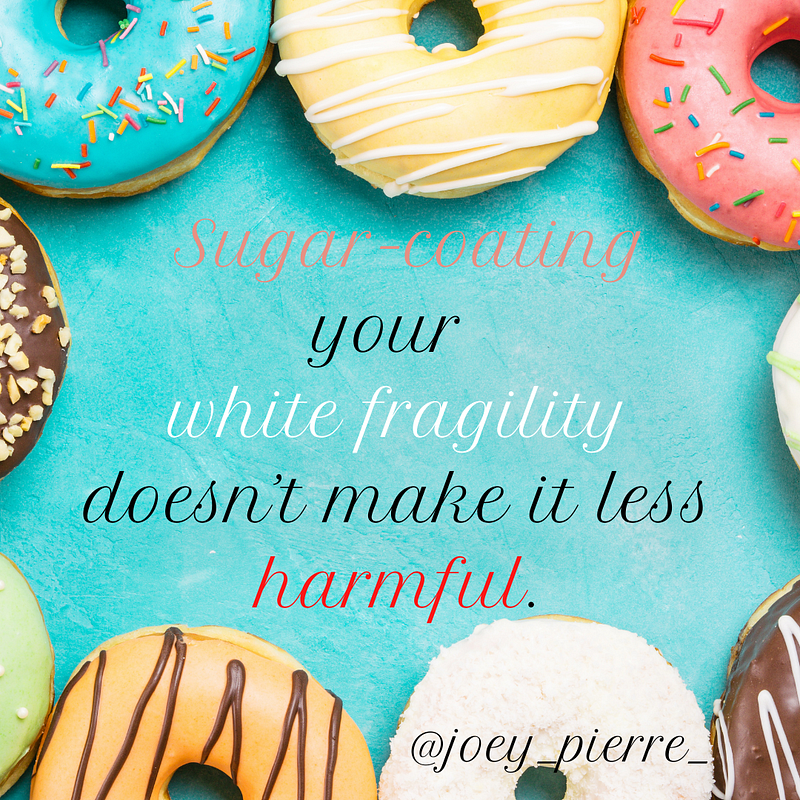
Settler Sam said phrases like “I totally understand” and “I empathize with you,” which sounded affirming until he delivered his next set of lines. I noticed him insert justifications for racial inequities and personal stories about how he was equally oppressed. Side note number two: Anti-racists aren’t saying that all white people experience whiteness identically — as a white-Mexican, I can attest to this. White people can experience oppression and be privileged at the same time. Settler Sam ultimately became angry and took personal jabs at me, and that’s when I realized what was happening: sugar-coated white fragility. Unfortunately, I went nowhere with him and had to end the conversation because of his insincerity.
Though I was unsuccessful in my attempt to connect the dots for Settler Sam, it’s still white people’s responsibility to talk to other white people (of all ethnicities) about race — specifically about our race, racism, and white supremacy. We unfortunately still need to convince other white people that racism is a virus that plagues our society and that our inevitable pathological fragility is one of the symptoms. Sugar-coated white fragility is no better than vanilla plain white fragility. Both are toxic, and both are harmful.
Hashtag:
“I totally agree with you, but…”
“I hear you, but…”
“Not all white people (insert ‘benign’ emoji)…”
Honestly, we can’t move forward if we’re running away from the issue and pretending everything is roses. To paraphrase the brilliant Rachel Cargle: There is no love and light without solidarity and action.
Joey Pierre is a race & class researcher, scholar, writer, and an amateur astronomer. He is evolving before your eyes, one article at a time. You can follow him here on Instagram.


