
Why Do We See Faces That Aren’t Real?
From the Face on Mars to the Man in the Moon and apparitions in clouds, we just can’t NOT imagine human facsimiles
Jesus appears on a piece of toast. A freaky face pops out of a swirly pattern on floor tile. Human faces from comical to scary appear briefly in the clouds. We even see faces on other worlds.
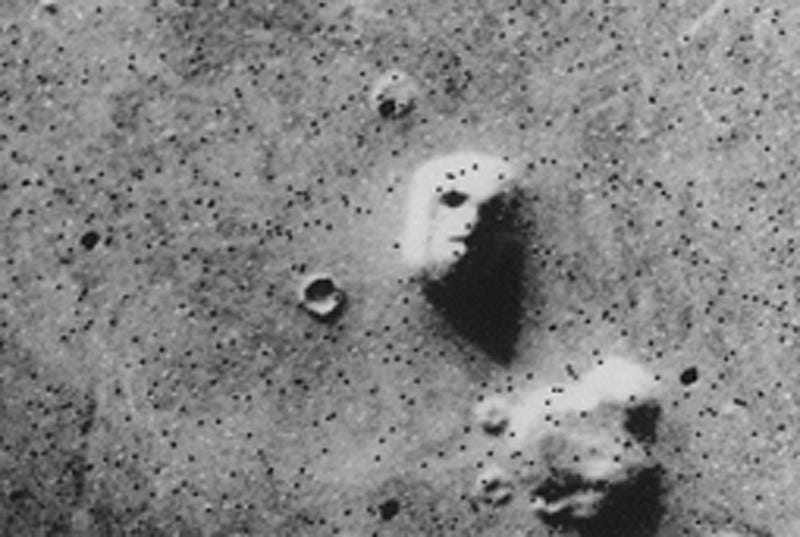
Seeing faces, animals and other things that aren’t there is called pareidolia. The propensity probably goes way back. It’s thought to have played a role in ancient imaginings of Orion the Hunter and other constellations. Further back, some 40,000 years ago, early human artists saw shapes on cave walls that inspired paintings of animals, according to research published in September 2023.
Even monkeys do pareidolia, lingering over images of inanimate objects in which humans had spotted illusory faces.
Believing is seeing
The human brain uses the same mechanisms to identify either real or fake faces. Once you’ve seen an imaginary mug, your mind won’t let go of the impression, storing the perception just like it would the image of a real person’s face.
One study using brain scans suggested that believing is seeing: The mind interprets signals to represent what we expect (or hope) to see.
“Our findings suggest that it’s common for people to see non-existent features because human brains are uniquely wired to recognize faces, so that even when there’s only a slight suggestion of facial features the brain automatically interprets it as a face,” explained Kang Lee, PhD, a professor of applied psychology at the University of Toronto.
The brain recognizes an illusory face in just a fraction of a second, according to findings published in the journal Frontiers in Human Neuroscience. It happens so quickly that “we believe that face-likeness processing occurs before we are aware of the object,” said lead author Yuji Nihei at the Toyohashi University of Technology.
In other research, brain scans revealed that pareidolia perceptions are processed in milliseconds — roughly the blink of an eye, in a part of the brain known to process images of real faces.
When a false face gets stuck in your mind, your brain analyzes the expression the same way it would evaluate the emotions expressed on a real face, another study found.
“We know these objects are not truly faces, yet the perception of a face lingers,” said the study’s lead author, David Alais, PhD, a professor of psychology at the University of Sydney. “We end up with something strange: a parallel experience that it is both a compelling face and an object. Two things at once. The first impression of a face does not give way to the second perception of an object.”
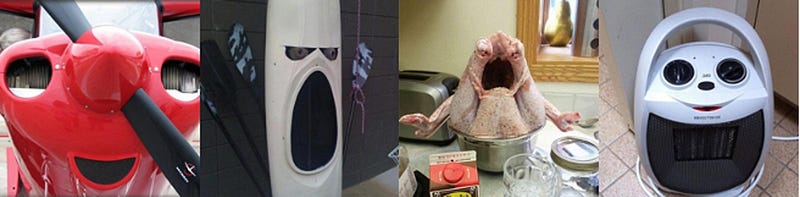
Those findings derived from a complex quirk of the mind known as serial dependence, in which the emotions perceived in one face affect a person’s perception of the next face they see. If you see a happy face, for example, you’ll perceive the next face as being happier than if you’d just seen a sad face, Alais explained. By showing people mixed-up sequences of real and pareidolia faces, Alais and his colleagues determined that the same mental process is at work analyzing the expressions.
Locking onto faces, for safety’s sake
Facial pareidolia is likely a survival skill, born of evolution. Carl Sagan long ago suggested that being able to recognize faces quickly, regardless of conditions, could have helped people escape danger. Spotting a face, say, in the bushes and being able to identify the human or creature it belongs to could be the key to a swift and safe getaway, for example.
“From an evolutionary perspective, it seems that the benefit of never missing a face far outweighs the errors where inanimate objects are seen as faces,” Alais says. “There is a great benefit in detecting faces quickly, but the system plays ‘fast and loose’ by applying a crude template of two eyes over a nose and mouth. Lots of things can satisfy that template and thus trigger a face detection response.”
Babies are known to be adept at spotting the faces of Mom and Dad. By just six days old, the brains of infants appear to be hardwired for identifying faces. The preference for faces seems to be established in the womb, researchers discovered in 2017 — by shining light through the uterine walls of pregnant women.
“The fetus can distinguish between different shapes, preferring to track face-like over non-face-like shapes,” said study team member Vincent Reid, PhD, a developmental psychologist then at Lancaster University in the UK.
Reality check
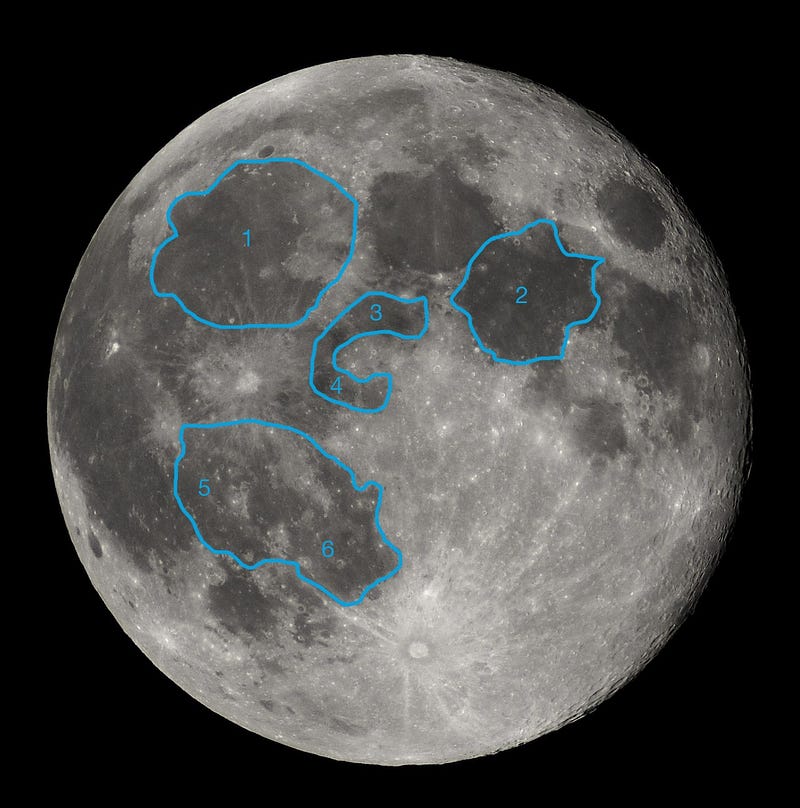
For the record, I’ve never been able to spot the supposed Man in the Moon. I squint and stare and, for me, it’s just not there.
Here’s one version (there are several) of what other people see:
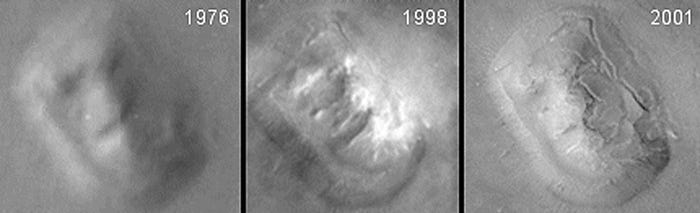
Finally, I must disappoint some true believers. Here’s the truth about the infamous Face on Mars: The original image that inspired the hoax was later revealed to be mere shadow-play, as the face disappeared in subsequent photos taken under different lighting conditions.
Thanks for your support, which makes my reporting and writing possible. To make your days better, check out my book: Make Sleep Your Superpower. And if you’re a writer, sign up for my Writer’s Guide newsletter. Note: Portions of this article were published previously.


