
Why Do We Lie to Almost Every ‘How Are You?’
How to elicit the truth to this simple yet complicated question, and in turn potentially save someone’s life?

I am good. How are you?
This is how we dodge a bullet every time when someone asks us, “how are you?” even if it is a genuine question.
This is the question we have to answer every day to almost everyone we talk to. About ten to twenty times a day? How many times do we tell the truth?
If you say that you are good and you really are doing good, I am honestly happy for you. But what about the rest of us? We all struggle at some point in our lives. We all have our ups and downs. Few ups and many downs. We all process them in a bizarre way.
Have we programmed ourselves to say, “I am good” even without our consciousness? Interestingly enough, sometimes we don’t know the exact reason why we are not good.
It is understandable that we lie when we don’t even know how we are. We may be still processing something that happened just recently. But when we know for sure that we have been downright miserable, why can’t we still be honest?
It depends on the person we talk to for sure. Granted, some people ask “how are you” just out of politeness with no real interest in knowing the answer. In that case, “I am good” is the innocuous way to go.
We are not going to share our depressing stories with a stranger we meet at a cafe or at a pub. At least not at a cafe, yet.
But with friends and family whom we know care for us, why is it so hard to answer that question? Is it really that tricky? Why do pretty much all of us lie to this simplest of questions?
This critical topic has not been talked about enough. Because the problem still persists. In these trying times, I am sincerely trying to create some influence in how we treat each other.
This is for the ones who answer the question and also the ones who ask the question “how are you?”. That’s pretty much everyone.
Trying to Fit In
We don’t respond with anything negative unless there’s something really horrible happened such as the death of someone or our pet. Rarely we say, “I am really struggling”. At best, we may say, “not bad” even when we are almost on our deathbed.
Sometimes we may get away effortlessly by saying, “I have been busy” or “I am alright”.
Some of us may be a talker by nature and oversharing their stories. That is one way of dealing with trauma. As long as this coping mechanism works, they don’t worry about being judged.
Another interesting coping mechanism is some of us might let you know how they really feel by writing in a Facebook post or in Twitter instead of directly answering your “how are you?”.
But not many of us are inclined to spill the beans. Not even with the close ones. Not even on social media.
Are we afraid that they won’t like what they hear? Are we worried that they will start to judge us? Are we scared that they will see us as vulnerable people? Are we trying to be socially acceptable?
Even if someone pushes us for the second time by catching us from our beautiful lie, we’d still be hesitant and say, “No, I am fine. I am just tired. Busy at work is all.”
Dodged a bullet again.
In some countries like Britain, sometimes “how do you do?” is almost a rhetorical question. You will get the response as same as the question: “how do you do?”. Nobody actually answers the question.
It is as same as “hiya” but supposedly with even more connection. Is it though? But in all fairness, this is some serious dodging.
You Don’t Want to Burden Them
You may be having the worst days of your life. But you don’t want to burden anyone by telling them you are not well even if they are so close to you. Isn’t it sad?
To put things in perspective, when someone tells you they are doing great and their day was fabulous, you really don’t want to burden them. That would mean that you are worsening their mood, which in turn worsening their day. Some may feel awkward and they might feel that they are stuck now in the conversation and cannot change the subject.
They may be empathetic if you are lucky and would genuinely want to release you from your suffering. But that’s not what you’d think. Ever.
What’s even sadder is sometimes when we answer, “I am okay. You?” and they say, “Oh, that’s good. I am okay too.” We move on to the next conversation.
Since when did “I am okay” become a good standard? Or is it the new gold standard?
My Lying Theory
We often lie that we are fine and we pass the formality question round with flying colors. If we tell them we aren’t doing well, not only they will have to listen to us more but also they will have to comfort us. They will have to unknowingly lie to us saying, “I am sure everything will be okay. Hang in there”.
It all basically comes down to this: Either you lie or you let them lie. So, the question is do you want them to lie for you?
I have not been well. I got a new job now on the unemployment line. Some of my family and friends have lost their lives to this never-ending pandemic.
My mental health has reached a new low of late. I have been ignoring friends and family so that I don’t have to go through all these awkward conversations and they don’t have to either.
Even if I get away with their “how are you?” by lying to them, I’d be caught somewhere along in the conversation. I am known for my enthusiasm and extrovertism. So I can’t hide from them forever and keep lying.
Isn’t it so hard to fake all the time? Aren’t you tired of wearing masks by now? I mean that only in a metaphorical sense.
Why We Shouldn’t Lie
Lying to them makes me feel guilty. That makes me think that I am taking them for granted to some degree. Making them look like a fool is not a noble thing to do. Not being authentic to the person who may sincerely care to know and even help is not fair to them.
Due to our lies, we are actually avoiding all the potential help we could get. It’s like if we share how we really are, then they may make us feel better. It’s like we are refusing to get better. We owe them the truth.
“I prefer an ugly truth to a pretty lie. If someone is telling me the truth that is when I will give my heart.” — Shakira
You may be telling nothing but the whole truth when your therapist asks, “how are you?”. But, sadly, not everyone can afford a therapist. Even if they can, they may be too shy to even visit a therapist.
Even rich and famous celebrities like Robin Williams, Chester Bennington, Marilyn Monroe, and Kurt Cobain committed suicide. The love and support from the whole world turned out to be not enough to keep them alive.
If they had talked to someone close about how they felt, any of them could have decided to choose life. If only. You’d never know.
It is necessary to process everything you feel and accept how you are really doing. Try to be tender to yourself. Be honest to yourself and your people. Whether you like it or not, we are all in this together. You don’t have to go through everything alone. Nobody should.
The month of May has been observed as Mental Health Awareness month since 1949. Here’s an idea: How about we raise that awareness for each month of the year?
When you are lying to someone that you are good, you are lying to yourself too. A psychology professor Arthur Markman in an article says that lying only induces more stress for you, which in turn increases your anxiety and depression.
I cannot stress this enough. It is okay to admit that you are not okay.
Just because you are supposed to be happy doesn’t mean you should be faking it.
Ask a Better Question
According to journalist Ashley Fetters, “how are you” usually “functions as a perfunctory greeting and nothing more.” A psychotherapist Kathleen Dahlen deVos says that “how are you” is often used as a “well-intended nicety and not a sincere inquiry about someone’s well-being.”
People lie because they know you don’t mean your “how are you?”.
A simple and formal “how are you” doesn’t cut it anymore. It isn’t going to make them tell you that they are having suicidal thoughts all this week. You are going to have to do a little better than that if you really want to know the truth. It will have to be informal and more personal.
Here are some ideas that could show genuine interest which makes people want to open up:
“How are you holding up?”
“What’s been on your mind lately?”
“I am here for you if you want to talk.”
“I wanted you to know I am thinking of you.”
“Please let me know if I can help in any way possible.”
“I wanted to know if things are okay with you.”
“I just wanted to check in on you and see how you are feeling.”
Your little words have more power than you think. It can literally save lives.
“Your words have the power to hurt, to heal, open minds, open hearts and change the world. Never forget the responsibility you have over the words you speak.”
— Steven Aitchison
Let them know that you’ve noticed something different about them. Say things like “I have been watching you behave differently. Do you want to talk about it?”.
According to a New York therapist Mia Rosenberg, these curiosity-driven concerns make them feel like you are genuinely concerned so they would want to open up.
Abigail Makepeace, a family and marriage therapist says that it is important to let the person know that not only you genuinely care to know how they are but also that the person can trust you to share their private matter.
Whom do You Ask?
You are not going to ask these more personal questions to someone who seems to be doing obviously well of course. You would want to ask someone who is showing some subtle signs. The signs could be:
- They are ignoring you for no reason
- They are the ones who suddenly disappeared off the face of social media
- They are calmer than usual
- They smile often just as any happy people
- They don’t engage in conversations anymore
- Their significant change in sleeping pattern
- They will tell you “I am fine”
Never ever get deceived just because someone is smiling. The below tweet was from Chester Bennington’s then-wife Talinda back in 2017.
Here’s the Rub
Once they shared something with you, it is important for you to check in on them frequently. Let them know that you are there for them even if they don’t feel like sharing anymore.
They will be tempted to talk once you offer help. If you don’t check in on them or if you forget to do with your busy schedule, they may feel like they have burdened you enough already. They will feel guilty and assume that they have given you negative vibes.
In an article, Abigail Makepeace said:
These check-ins do not have to always directly address your friend’s struggles. Sharing things that have brought you joy can bring joy to others. Sometimes, simply sending a funny text or an inspirational quote can be just as impactful as speaking deeply.
It may be impossible for you to solve their problems. But listening to their problems alone will make them feel like they are not alone in this lonely world.
They know you are spending time for them and that would mean the world to them. They’d be grateful for you, your time, and your efforts which will make both of you happy.
Kathleen deVos in an article said:
Sometimes all we need is someone to listen to us, nonjudgmentally, while we process something. Other times, we actually need support in figuring out a strategy, path forward, or ways to cope.
Sending exactly how you feel through emojis
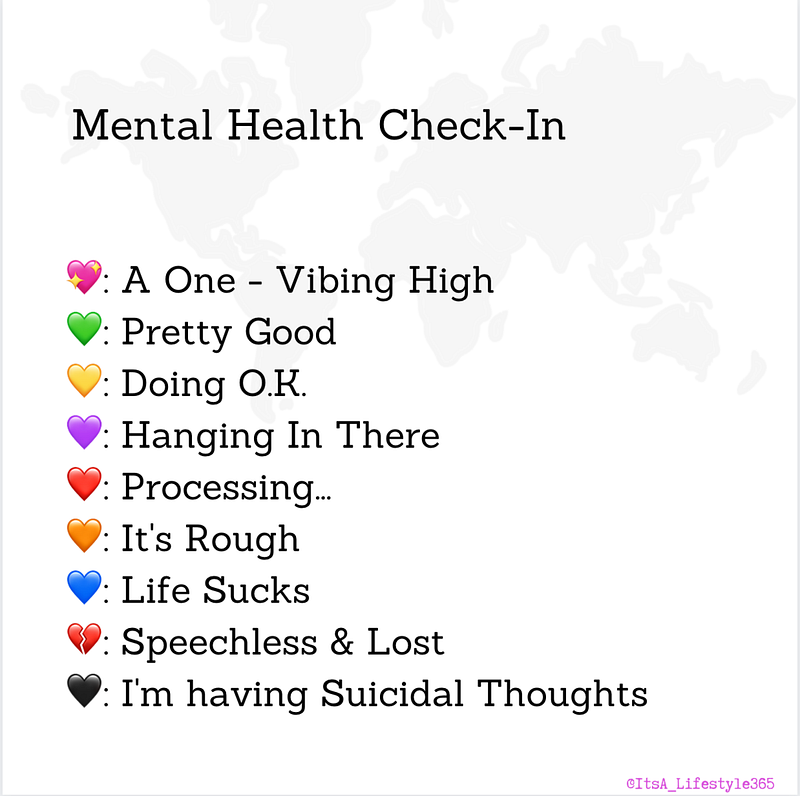
You can check in on their mental health regularly by sharing the above sort of picture to ask them how they feel. They cannot just say now, “I am good”. They’d have to do be precise. So, there is more chance for the truth.
A month ago, I sent a black heart emoji to my friend. She understood exactly how I felt. She and I had a deep talk about it until I felt better.
Rose and Thorn
My friend Jenna who lives in California is easily the kindest person I know. Even though I live in Norway, she never fails to check in on me. She is as beautiful as Southern California sunset during the winter. Beautiful inside and out.
When I was really struggling, she introduced an activity that you may or may not be familiar with. Sharing each other’s rose and thorn.
Rose indicates your positives of the day even if it includes your small wins. Thorn indicates your burden or whatever is bothering you that you could talk to someone about.
This is a nice way to check in on each other. Both parties can share their day and you can encourage them for their positives and you can say something comforting for their negatives. What it does is nobody has to be awkward here when both of you are sharing personal things in detail.
These activities may look childish but it carries nothing but love and compassion.
Final Thought
“How are you” doesn’t just have to be a mere formality. “I am good” doesn’t have to be cryptic.
Let them know you care. After all, you do care. Let them know that they fit right in without being judged and that they are no burden. Let them know that you are a better human than they may have thought.
Don’t let them take your “how are you” for granted. Make sure that you are known for your empathy more than anything else. Your sincere “how are you” filled with love can be someone’s remedy.
In this needle and haystack life, what’s certain is all of us are once in a lifetime.
With all my heart, I can only hope that you have at least one Jenna or Shakira in your life who takes time to listen to your ugly truth without any judgement.
Nowadays I have started to tell my people who ask me “how are you”:
“I am not okay. But I will be.”
So, I ask you now
How are you…holding up?


