
Why Do We Always Root Against Serena and Ronaldo?
Appreciating the Greatness of Superhuman Athletes
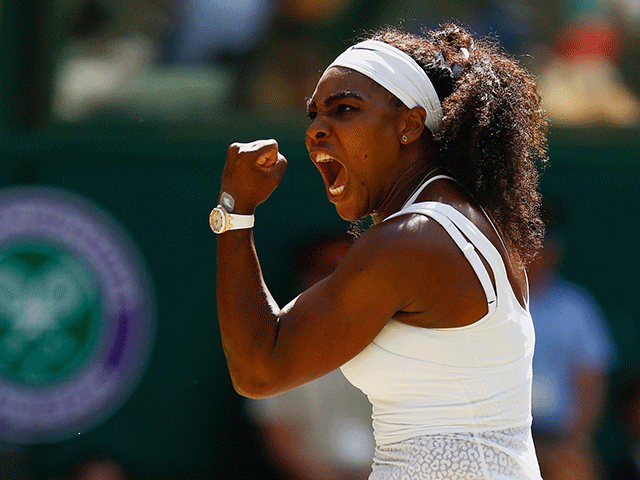
Serena Williams raised both arms in victory and screamed a delighted war cry. Fresh off a dominant victory in the Saturday Wimbledon final, she had won her 22nd Grand Slam, tying her with Steffi Graf for most in Open history and cementing her place as one of the greatest athletes of all-time.
A day later Cristiano Ronaldo watched from the sidelines as Portugal battled for the European Championship. In the biggest game of his life, Ronaldo picked up an early knee injury and was subbed off in tears. They soon became tears of joy as Portugal lifted the cup with a late winner, a crowning moment for Ronaldo in a career already marked with top achievements.
Ronaldo is the leading scorer in history for Portugal, for Real Madrid, and for the entire Champions League. He’s won 4 domestic titles and 3 Champions League cups and is Forbes World’s best paid athlete. Serena has won 22 singles and 14 doubles titles. She trails only Margaret Court for most women’s Grand Slams ever, and only by 2. She is a 4-time Olympic gold medalist and a 6-time #1 player in the world.
So why do we almost instinctively root against Serena and Ronaldo?
As Serena stormed toward another Wimbledon title, she was not even the biggest story in her own family. Big sis Venus made her own charge all the way to the semifinals before falling short. And Ronaldo was not the biggest superstar in soccer to make a big finals run — just a few weeks ago, Messi came up short at Copa America.
Venus and Messi were almost universally celebrated. Fans love the finesse of their games. We love the underdog story. Messi is tiny and unassuming, someone you’d never expect to be a world-class athlete if you met him on the street. Venus is soft-spoken and inspiring, fighting a constant battle with Sjögren’s syndrome that causes chronic fatigue and pain. Each plays quietly and humbly, and each has overcome so many expectations.
Messi and Venus fit our chosen sports narratives. They’re the ones we make movies about.
They are one of us.
Ronaldo and Serena are superhuman. Human beings aren’t supposed to be able to do the things they do.
Serena and Ronaldo are the players you create on video games when you want to set the difficulty to rookie and just slaughter the computer opponent. They are the real life version of Space Jam’s Monstars in their sport.
Ronaldo and Serena are raw power and uncaged athletic ability. They win not by overcoming but by being the one opponents cannot overcome. They harness sheer athleticism and talent in a way no one else in the world can.
Serena and Ronaldo are not fair.

And perhaps that’s the problem —Ronaldo and Serena do not appeal to our sense of sports justice. We desire parity in sports, and in life. Every team should have a fair shot, dealt from the same deck. Each player should start on the same ground, so cliches like grit and heart and effort are the difference.
We don’t resonate with Serena or Ronaldo because they were given the complete package and we weren’t. Something ridiculous inside of us believes that maybe, if we had just trained hard enough, we too could’ve been Messi or Venus. But we never would have been Ronaldo or Serena. Raw athleticism and power is given at birth — an unfair, unearned advantage.
An uncomfortable narrative.
To root for Serena and Ronaldo is to root for The Power.
We used to group LeBron James in with the Serenas and Ronaldos of the world. LeBron was given the full package and we resented him for it, held him to a higher standard. We rooted for the underdog Steph Curry, the little everyman that could. It took us 13 years and a 3–1 deficit in the Finals to finally embrace LeBron, underdog at last, and appreciate his greatness.
Like LeBron, Serena and Ronaldo are not everyman. They are freaks, cyborgs created in a lab to do exactly what they are doing, to dominate exactly how they are dominating. They are special. They are The One.
Ronaldo, Serena, and LeBron make underdog stories possible. They are the very thing that every other athlete is not. They are 1 in 7 billion, uniquely dominant in a world filled with imperfect facsimiles.
They are magnificent, sports perfection embodied. They’re what the creators of tennis and soccer envisioned a human might one day be — but better.
Perhaps we’ll never universally root for superhuman athletes like Serena and Ronaldo. But maybe we can stop rooting against them and learn to appreciate sporting greatness unique from anything else in human history.

Follow Brandon on Medium or @wheatonbrando for more sports, humor, pop culture, and life musings. Visit the rest of Brandon’s writing archives here.