
Why do most Western people have a negative view of China?

Entering 2024, the American think tank Pew Research Center will begin its research on various countries’ attitudes toward China again.
For some unknown reason, the Pew Research Center has conducted an annual survey on China’s image in countries around the world (selecting 24 countries as representatives) since 2005.
The survey takes several months and is released between April and July each year.
Although this kind of poll may not be reliable, because the interviewees are mainly public groups, it is a good window to observe the attitude of foreign people towards China.
Judging from the data in 2023, the survey results are very unfavorable to the Chinese.
In the overall data, 2/3 of the respondents have a negative view of China.
Among them, the proportion in Japan and Australia is as high as 87%, and the United States and Sweden also exceed 80%, even higher than in 2020 during the COVID-19 pandemic.
The proportion of Indian people’s negative views on China has climbed to 67% from 41% in 2019.
Among the 24 countries surveyed, only Kenya, Mexico and Nigeria have more than 50% positive views on China.
This result makes Chinese people generally feel aggrieved.
Chinese people are not usually arrogant and domineering in the world, nor do they bully others. They are also cautious when traveling. Why do foreigners still dislike the Chinese?
In fact, this negative view is not accidental, but inevitable.
First, the image trap under the hegemony of public opinion
Good impression or bad impression, how is it generated?
Obviously, this requires an input type of cognition, and then each person makes a judgment based on his or her own moral standards. If it is consistent, it will be a good impression, and if it is not consistent, it will be a bad impression.
Therefore, Westerners have mostly bad impressions of China, which has a lot to do with their “cognitive input.”
In fact, the West has been working tirelessly to discredit China for many years in terms of “cognitive input”, even starting hundreds of years ago.
The first is the deliberately created negative cultural symbol.
In fact, at the beginning, Westerners had a good impression of the Chinese.
According to the rumors brought back by various missionaries and sailors, China is an ancient, mysterious and civilized country.
China has a splendid culture and numerous scientific and technological inventions, and can also produce exquisite porcelain, silk, tea and other products.
On the contrary, Europe at that time was filled with corrupt churches, tyrannical nobles and autocratic monarchs.
So at that time, Westerners admired China.
However, the Opium War broke all this.
In the Opium War, China suffered a complete defeat, which also allowed Western countries to completely recognize China’s reality.
Westerners are shocked to find that China is so weak, its officials are so ignorant, its people are so poor, and its technology is so backward!
In the hundreds of years since then, Westerners’ impressions of China have changed from one extreme to the other, thinking that China is an uncivilized and barbaric country.
Later, in order to beautify their aggression against the East, Western countries created the “Yellow Peril” theory.
The term “yellow peril” originated from the history of the Mongol Empire’s conquest of Eastern Europe.
At that time, the Mongolian army burned, killed, looted, and destroyed civilization in Europe. Their brutal and barbaric behavior brought a huge psychological shadow to Europeans.
So since China recognizes the Mongol Empire as one of the Chinese dynasties, it is naturally a barbaric and cruel country that will bring disaster to Europeans.
This Yellow Peril theory directly gave birth to the biggest negative cultural symbol about China-Fu Manchu.
In the novel “The Mystery of Dr. Fu Manchu”, Fu Manchu is the leader of a Chinese evil organization. He has a bald head and long braids, a Qing Dynasty dress, thin eyebrows and long eyes, and a cunning face.

Fu Manchu’s biggest hobby was to kill white people. He “used insects, bacteria and venom to cause more casualties in a week than Hitler did in a year.”
The appearance of this image completely embodied the Western world’s fear of the mysterious East at that time.
Subsequently, with the embarrassment of Hollywood screenwriters, Fu Manchu in the movie was even more terrifying than what was described in the book.
Indulging in murder and various tortures, these horrific plots have become the childhood shadow of generations of Europeans and Americans.
Subsequently, the Asian people represented by China, together with the evil-doing Fu Manchu, became a cunning, cunning, cruel existence that posed a serious existential threat to the white people.
This is how Western countries use cultural symbols to completely vilify the image of the Chinese people.
As a result, when Westerners mention the Chinese, the first impression that comes to mind is the cunning and insidious Fu Manchu. How could they have a good impression?
Second, ideological incompatibility.
As we all know, China is a socialist country and believes in communism.
Communism advocates the elimination of private ownership of the means of production and calls on the proletariat of the world to use revolutionary violence to overthrow the rule of the bourgeoisie.
Capitalism is a social system based on private ownership of the means of production.
This determines that there is naturally the most intense ideological conflict and opposition between the two.

Since the birth of communism, Western countries have tried their best to vilify communism, causing people to feel disgusted with communism and have faith in and dependence on capitalism.
For example, Western countries took advantage of the public’s antipathy toward Hitler and deliberately confused Nazism (National Sozialismus) with socialism, combining historical inducements to arouse people’s antipathy and fear of communism.
Through the export of strong ideology, the United States has taught children to hate and fear communism from an early age.
So no matter what you say, no matter how much communist propaganda they see, they think it’s “brainwashing.”
After the collapse of the Soviet Union, the United States shifted its target of vilification to China, which still adheres to the socialist path.
For example, the English abbreviation of the Communist Party of China is CPC (the Communist Party of China), which emphasizes the Communist Party of China.
However, Western media have always called it the CCP (the Chinese Communist Party), emphasizing China’s communist attributes.
This is actually a discourse trap that deliberately leads the public to unconsciously associate CCP with the image of communism that has been vilified in the past few decades, creating a negative image.
For example, in the US Congressional debate, China was not called China, nor was it PRC, but Communist china.
The purpose is also to highlight China’s communist identity and lay the foundation for smearing and targeting.
This leads to the fact that when Western media mentions China, what people think of is communism, which has been stigmatized for a long time.
When talking about the Chinese, what comes to mind is that they want to bury communist believers in the Western capitalist world. So how can we expect them to have a good impression?
In fact, during the honeymoon period between China and the United States in the 1980s, the United States had a relatively friendly attitude toward China. Even Fu Manchu was banned at that time.
But with the disintegration of the Soviet Union and the United States labeling China a new generation enemy, this organized smear campaign motivated by anti-China began again.
At the beginning, the US anti-China propaganda mainly focused on “human rights violations” and “Tibet issue”.
After China’s economic aggregate ranked second in the world in 2010, Western countries were worried that China would threaten them, so they began to create the “China threat theory”.
The “China threat theory” covers a very wide range and can be applied to anything.
For example, they say that the Chinese people do not have enough food to eat, which will bring a crisis to the world’s food supply and cause food shortages.
For example, they say that Chinese people’s environmental pollution will bring about ecological disasters.
For example, they say that China’s Belt and Road Initiative has created a “debt trap” for relevant countries.
For example, they say that China’s Confucius Institute is a spy agency and a cultural invasion.
Even when Chinese people eat meat, Western media say that the carbon dioxide brought by Chinese farming will cause global warming and threaten all mankind.
According to the Western media, everything the Chinese do is wrong and threatens all mankind.
Such negative reports, which are strange and varied and beyond the imagination of the Chinese people, have offset China’s positive influence in neighboring countries and even in the international arena.
By suppressing China’s international image, the West creates obstacles for China to go global.
After all, in the face of a China that has been smeared as “doing everything with conspiracy”, any country that wants to cooperate with China has to be prepared to do so.
How can people in Western countries have a good impression of China when they are immersed in this information cocoon of anti-China public opinion every day?
Third, conflicts of interest
If the media’s exaggeration is an external factor, then the conflict of vital interests is the internal reason for the deterioration of foreign people’s impression of the Chinese.
The total global GDP in 2023 will be approximately US$93 trillion.
Among them, the overall GDP of developing countries is US$36 trillion, and the total GDP of all developed countries is approximately US$57 trillion.
What about population? The total population of developed countries is only about 1.1 billion. Except for the United States, which has more than 300 million, and Japan, which has just over 100 million, none of them exceeds 100 million.
In other words, developed countries, which account for less than 18% of the world’s total population, control two-thirds of the world’s total wealth!

If you are reincarnated in a developed country, you will have enough food and clothing, and you will receive basic benefits even if you don’t work.
If you were reborn in a small, poor country at the bottom, having enough to eat would be a luxury.
So how did these two severely separated parallel worlds come into being?
The reason is simple: industry.
If we look at developed countries, we will find that they always have at least one or two trump industries.
These countries are relatively small, and with a few advantageous industries, they can easily ensure that their citizens live a prosperous life.
Why can Westerners work for 4 hours a day, drink coffee for another 4 hours, go on vacation in the Mediterranean, sunbathe, and pick up girls, but they are often dissatisfied and go on strike at every turn?
Because their high-end industries support this kind of life.
Other developing countries can only be locked in agriculture, animal husbandry, mineral resources and low-end industries forever.
In terms of profits, these low-end industries can never compare with high-end industries.
This system has been running stably for decades, and the United States and developed countries have been sitting on the top of the pyramid, sucking the blood of developing countries for decades by selling sand for the price of chips.
But I never expected that China would pop up.
China is different from other countries in that it has too many people and low-end industries cannot give Chinese people a decent life.
Even if the United States donates some high-end industries, China cannot become a developed country in an instant like South Korea, which has a small population.
Therefore, what China is pursuing is the upgrading of the entire industry, covering more Chinese people with the rise of various industries, so that everyone can live a good life.
No matter how many pearls you have in the crown of your industry, the Chinese will find a way to seize them.

Moreover, China has the most complete industrial chain in the world.
There are millions of science and engineering students every year, a huge domestic market, strategic support at the national level, and the national sentiment of “Princes, generals, and generals should be content with each other” engraved in the Chinese DNA.
This means that as long as China wants to do something, there is a high probability that it can be done.
Therefore, when the Chinese are no longer satisfied with sewing buttons and knitting clothes, and begin to upgrade their industries, the comfortable days of Western countries may come to an end.
China’s industrial upgrading also has a magical ability. No matter what high technology is conquered by China, it will immediately become a bargain.
Then when we return to foreign markets, we can immediately reduce the dimensionality of foreign manufacturers and attack them, without even the possibility of competition.
For example, Westerners used to sell dyes used in the textile industry to the Chinese for hundreds of thousands per ton.
After the Chinese mastered the core technology, they directly worked up to 11,000 tons, killing 70% of their international counterparts.
There are also white goods. In the past, every Chinese household was proud to have a Toshiba TV.
As a result, now that China’s white goods market is all over the world, Toshiba is about to go bankrupt.
The same goes for LCD panels. In the past, China could only rely on imported LCD panels to make color TVs, and most of the profits from a color TV would be taken away by foreign countries.
Now after China’s breakthrough, it has directly captured 80% of the world’s LCD panel share, and the price is so low that LCD panels can be installed above toilet urinals.
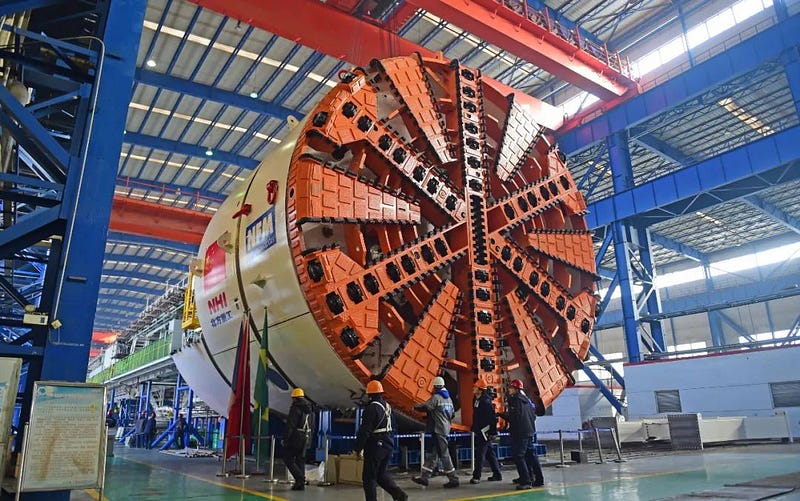
Also, China broke through the TBM, and Germany’s Waldrich Coburg Machine Tool Factory closed down.
China made a breakthrough in pen tip steel, and Japan’s Shimomura Special Seiko suffered a sharp decline in profits and was on the verge of bankruptcy.
China started making mobile phones, but Nokia and Motorola died.
China’s practice of using low prices to completely overturn the market structure once a technological breakthrough is really unbearable to foreigners.

You’ve killed the business that others were working on to make money, and made their lives less comfortable. How can you expect others to have a good impression of you?
Let’s take a look: why were Western countries not as anti-China in 2010 as they are now? Has the anti-China voice in Western countries suddenly become louder since 2010?
Isn’t it because this year China began to vacate the cage and change the bird, and its GDP surpassed Japan’s?
Fourth, China has explored a successful path to modernization that is different from the West.
For a long time, there has been only one successful path to human development, which is Western-style modernization.
This was the only correct path proven by practice, and it became a model for all countries to learn from.
To a certain extent, Western-style modernization has dominated the process of human modernization.
But strangely enough, there are many countries that follow the path of Westerners. Whether in terms of political system or economic system, they are basically planned according to the Western model.
But today, not many countries have really reached the level of modernization in the West. On the contrary, some countries are getting worse and worse, and even go bankrupt.

China chose to rely on its new national institutional advantages and scale advantages to change from a free flow of funds to a government-guided capital flow.
Through rural revitalization and urbanization, China’s advantages of huge population and large cumulative effect have been used to help rural areas get rid of poverty and promote common prosperity.
Facts have proved that China was successful, and it took several decades to go through the path of modernization that took Western countries hundreds of years.
Today, both its economy and military strength have reached the point where it is second to none, surpassing many developed countries.
China has provided a model, a model that can still succeed without taking the path of Westernization, which has strengthened the confidence of all countries in the world that are interested in developing their own modernization.

But in this way, the modernization theory that Western countries have maintained for decades will go bankrupt.
To put it simply, the rise of China has completely destroyed Westerners’ institutional and theoretical confidence.
Therefore, the Chinese cannot expect Western people to have any favorable impression of China, a “heretic” that does not follow the Western path.


