
Why Do I Listen to Metal When I Run?
Music’s relationship with mood and leisure.

Iron Maiden, ABBA, and piano.
What do they have in common?
Not much. Other than the fact that I listen to them frequently.
When I’m on a run and I’m motivated to crush shit, I blast Metallica, Black Sabbath, and Iron Maiden. When I’m writing a blog like this I’m either listening to something like ABBA or the Spotify Peaceful Piano playlist.
There’s a plethora of different settings and activities for different music. Certain leisure time is associated to certain music. When I’m at the beach I listen to The Eagles. But when I’m jamming I listen to the Red Hot Chili Peppers.
Why is it that I listen to different music when I’m feeling different moods? Or engaging in different activities?
I did some research on the Web. Here’s what I learned.
Hypothetical Questions
We’re trying to understand the relationship between music, mood, and activities. These are some hypotheticals we’ll ask:
Does music affect your mood?
Why is certain music associated with certain activities?
I’m trying to understand if there are possible scientific answers for these questions. Why?
Because it means everything.
Imagine how much of the world operates on the complex science of ourselves that we’re yet to understand. Look around you and you’ll see it for yourself. Certain music is associated with certain environments and activities.
Why is it that we listen to Avicii when we go to the club? Why is it that Avicii— among other things — makes us in the mood to dance?
Why do I listen to punk rock when I’m skating? (I don’t skate, but my longboard skills are subpar.) Why do I listen to metal when I run? Why are these songs associated with certain moods and activities like these?
It’s these questions that raise up even more questions. I can see an economist writing a blog on how this relationship between music, mood, and activities affects what products we see in the market, why and how we consume them, etc.
There tons of applications in the real world that affect our lives everyday — and, above all, that’s why I’m writing this. We should be more aware of ourselves. If not, we aren’t deciding how to live our lives the fullest.
In addition, the time to examine this subject is now because of accessibility. We have, never before, lived in a day and age where we can listen to literally anything we want. Only ten years ago the music streaming market was dominated by Apple’s iPod and iTunes, and the unit economics were different. Songs were typically priced at either $0.99 or $1.29 (Apple increased the price in 2009). The profit was split between the record label, the musician and their agent, and the platform.
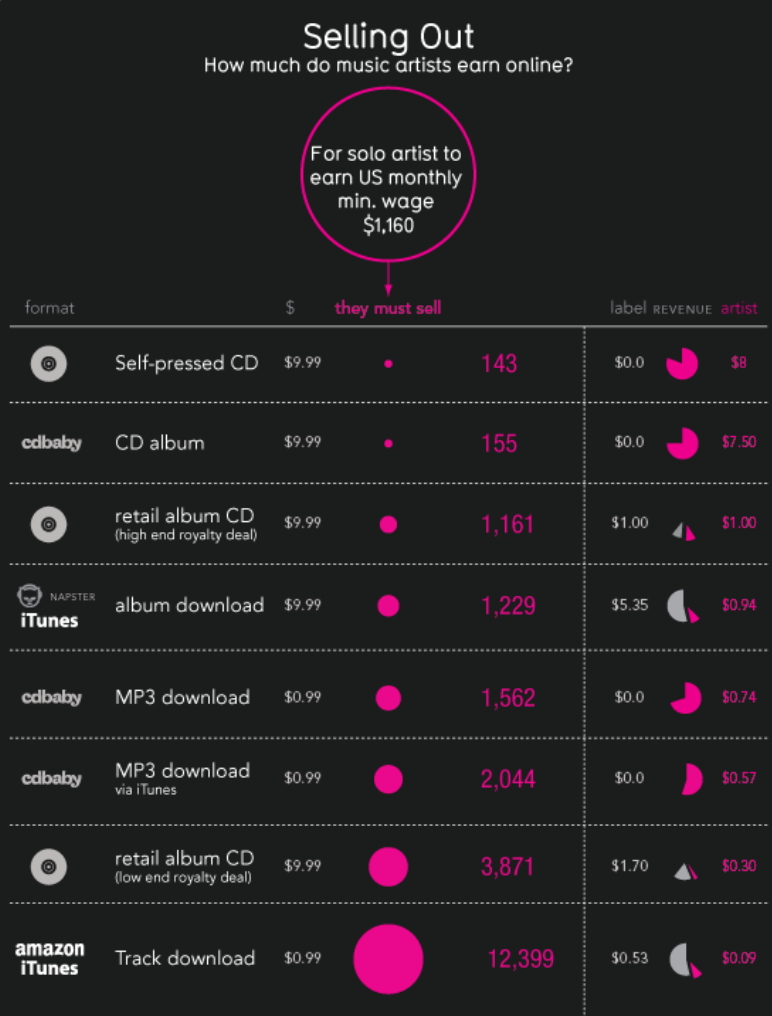
The unit economics of streaming may suggest that artists aren’t being compensated fairly. Whoever owns the rights of the song is compensated by Spotify $0.006 to $0.0084 for each stream. That’s not a lot of money.
However, it’s easier than ever to become a popular artist today than back then due to new digital distribution channels. Not only is social media a prevalent presence in today’s music biz, there are more accessible technologies today that have innovated all aspects of the musical experience.
DAW (digital audio workstation) software innovations have allowed for the emergence of free tools such a GarageBand to produce and edit any music for free on an Apple device. Content creation is therefore easier to do and manage. And because streaming is less expensive for the end user as a listener ($9.99 of monthly Spotify Premium versus $1.29 per song), there’s more accessibility on the economic front which creates more users. Apple’s peak year in iPod sales sold roughly 50 million units. Spotify currently has 271 million monthly active users.
Today people like Chance the Rapper can go from being nobody to somebody to celebrity without record label backing. Today I can listen to music in Hebrew, Arabic, and Greenlandic. Today artists have more digital distribution channels to connect with fans who they never met. If that’s not fucking amazing, then I don’t know what is.
There’s no doubt that there is some relationship between music and mood: We see it in the real world. It’s not a coincidence that listening to dance music makes you in the mood to dance.
Are we listening to music to become in the mood for something? Or are we listening to music because we’re already in that mood?
Both happen in the real world. Yet at the very least, we should look at the psychological functions for why we listen to music in the first place.
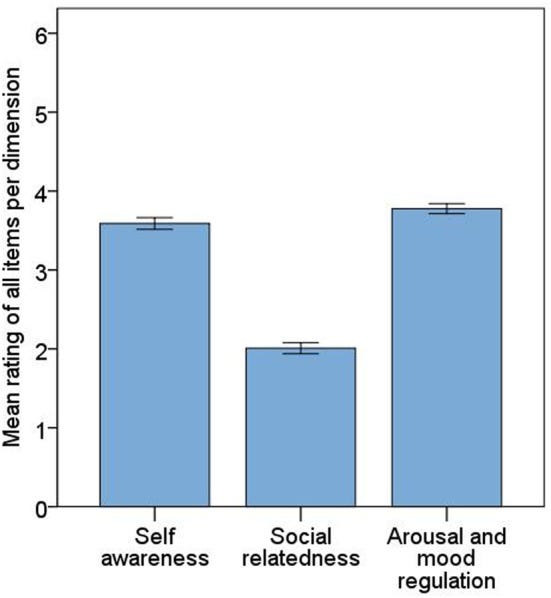
A 2013 study published in Frontiers in psychology found that — generally speaking — there are three major functions for why people listen to music.
“People listen to music to regulate arousal and mood, to achieve self-awareness, and as an expression of social relatedness. The first and second dimensions were judged to be much more important than the third — a result that contrasts with the idea that music has evolved primarily as a means for social cohesion and communication.”
Music also affects mood and health by boosting both.
“Studies have shown that music can buoy your mood and fend off depression. It can also improve blood flow in ways similar to statins, lower your levels of stress-related hormones like cortisol and ease pain. Listening to music before an operation can even improve post-surgery outcomes.
“How can music do so much good? Music seems to ‘selectively activate’ neurochemical systems and brain structures associated with positive mood, emotion regulation, attention and memory in ways that promote beneficial changes, says Kim Innes, a professor of epidemiology at West Virginia University’s School of Public Health.” — TIME, April 2018
Alternatively negative music can “bolster negative emotions.”
“One 2015 study from Finland found that music can bolster negative emotions — like anger, aggression or sadness — much the same way it can counteract these feelings. Why? The rhythm and other characteristics of the songs we select can modulate our heart rates and the activity of our brain’s neural networks, explains Daniel Levitin, a professor of psychology who researches the cognitive neuroscience of music at McGill University in Canada.
“Tracks with a slow tempo, gradual chord progressions and drawn-out notes tend to be calming, Levitin says, while chaotic and up-tempo music tends to have the opposite effect. But all of this is subjective. Levitin says he’s encountered people who have said that AC/DC is their relaxation music. ‘These were people who normally listened to Swedish speed metal, so to them AC/DC was soothing,’ he says. ‘There’s no one piece of music that will do the same thing for everyone.’” — TIME, April 2018
This also helps answer our second hypothetical question: Why is certain music associated with certain activities?
Certain activities have certain moods. It’s important to note that not everybody listens to Jimmy Buffet when they go to the beach. At the same time, however, it’s inevitable that going to the beach makes many beachgoers happy. So maybe they listen to music to maintain that happy mood.
At the end of the day, the beauty of music is that it’s an art. And what is art powered by? The subjective experience. Daniel Levitin knows people who relax to AC/DC. Why should we judge them for that? If that’s what they enjoy, and if that’s what makes them feel good, then they should jam to it. That’s why artists create art in the first place. For it to be enjoyed.
And you can’t force us to enjoy it a certain way either. No one told me that I have to listen to Jimmy Buffet when I go to the beach. I don’t listen to him there. But sometimes I listen to him in the shower. I don’t know why. It’s just soothing under hot water.
To answer the hypothetical questions, yes: There’s scientific evidence that suggests music relates to our mood.
But the second question is murkier. An experience, such as the beach, is not enjoyed by everyone. Some people don’t like going to the beach. Some people might hate it. So they don’t engage in beach music.
It goes without saying that, like anything, music is another commodity that affects our quality of life.
There’s a reason why the music industry is worth billions of dollars: Our bodies need it. Our communities need it. We need it.
Music is the missing piece in society that can bring everyone together. We have the digital technologies to empower a new renaissance in the musical arena. I wouldn’t be surprised to see the next Paul McCartney’s and Barbra Streisand’s emerge purely from digital technologies.
Between its ubiquity and its psychological and physiological effects on humans, music is an incredibly powerful tool. And we can use it to better our lives.


