
Why do Boolean functions play a central role in hardware architectures?
The heading as you see it is exactly the question raised by my CS1104 — Computer Systems instructor for my discussion assignment. In case you do not have a CS degree or never took a course dubbed “computer systems” in college, or anything remotely close to it, it might be worthwhile explaining the key terms for you: boolean functions and hardware architecture, even though you can just ask ChatGPT😀
Boolean functions
In the language of mathematics and computing, boolean functions are simply binary functions. They take input values that can ONLY be either true or false, often represented by the binary values 1 and O, respectively.
Boolean functions can have one or more input variables and produce a single output based on the logical operations performed on the inputs. The basic operations in Boolean algebra include AND, OR, NOT, XOR (exclusive OR), and NAND (NOT AND), among others.
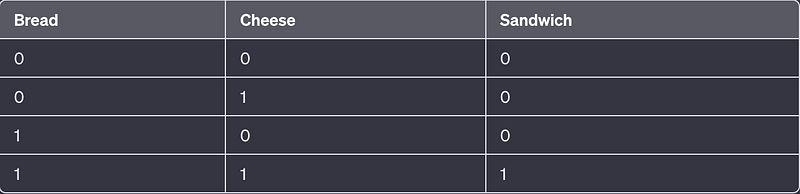
Let’s imagine you’re in the kitchen preparing a recipe, and you have a set of ingredients that can either be present (true) or absent (false). Each ingredient represents a binary variable. Now, let’s define some Boolean operations using this cooking scenario:
AND Operation (Conjunction):
- Scenario: Making a sandwich with both bread and cheese.
- Result: The sandwich is made only if both bread and cheese are present.
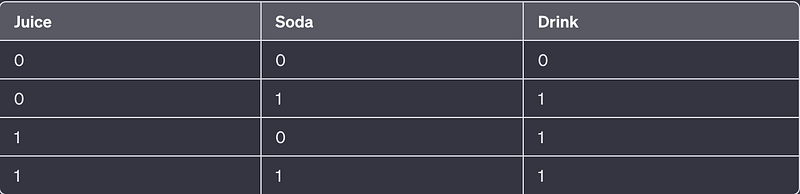
OR Operation (Disjunction):
- Scenario: Making a drink with either juice or soda.
- Result: The drink is made if at least one of juice or soda is present.
NOT Operation (Negation):
- Analogy: Making a dish without onions.
- Result: The dish is made without onions if they are not present.

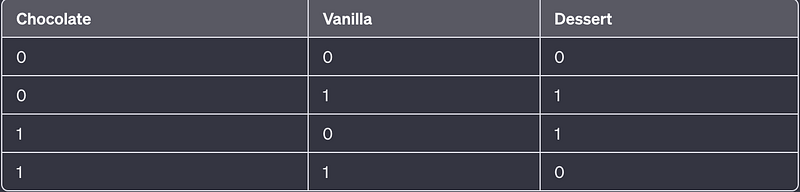
XOR Operation (Exclusive OR):
- Analogy: Making a dessert with either chocolate or vanilla, but not both.
- Result: The dessert is made if only one of chocolate or vanilla is present.
Remember, boolean functions can take on more than two inputs and produce a single output when a logical operation is performed on the inputs.
Let’s say you’re cooking and you want to decide whether to prepare a special dish based on the availability of three key nutrients: A (Protein), B (Carbohydrates), and C (Vitamins). The Boolean function F (A, B, C) will determine whether the dish is prepared, and it uses the OR operation:
F(A, B, C) = A + B + C
In this scenario, the dish is prepared if at least one of the key nutrients is available. Here’s the truth table:
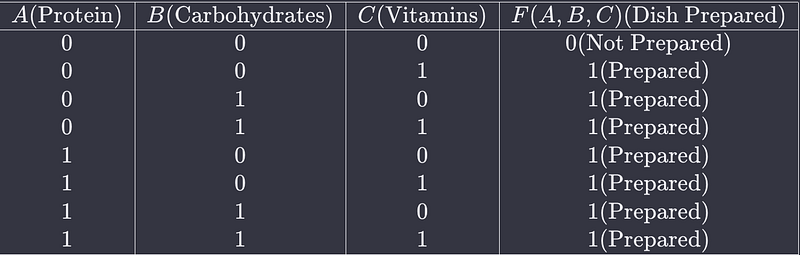
Why don’t you apply the other logical operations on this three-input Boolean function to test your understanding.
I believe at this point you could hazard a guess for why Boolean functions play a central role in hardware architectures. If not, let’s try to understand what hardware architectures are.
Hardware architectures
Hardware architectures refer to the organization and design of the physical components and structures that make up a computer or electronic system. It encompasses the layout and interconnections of various hardware components, such as the central processing unit (CPU), memory, input/output devices, and other peripherals.
There are components to the hardware architecture. I like to use the human anatomy to explain the components:
Instruction Set Architecture (ISA): Think of the ISA as the human language. It’s the set of instructions or commands that our body (the computer) understands. Just like people may speak different languages, computers with different ISAs may “speak” different instruction sets.
Processor Architecture: The processor is like the human brain. It processes information and controls the overall operation of the system. Just as the brain has different regions responsible for specific functions, a processor has components like the arithmetic logic unit (ALU) and control unit that perform specific tasks.
Memory Architecture: Imagine the memory architecture as the human memory system. We have short-term memory (RAM) for quick access to recent information and long-term memory (storage) for more permanent storage. The organization of this memory system affects how efficiently information is retrieved and stored.
System Bus Architecture: The system bus is like the circulatory system, transporting information between different parts of the body (components of the computer). It’s the highway that allows data to flow between the processor, memory, and peripherals.
Input/Output Architecture: Input and output devices are like our sensory and motor functions. They allow the computer to interact with the external environment, just as our senses (input) allow us to perceive the world, and our muscles (output) allow us to act upon it.
Peripheral Architecture: Peripherals are like our organs — specialized components with specific functions. A graphics card (GPU) is like the eyes, handling visual information, while a network interface card (NIC) is like the ears, facilitating communication.
Parallel Architecture: This is akin to having multiple limbs or organs working together in parallel. Just as we can perform multiple tasks simultaneously with different body parts, parallel architecture allows a computer to handle multiple processes at the same time.
Network Architecture: In a networked environment, computers are connected like individuals communicating within a society. The network architecture is like the infrastructure that enables this communication, such as roads or the internet.
These components collectively form the fundamental elements of the von Neumann architecture, a concept proposed by mathematician and physicist John von Neumann in the 1940s.
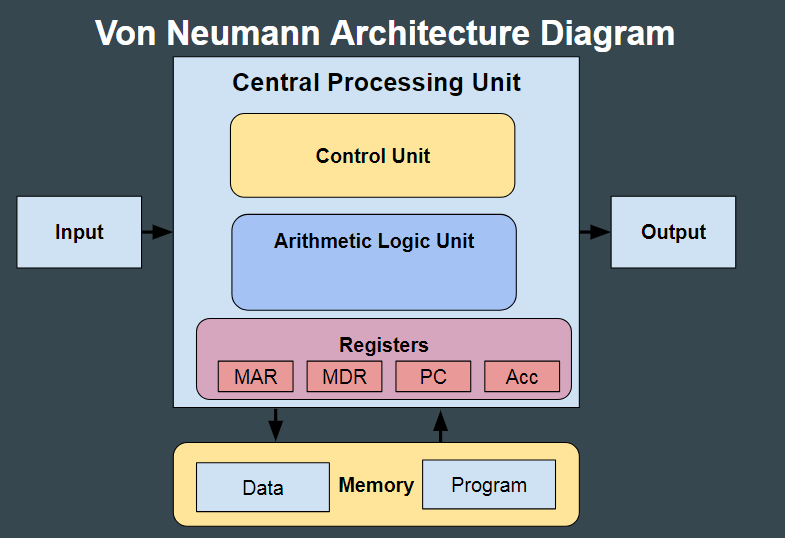
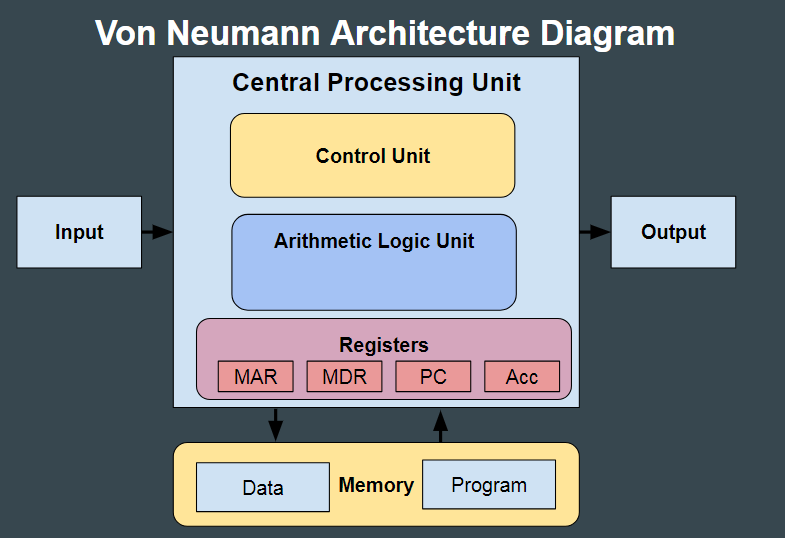
At this juncture, we can segue into exploring why Boolean functions play a central role in hardware architectures. To make it fun, let’s use gardening to explain why Boolean functions are crucial in hardware architectures:
Imagine you have a digital garden where you can plant flowers, fruits, and veggies, but there are special rules for how these plants grow and interact. These are some of the reasons why Boolean functions play such a critical role in the digital architecture of your garden:
Digital Nature of Gardening:
In your garden, plants can either be present or not present, just like the 0s and 1s in the digital world of computers. Boolean functions are like the gardening rules that help you decide which plants to plant and where.
Logical Garden Design:
Boolean functions are like instructions for your garden design. For example, you might have a rule that says, “Plant sunflowers AND roses together.” This is similar to the logical AND operation. Another rule might say, “Plant either tomatoes OR strawberries in this spot.” This is like the logical OR operation.
Garden Planning with Boolean Logic:
Let’s say you want a garden that has both colourful flowers (A) and tasty fruits (B). Using Boolean functions, you might decide to plant flowers AND fruits in certain areas, creating a beautiful and fruitful garden. The logical rules help you plan and organize the garden just like Boolean functions help organize information in a computer.
Gardening Tools as Logic Gates:
Now, imagine your gardening tools are like logic gates. A shovel might represent an AND gate, planting only when you have both flowers and fruits. A watering can might represent an OR gate, watering the area if either flowers or fruits are present. These tools, guided by Boolean rules, help you create a well-organized and efficient garden, just like logic gates in hardware architectures.
Reliability and Predictability:
Following the gardening rules ensures that your garden grows the way you want. Similarly, in hardware architectures, using Boolean functions helps engineers create reliable and predictable systems. This means that just as you can expect certain flowers and fruits in specific areas of your garden, computer systems behave predictably based on the logical rules they follow.
So, just like your magical garden needs rules to grow and flourish, computer systems use Boolean functions to make logical decisions, organize information, and create reliable and efficient architectures.
I’m excited to share that I have a newsletter focused on all things tech, and I’d love for you to be a part of it!
🌐Nana’s Substack
✨Why subscribe?
Explore the latest in AI, blockchain, cybersecurity, and more. Stay updated on the tech trends shaping our world. It’s your backstage pass to the future of innovation!
🚀Start for FREE! I understand that everyone loves a good deal, so worry not! You can start your tech journey with us absolutely FREE. No strings attached.
👉Subscribe here: https://nanakwameowusuafriyie.substack.com/subscribe
Your support means the world to me, and I can’t wait to embark on this tech adventure together. Feel free to reach out if you have any questions or suggestions!