
Why Discomfort is Vital for Fulfillment
Lessons from a Canoe Trip
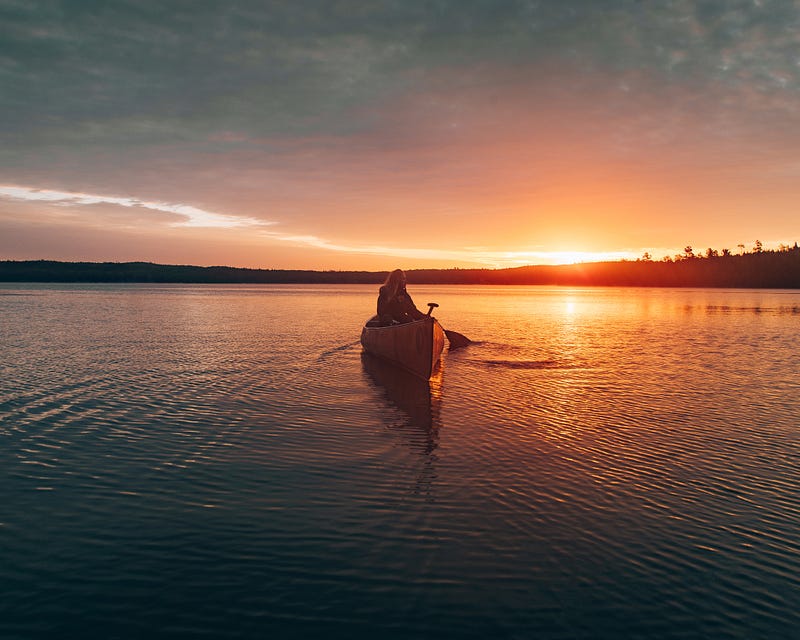
M y schedule was completely thrown off. On the early morning drive up to Algonquin Provincial Park for my first ever solo canoe trip, I witnessed an accident in Orangeville (which set me back by an hour and a half), and then failed to take into account how difficult it would be to strap a rental canoe to the top of the car by myself. Finally, I managed to get on the water at noon. Now I was in my bliss.
Until I hit the first portage.
Having never solo tripped before, I figured that it would be smart to pick a route that I was familiar with; however, I neglected to take into consideration how much weight I was carrying alone and how many portages there were along the way. So I was faced with an average of three portages per day (one of which was nearly 3 km long) and I had to carry all my food, the canoe, and all the gear (including a three-person tent because I don’t have a smaller one and I didn’t even think to rent a one-person). And, being the hard-headed determined just-get-through-it person that I am, I needed to do it all in one go — no doubling back for more gear a second time.
All of this was quite short-slighted. And I don’t regret that I made such a foolhardy decision.
After the four days in the interior were up, I dropped the canoe rental off and called my wife to confirm that I hadn’t been eaten by a bear or trampled by a moose (the latter nearly happened, but I didn’t mention that).
“How was it?”
After a moment’s pause: “Definitely not a vacation.”
I have been canoe tripping for over nine years and I will never tire of it. Something keeps pulling me back every year; something beyond the beauty of the landscape, the sound of the paddle dipping into the mirror of the lake, the smell of the leaf-sweetened air, the haunting call of the loon, and the absence of other people. The more I struggle on a trip, the clearer I remember it and the more I feel the pull to jump back in and do it all again.
If backcountry camping has taught me one thing, it’s that discomfort not only yields lasting rewards, but that it is absolutely essential for a fulfilling life.
Discomfort is natural.
As much as you strive for comfort and security, nature has other plans — not just for you, but for all living things. How many mosquitoes have you killed in your life? How many spider webs destroyed on a morning’s walk? Yet they did not have anything against you; they were simply trying to live, to find their own comforts. The natural world doesn’t care, or it would make spider webs unbreakable and mosquitoes indestructible (thank God neither are true!)
No, nature asks far more of all living things, including us: that we look after ourselves and find our place in the natural world. To do that requires agency of our bodies and minds, and the willingness to stretch ourselves beyond what we know.
On our last trip, my wife and I witnessed a red squirrel attempt to swim from the island campsite we were on to another island right next to us. It was more suspenseful than a masterfully-crafted thriller, for at any moment the squirrel could have become dinner for a snapping turtle or large fish. We watched, transfixed.
How come you resist taking the plunge, venture beyond your own canopy? And often the stakes are far lower than they were for that squirrel. What other islands are you missing? How many other rewards are waiting just outside your grasp?
It is when you dare to plunge into unknown territory that you find fulfillment and carve your place in the natural world.
Discomfort helps you grow.
There are two kinds of backcountry campers: trippers and trekkers. The tripper will enter into the park by the same access point each time, perhaps aim for the familiar campsites along their well-known route. They will rarely travel more than 15 km per day, taking time to breathe in the scenery around them.
Trekkers, on the other hand, live to cover ground and explore. They won’t think twice about travelling 20 km+ per day and taking on long portages with gusto. They will always push to explore new routes and resist staying on familiar campsites.
I fall into the trekker category if left to my own devices. For the last few years, however, my wife and I have gone on trips with shorter travel times each day, so I have been challenged to find fulfillment not through how much ground I cover, but by staying on the same site for most of the day and allowing it to become familiar territory, a home to return to on later trips.
Likewise, it would be asking a lot to push someone who is used to remaining at the same campsite for multiple nights to get up at the crack of dawn, canoe and portage for 22 km straight (barely stopping for lunch), and then set up their camp all over again after having done 6–8 hours of hard travel.
Both of those experiences are uncomfortable if you are used to the other and both provide opportunity to give yourself a new experience. But, if you can do that every once in awhile, all the other areas of the your life where you may not be pushing yourself quickly become apparent.
Challenge yourself to step onto the path less traveled and you will find rewards, like campsites, that you can return to time and time again.
Discomfort helps you weather the storm.
A few years back, my wife and I embarked on the longest and most grueling experience of our lives: a nine-day canoe trip deep into Algonquin Provincial Park’s interior. In addition to spending over a week away from all contact with other people, we hadn’t truly taking into consideration the distances that we had mapped for ourselves each day (or realized that one portage en-route was an uphill battle that lasted over a kilometre , giving it the name “Heartbreak Hill”).
We were also completely unaware that we had picked a fluke rainy week in August where the temperature would dropped to as low as 6°C each night. Or that the rain would last for seven days straight.
We had no proper rain gear, we were not prepared; however, it didn’t occur to us at any point in the trip to turn back. Even when I was hurriedly trying to cook dinner in the cold torrent (and, in all likelihood, verging dangerously close to hypothermia), there was nowhere else I would have rather been. Something about weathering the ordeal felt human, like I was playing my part — not just in my life, but within the natural order of things.
We couldn’t afford to remain miles away from civilization in the rain — we had to keep moving to make it out the other side. As much as we’d like to think otherwise, we aren’t meant to be comfortable all the time because comfort doesn’t push us forward.
You need experiences that throw you into deep water once in awhile so that you remember how to swim, for storms approach whether you like it or not (COVID-19) and if you haven’t conditioned yourself to take them as the growth opportunity that they are, then you’ll sink.
Don’t let a little rain weigh you down; don’t let a lot of rain drown you. Drink in the tempest and flourish.
Discomfort instills empathy.
On that nine-day trip, there was a section of creek where we had a choice: we could take one route and deal with the water becoming too shallow to get through, or we could take another section and contend with fallen trees and having to maneuver around them. We weren’t keen on the idea of wading through mud, so we opted for the trees.
After hauling all our gear and the canoe over the sixth tree of the day (they were lying directly across the creek), my wife just sat in the canoe and cried. Then I joined her — how could I not? I was in the ordeal with her. And, simply by sitting in the misery together, we were able to comfort one another an carry on.
While there are times you wish that you didn’t have to go through something — that you would trade places with anyone else in the moment — resist that way of thinking and take the experience in. Don’t short-change yourself by throwing your hands in the air, saying, “Nope, this isn’t for me,” because you maybe be able to help someone else work through the exact same experience down the line. Don’t deprive yourself of that gift; you’ll have the wisdom to help them because you experienced it yourself. Discomfort will connect you and bring you closer to others, if you let it.
We are not shaped by comfortable situations: like iron, we are forged in fire (and sometimes in water). As the intensity heats up, as we are pounded on all sides, we are rearranged, we are molded. And we come out more resilient than ever before.
Like that squirrel swimming for the island, we just need to keep our eyes forwards and continue steadily one, driving towards new territory, new rewards, new life.
And that squirrel? He made it.


