Why Did the Bitcoin ETF Approval Not Immediately Impact Price?
God candle? Mass sell off? We were all wrong. So, what’s next?

Since I’d written so many articles on this subject previously, there is, of course, no point denying that I was predicting an immediate jump in Bitcoin on news of the spot ETF approval on January 10th 2024. It’s well documented.
Why? Because, well, it was obvious.
Duh.
Think about it: twice we’d had a false start, first with an announcement by Cointelegraph back in October and then a message on the official SEC twitter feed, allegedly from a hacker.
On both occasions, the market instantly moved upwards until the announcements were proven to be false, when an immediate reversal inevitably followed. Two dry runs? You don’t get a better indicator than that.
However, in the days immediately leading up to the announcement, there had been a growing number of voices predicting a Bitcoin price dump, something that I was personally unable to get behind. Yes, there was the traditional “buy the rumour, sell the news” argument, but I felt the maths of the matter would outweigh the sentiment.
In fact, in the last major Twitter spaces that I attended as a speaker before the ETF announcement was the Crypto Town Hall with Wolf of all Streets (Scott Melker), Ran Neuner and Mario Nawfal. In that spaces too, the consensus was that price would drop on approval. I still wasn’t convinced. In my mind, even these ‘big names’ were also completely wrong.
Except, of course, when the announcement was actually made — for the third time — nothing at all happened.
Bitcoin just traded sideways and completely ignored the thousands of people, companies and organisations looking at it.
What happened?
A false start
Part of this had to be the fact that there had been two false starts already in my view.
Those people who had sent the price instantly upwards on two occasions only to be wiped out immediately had reacted on gut instinct and paid the price.
In fact, the second announcement wiped out many millions of dollars of leveraged trades both ways as the price first jumped and then dropped just as quickly, creating one of the neatest 30 minute Darth Maul candles I have ever seen.
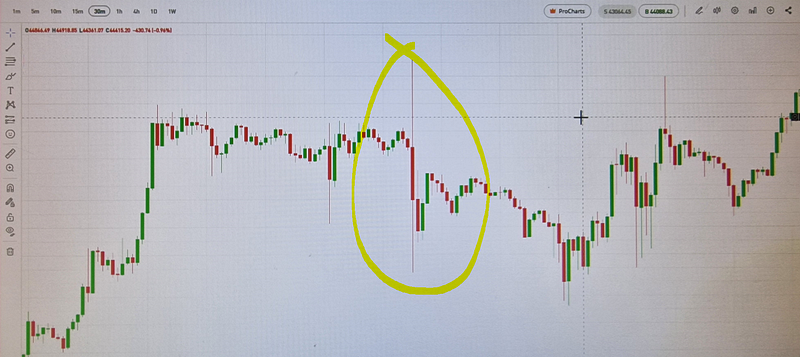
There simply has to be a case to argue where traders were not going to trust a single source of information again, even if it came from the SEC, since that source had also been previously compromised.
In fact, even the moment of the announcement was farcical, with the official statement on the website being either removed or deleted before being replaced for a second time, shedding further doubt as to whether this was actually real or yet another hack.
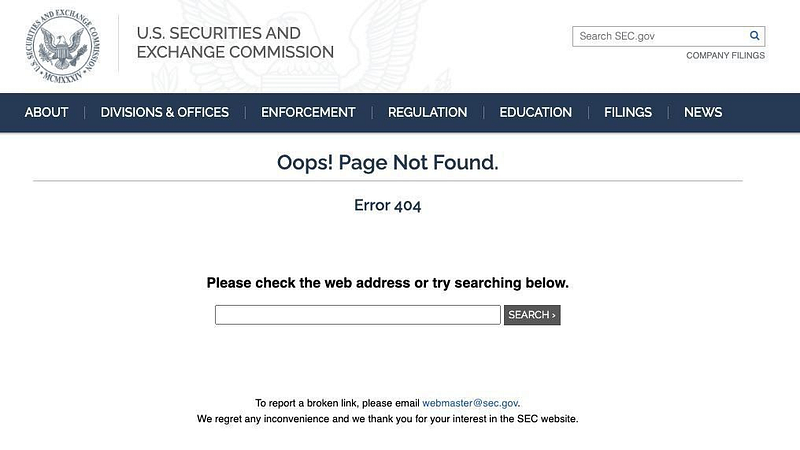
In the end, the whole thing was such a mess that by the time traders started to accept that this was real, it was a gradual, rather than sudden process.
Combine this with the fact that many traders had already been fooled twice — and burned — I think it’s quite likely many would-be traders then adopted a ‘wait and see’ approach to let everyone else make the first move. Which was exactly what everyone else appeared to do as well.
The result?
A muted response that entirely killed off any prospect of a momentum driven speculative “God Candle” upwards. And once that momentum gets going, just like when you're pushing a car, it can be tough to stop it once it’s in motion, especially with the expectation and euphoria lurking in the background.
But, like pushing that car, if you don’t get enough momentum to start with, it doesn't go anywhere.
In the end, the whole thing was a damp squib — especially when compared to the expectations set— and the market had no real direction. Yes, there was a short term price increase on day one, but this was reversed entirely by the end of the day and Bitcoin has simply, and stubbornly, traded sideways since.
Of course, we’re only really talking about speculative trading activity here, not those who HODL or DCA (since they would have, and almost certainly did, carry on as usual anyway) and not those, like myself, who consider Bitcoin something you invest in for the very long term and will be entirely unmoved by what happens either way.
But interestingly, this also does not include ETF trading activity.
Which may surprise a few people.
ETF seeding — what happened?
The eleven fund issuers were probably fairly certain that the ETF decision was going to happen and this seemed evident from the money spent on TV advertising even before the decision was announced, but also general activity behind the scenes.
Most of the issuers had also announced they were ‘seeding’ their funds with varying amounts of money, but actually getting a clear definition of what that meant in practical terms was not as easy as it seems it should be.
I’m not an ETF mechanics expert (and I now strongly suspect that few others actually are either!) but I took this to mean that Bitcoin would be purchased on the open market ready to satisfy expected demand in the amounts specified.
Therefore, quite obviously, one would expect a significant increase in price as this was carried out and large swathes of Bitcoin was required.
Except that didn’t happen at all.
However, this isn’t exactly right and I went searching for the answers via several articles and, in my view, the best of these is a piece by Dave Abner on LinkedIn entitled “Spot BTC ETF seed misconceptions” which includes the following line:
Large seed investments usually indicate some sort of institutional investor. Many large BTC investors already have BTC investments, and if they show up as a seeder to a Spot BTC ETF they are probably just moving assets from one wrapper to another.
I’d strongly recommend reading the whole piece for proper context and a solid detailed summary, but the bottom line is that it doesn't work how I initially believed thought it did. I think the same also applies to most people.
There was simply never going to be that impact.
ETF trading — why is there no impact on price so far?
When the markets opened on the morning of Thursday 11th January 2024, money started to change hands rapidly as all the preparatory work had been done.
According to Eric Balchunas, Bloomberg analyst specialising in ETFs, this was “easily the biggest day one splash in ETF history” with over $4.6billion traded in the first session.
However, it wasn’t all plain sailing.
It was clear that some of the big names in the industry were not going to allow their clients to buy the Bitcoin ETF even if the SEC said they could, including Citi, UBS, Merrill Lynch and Vanguard.
Most of these have mumbled some vague recycled nonsense about not ‘aligning with their company values’ and Vanguard in particular have received the full wrath (and ridicule) of Bitcoin Twitter.
This is almost certainly due to the fact that despite their ‘company values’ Vanguard are also one of the largest holders of Microstrategy stock (over 8%) which is, of course, a Bitcoin proxy investment due its large holdings of the asset class.
These companies are obviously not contributing to inflows, but I suspect they will cave to pressure eventually as it is clear that a significant number of clients, especially those of Vanguard, have already closed their accounts in protest. It really is a daft business decision and one that will almost certainly hurt them in the bottom line.
Even the companies that had prepared and were ready to go are not yet operating at full capacity. It will likely take weeks — or longer — to get there.
But all of this is incidental. What really matters is the numbers and this is where we may get some insight into the real picture.
You can see the numbers from day one here, courtesy of this rather clunky, but informative, spreadsheet snippet:
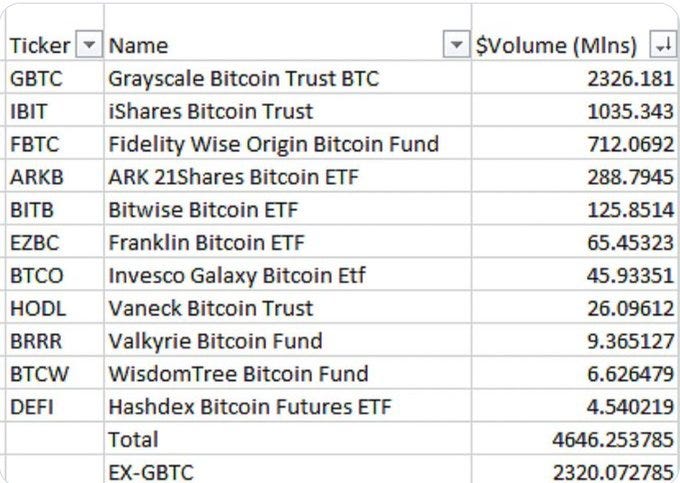
There are two things that stand out here.
First, Grayscale has seen a huge outflow of Bitcoin from long term holders who are now able to move it away from Grayscale’s very high ETF fees, which account for $2.3bn in rotation of that $4.6bn.
Second, even accounting for this, it still means that there was net inflow of around $2.3bn.
We all know the multipliers in effect when dollar inflows find their way into the Bitcoin asset class, so where did it go?
ETF’s in action — the practical impact
This is where it gets interesting.
ETFs are traded in market hours only. At the end of the day, the trades are settled and the Bitcoin is bought or sold according to the net order book position.
In fact, this is done on a T+2 basis which means “Trade Plus two days”. In theory, if not in practice, Thursday’s trades will not be settled until Monday. Except that in America, Monday is Martin Luther King Day and the markets are closed, which bumps us to Tuesday.
In fact, if you want to get really technical, these trades could not be 100% finalized for up to 30 days, although my understanding is that is very much the exception and not the rule.
Add to this that orders are settled via OTC desks and you get both a lag and opaque effect on both the data itself and at what stage those orders are, or when they’re likely to be reflected in the broader markets.
This almost certainly means that those inflows are not adequately reflected yet, or may be settled over time, but we can also be certain that as the weeks and months progress there will be momentum with whatever timescale is used. Since we’re only hours in, in trading terms, we can’t read anything definitive on what we have so far.
It’s also a pretty complex process under the hood which introduces more variables and process that lay people like me may have been unaware of.
Preston Pysh covers the process beautifully in this tweet from January 10th 2024, although he supposes that the settlement cycle may actually be T+1:
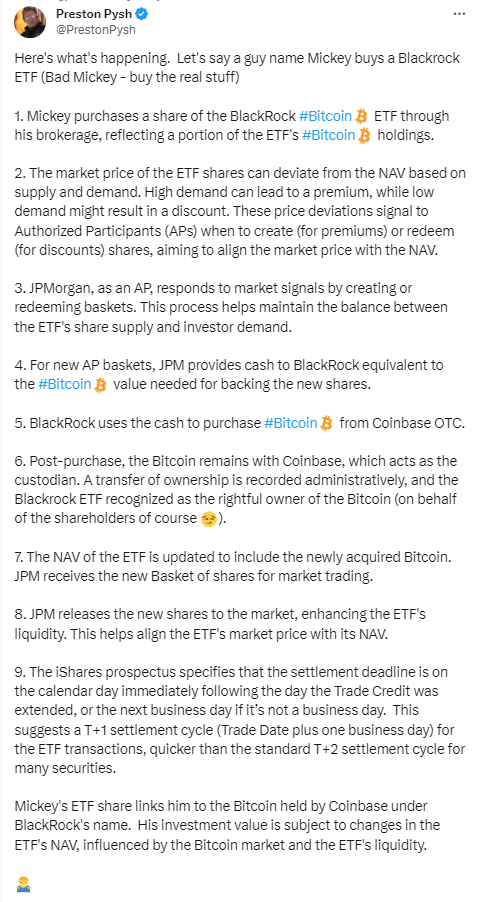
Got that? Good.
However, we need to step back a minute and look at the bigger picture.
The ‘Big Picture’ and what’s next
We’ve experienced a millisecond of trading in the grand scheme of things and expected God Candle or total sell off. We got neither.
However, if we take the time to step back, this becomes entirely irrelevant.
We already know where this is going.
We know there will be significant inflow over time and we also know that the rotation form existing money exposed to Bitcoin proxies or Grayscale’s fund will eventually be superseded by entirely new money as sales activities run into overdrive.
And we know this because these huge companies are serious about taking their money on fees. They absolutely will not let it rest.
At the same time, we have, at best, around 1.8 million Bitcoin on exchanges, a number that will rapidly decrease as demand ramps up.
To cap it all, new supply drops by half in less than 100 days, meaning that new Bitcoin coming to the market — assuming it makes it that far — drops from 900 a day to 450.
And we haven't talked about sovereign adoption, the new FASB accounting rules making it easier for companies to hold Bitcoin directly and a myriad other developments in the pipeline on a global scale.
You simply don’t need to try and second guess what the numbers in each of these categories might be in dollar terms. It only matters what market mechanics and the rules of economics say.
In short, demand is almost certainly going to outstrip supply.
The ETFs have simply made this process quicker, easier and more certain than ever before at a time supply will be noticeably — and permanently — reduced.
So don't be concerned by lacklustre sideways trading in the short term, if, indeed, you even are.
It simply isn’t sustainable.
Update 19/1/24 — This article was written with the first 48 hours of ETF launch. Since then it has become much clearer what’s driving pricing activity as the initial euphoria has settled down — a balance of Grayscale outflows vs new money inflows. I’ll continue observing this and will add a new article later on!