Why Did Some People Call Antoni Gaudi God’s Architect?
We went to Barcelona to find out.
Towards the end of the 19th century a movement in art, music and literature spread around the world generally called Art Nouveau. Some people called it modernist. In Barcelona it was called modernisme and the leader was a young architect named Antoni Gaudi.
In 1883 at the age of 31 Gaudi took over the design of a new church in the city’s Eixample district dedicated to the Holy Family. Something clicked in him and the dapper Gaudi with strong interests in fashion and fancy restaurants suddenly became an ascetic with one burning desire: to create the best work possible for his God.
Gaudi worked at a snail’s pace for the next 31 years. Sometimes there would be no noticeable development in the church’s construction for months. Sometimes years. All along Gaudi would also work on other projects, mostly for his patron, Count Eusebi Güell. Gaudi designed Güell’s Barcelona residence and also several other buildings around Barcelona for Güell’s friends.
On our walk down Passeig de Gracia in the Eixample district we admired a few of Gaudi’s modernisme creations, including Casa Mila.
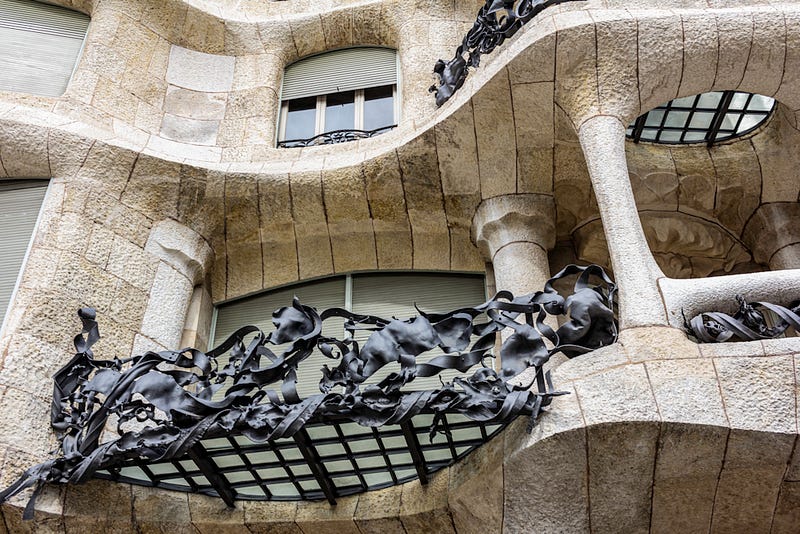
Gaudi did not like right angles. And he seldom drew straight lines. Also, many of his buildings featured wrought iron balconies. Gaudi’s father was a blacksmith, and he was proud of continuing this tradition.
Güell commissioned Gaudi to design a chapel for his textile factory workers in Santa Coloma de Cervello, about 20 km west of Barcelona. True to form, Gaudi spent eight years puttering around and his four-story chapel never got beyond the crypt. What was to be the first floor of his chapel is now the roof of the unfinished chapel that is often referred to as Gaudi’s Crypt. It is also sometimes called the Church at Colonia Güell. We visited the crypt on our way to Montserrat one day.
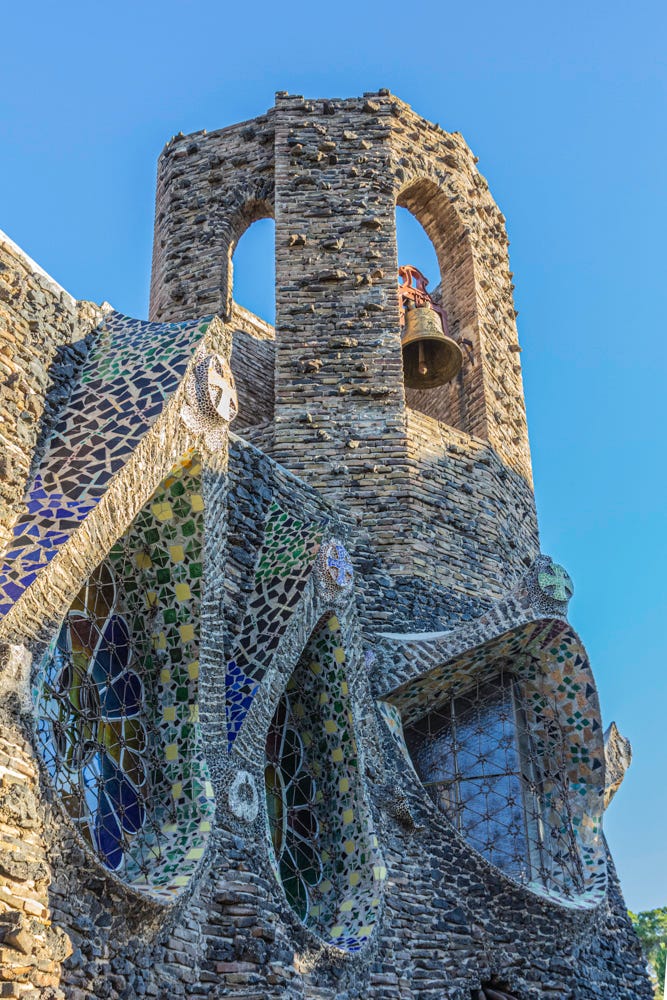
Gaudi basically used Güell’s chapel project as a laboratory for the developing of materials and geometric structures that he envisioned he could use in the future building of La Sagrada Familia. One integral portion of Gaudi’s art was his use of pieces of glass and tile to cover his structures with mosaics. He even hired people to break wine bottles and ceramic dishware to produce his mosaics. He called this technique trencadis after the Catalan word for “broken.”
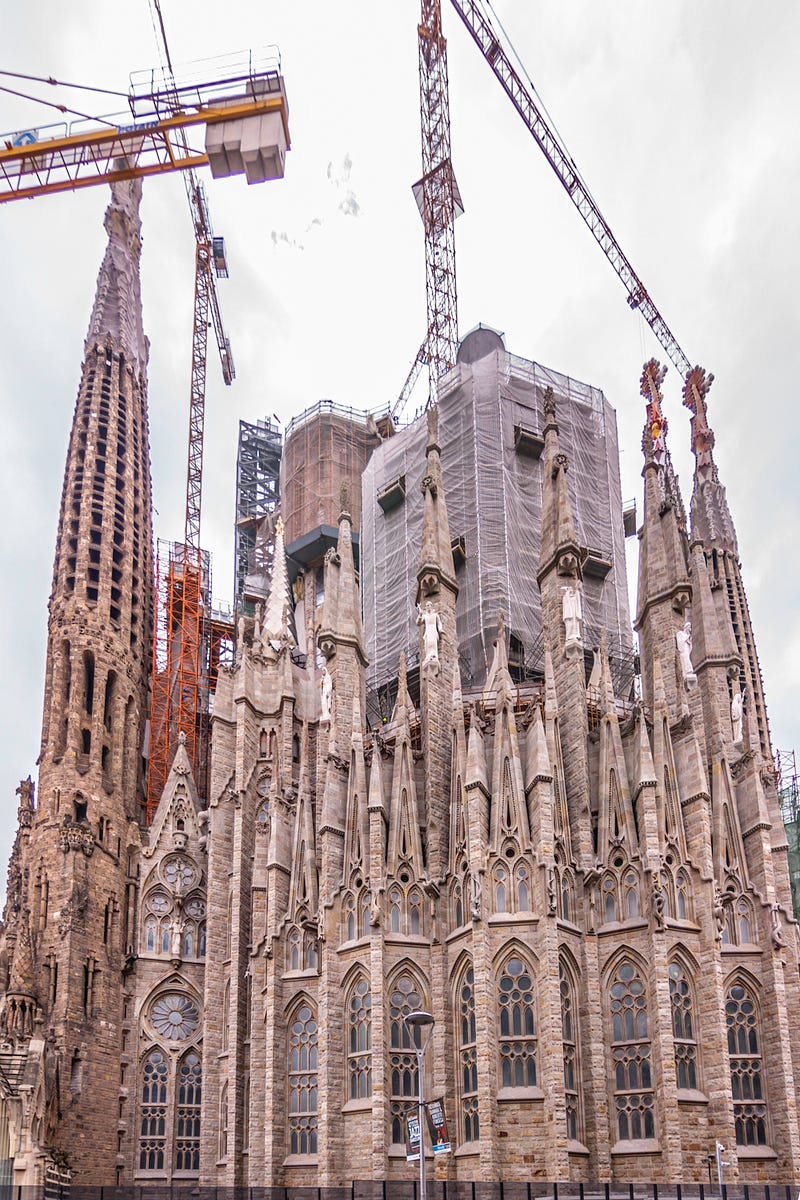
In 1914 Güell’s family shut down Gaudi’s project and he then spent every single day for the rest of his life building his masterpiece. By the time he died in 1926 La Sagrada Familia was about 15% complete. It was 70% complete by October 2015. The estimate then was that the church would be completed by 2026, the hundredth anniversary of Gaudi’s death.
It now looks like the church will not be completed until at least 2030. Gaudi’s design called for 18 towers. There were only eight towers when we visited in 2015. The project was shut down for several months in 2020 during the Covid-19 epidemic. And most of 2021 was spent constructing the Tower of the Blessed Virgin. In December of last year, a huge star was placed on top of that tower.
Gaudi also called for three facades, each with its own entrance to the church. The main facade, with a Nativity theme, was finished before Gaudi died. The west facade, with a Passion theme, looked to be about 90% complete when we visited in 2015. There is still a lot of work to be done until the third facade, with a Gloria theme, is completed.
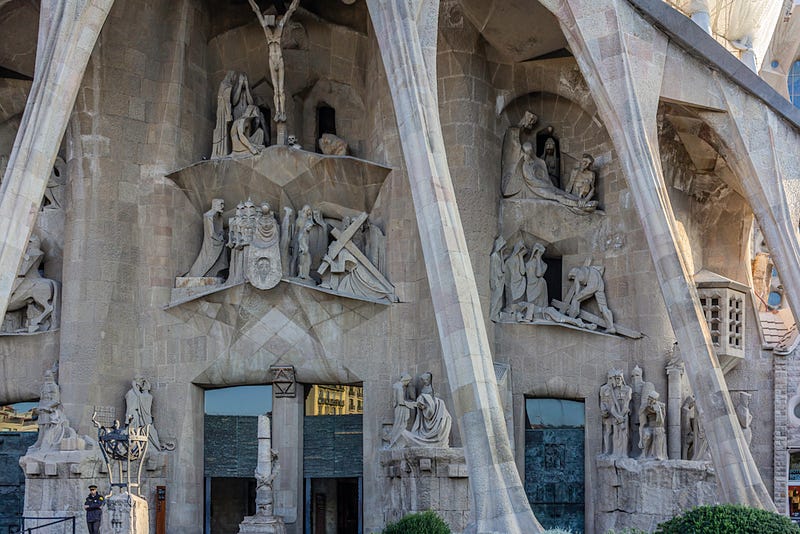
By 2010 the development of the church’s interior was far enough along to allow the Pope to come to Barcelona and dedicate the church as a minor basilica. The official name is now the Basilica i Temple Expiatori de la Sagrada Familia (Catalan) or Basilica de la Sagrada Familia (Spanish) or Basilica of the Holy Family (English). More than 7,000 people including a choir of about 800 attended the Pope’s Mass.
Most of Gaudi’s detailed plans for La Sagrada Familia were all in his head. He was not a very good note taker. Work then continued by his successor at his snail’s pace until one day in 1936 when some terrorists at the beginning of the Spanish Civil War set fire to Gaudi’s workshop in the church’s crypt and destroyed almost all of whatever notes Gaudi did have plus most of his models. Construction was pretty much abandoned for the rest of the Civil War and during World War II. An international consortium of architects and devotees was formed in the 1950s to take over and complete the construction based on whatever remained of Gaudi’s design.
Another reason for the slow pace was the tremendous difficulty of hand carving brick and stone to precisely fit Gaudi’s intricate geometrical designs. The parabolas that Gaudi experimented with long ago while building Güell’s chapel found their way to La Sagrada Familia. He would build models of string, measure the various angles formed when weights (Gaudi used birdshot) were applied to the string, photograph the models, and then turn the photos upside down to build his pillars and walls and ceilings. Most of this work is now computerized and stone carving is now accomplished via robotics technology.
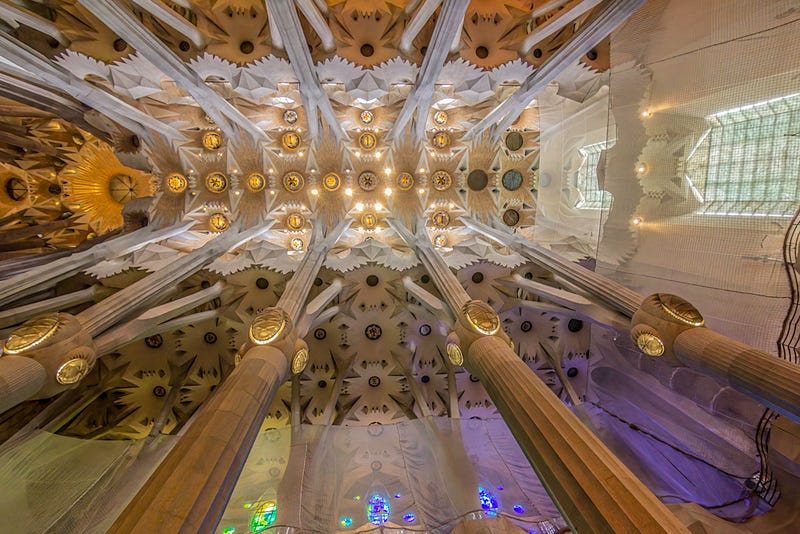
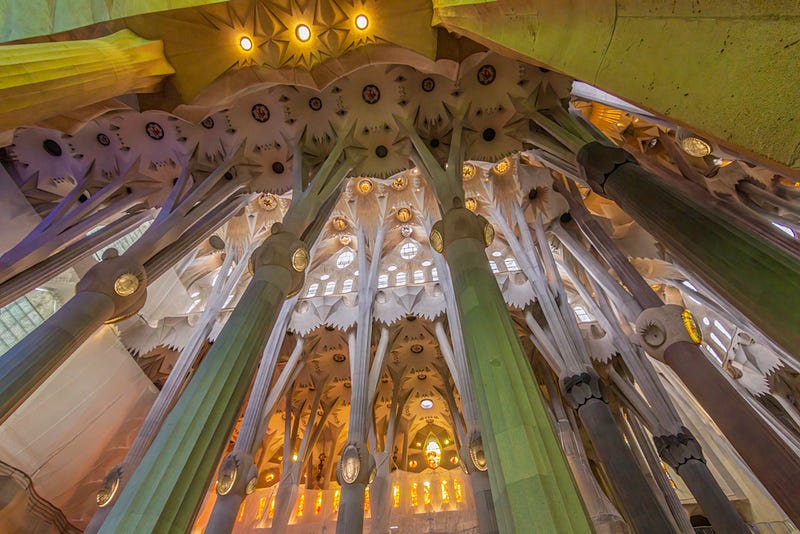
Gaudi used the basic forms of nature to build his church. The pillars are in the form of trees with branches that reach the ceiling. Even the ellipses containing lights on the pillars represent sawed-off branches. And the stained-glass windows and other light fixtures display flowery patterns.
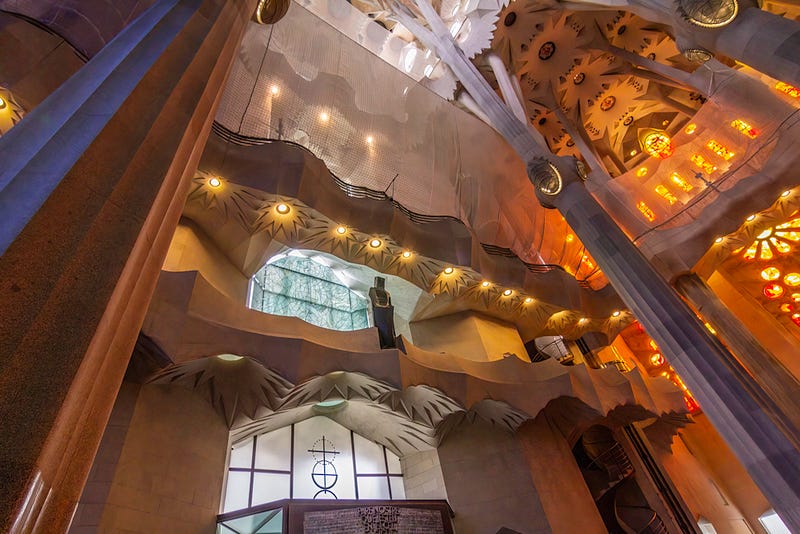
About four million people a year visit La Sagrada Familia. The ongoing construction is financed by the entrance fees they pay.
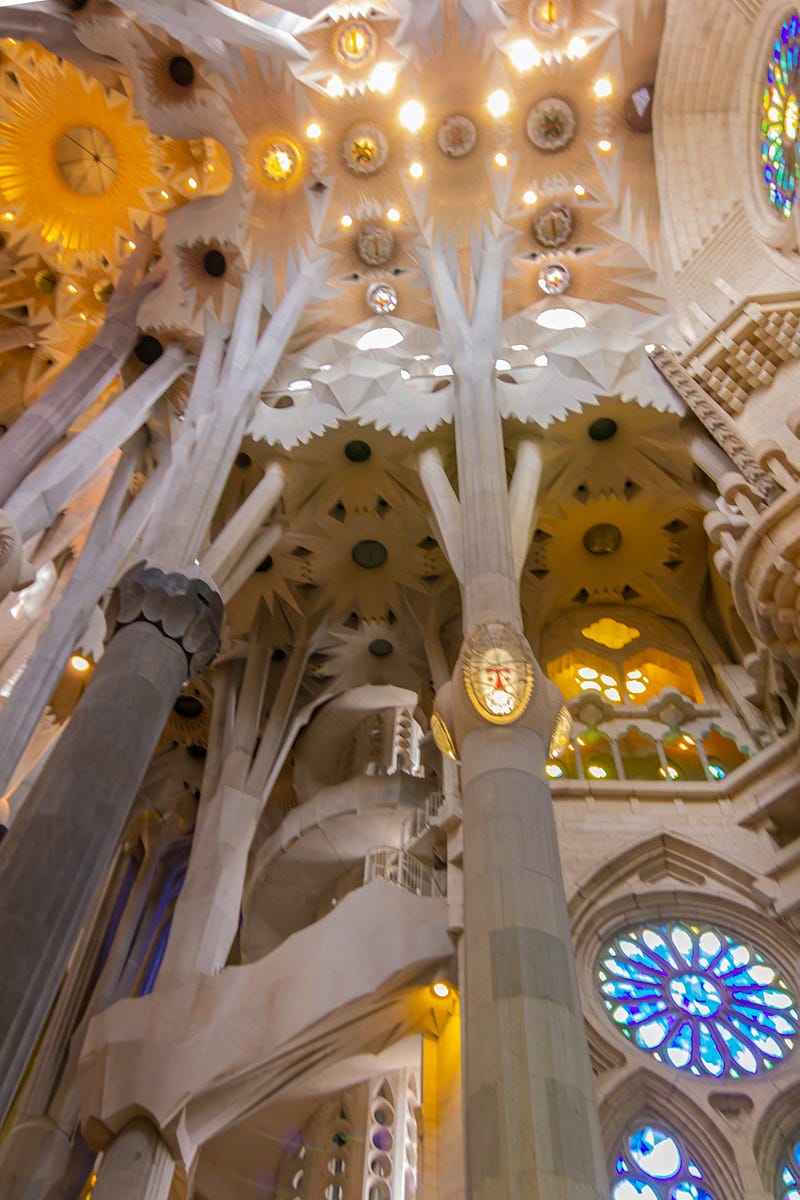
We have visited many of the great Gothic and neo-Gothic cathedrals in our European travels. I believe Gaudi was attempting to blend this centuries-old atmosphere with his modernisme ideas. The word “awesome” is greatly overused these days. I think it should be reserved for that point of time when you find yourself standing in the middle of a fantastic place and you are in awe as you gaze at the surroundings.
Why was he called God’s Architect? We found our answer during one of these awesome moments.
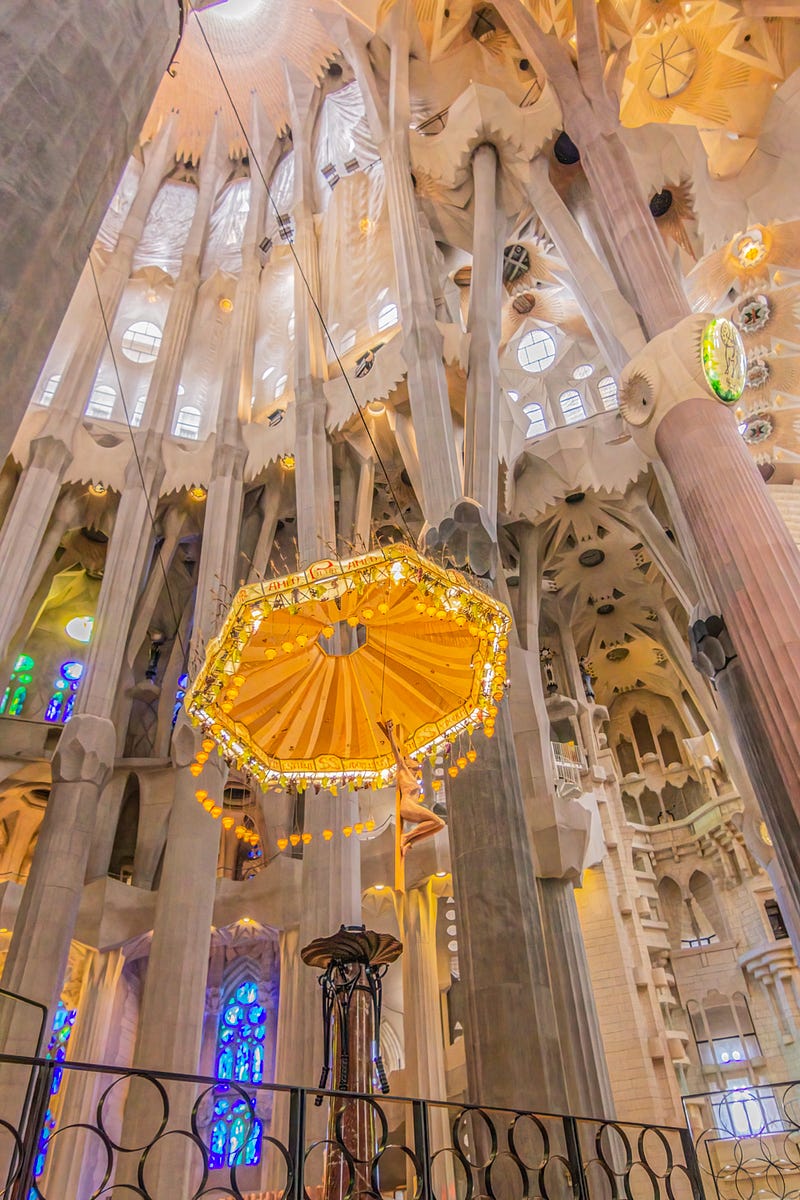
The movement for pushing Antoni Gaudi for sainthood in the Catholic Church began in the 1990s. By 2003 he was declared “Servant of God,” which is the first step to beatification. The movement has bogged down in recent years, however, because of the need for a medical miracle. Also, some negative information has surfaced regarding Gaudi’s personality and character. He apparently was often cranky and not eager to converse with anyone. Then there is the rumor that he was addicted to hallucinogenic mushrooms. We know he was a vegetarian and probably ate a lot of mushrooms, but whether they were of the hallucinogenic category, I have no idea!
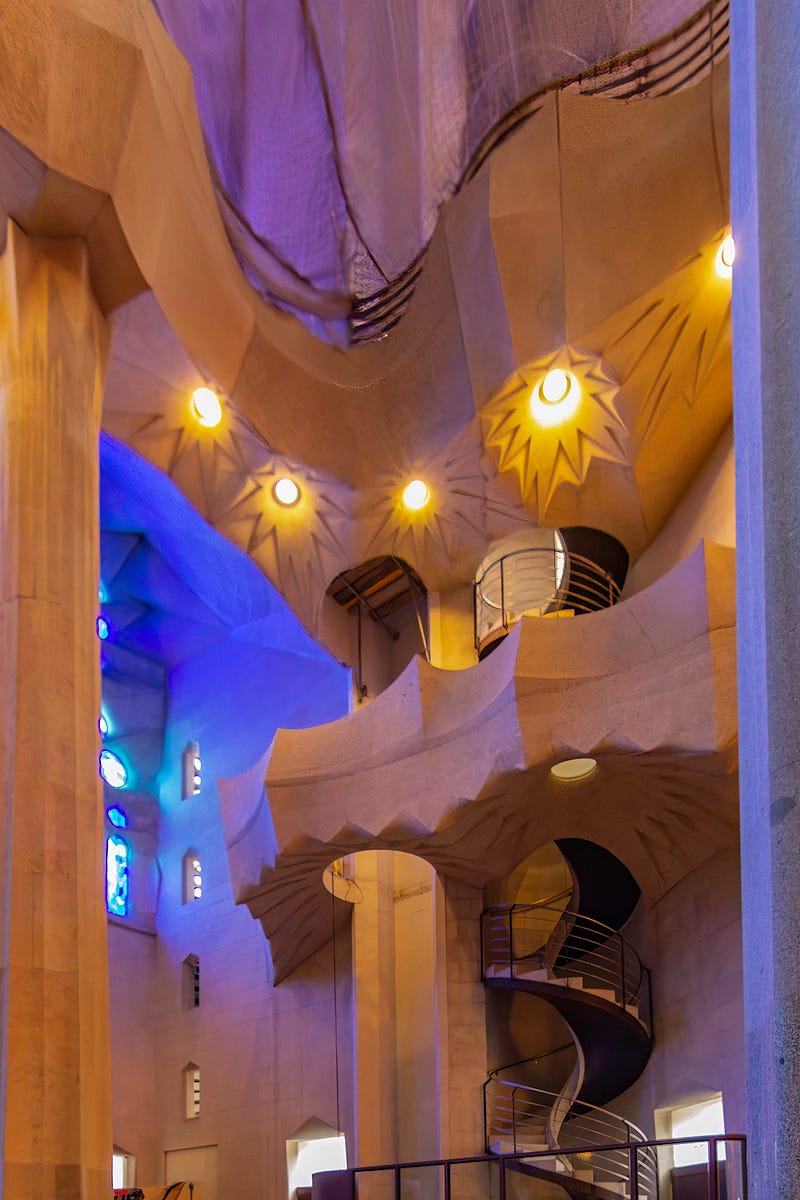
Gaudi never married and had few friends. And he outlived all of his relatives. In his later years he was known to be unkempt and wore ragged clothes. It seems he was focused on only one thing in life: the building of his church for his God. On his way to work one day in 1926 he got runover by a tram. It was thought he was a homeless tramp, and he was brought to a hospital for the poor where he died three days later.
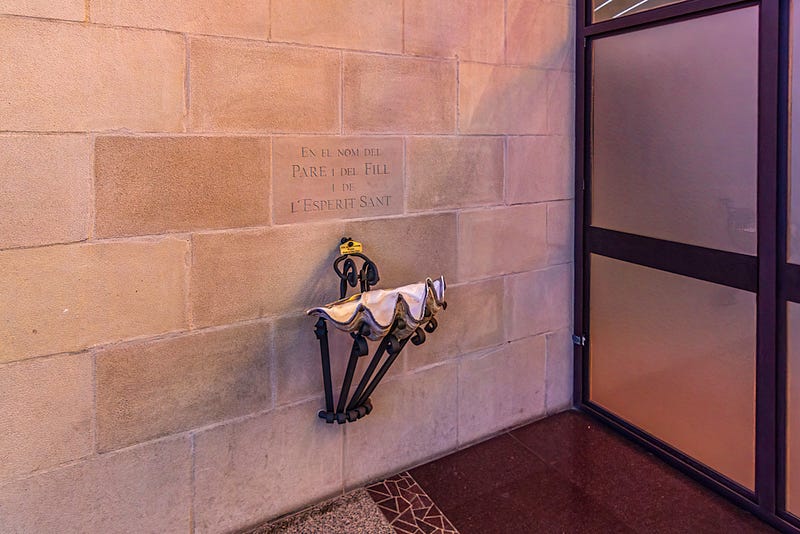
There are six giant clam shell holy water fonts in the church, all gifts from The Philippines.
When the Christ-spire, the last of Gaudi’s 18 towers is completed, La Sagrada Familia will become the tallest church in the world.
Epilog
We returned to Spain in 2017 and visited portions of the Camino Santiago de Compostela, including a three-day stay in León. One day we got to admire a building called Casa de Botines, one of three buildings designed by Gaudi outside of Catalonia. And on a bench in the small plaza in front of this building I found an old friend.
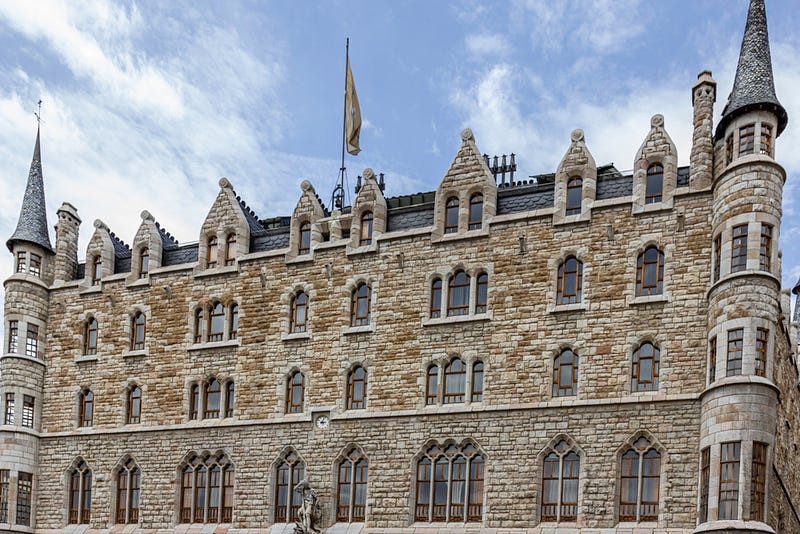
Gaudi designed this building to look like a medieval fortress. It was designed for the owner of a fabrics company who lived on the first floor. There were business offices in the basement and the rest of the building was a warehouse. The building was later sold to a bank and is now a museum dedicated to Gaudi’s architectural work and Spanish art of the 19th and 20th centuries.
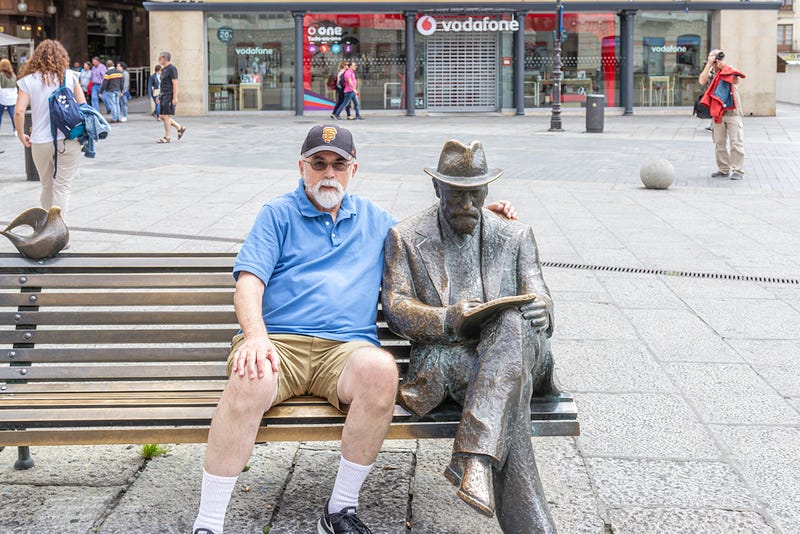
I peeked over his shoulder to see his notebook. He was drawing a picture of the building in front of him. Of course.