
Why Denali Highway is the Best Place I’ve Been
When there are no other people, it’s just you and the Creator
In contemplating my life’s travels for work and pleasure, I have been fortunate to have visited many special places on Earth. From ancient historical sites and old cities, where humans have settled for centuries, to natural wonders, where humans have visited but never settled. These places have given me beautiful memories, but there is one place I will always remember for the feeling it evoked.
It was August 1995 and my life travel partner (my wife) and I were vacationing in Alaska. I fell in love with Alaska in my college years when I came here during vacations to work in the fishing industry. The grandeur and wide-open spaces left an indelible impression on me and I wanted to show her the “great land.” The places I had worked were accessible only by plane, and so we decided to visit those parts of Alaska accessible by car.
Our trip took us from Anchorage, Alaska’s largest city, north to Denali National Park, site of North America’s highest mountain. After visiting the park, our next destination was Paxson, a small settlement located on the Richardson Highway, 150 miles (250 kilometers) east. To get there, we would drive the Denali Highway. This gravel “highway” connects Cantwell, just south of Denali National Park, on the west with Paxson on the east and crosses the southcentral part of Alaska, south of the Alaska Range.
At Cantwell, we turned left (east) onto the Denali Highway and had been driving for a while when, thanks to all the breakfast coffee, nature called and we had to find a rest area. There are some unique benefits of traveling through uninhabited areas and neverending rest areas is one of them. On a previous trip to Alaska, I had driven this 135 mile (220 kilometer) road and saw only two cars the entire stretch. I stopped the car at a higher point in the road affording an expansive view to the north, turned off the engine, and we climbed out.
Relieved of any worldly burdens, I walked across the gravel road, stepped onto the grassy slope beyond, and looked north out across the expanse. With the car at my back and the road no longer beneath my feet, there were no signs of humanity as far as my eyes could see.
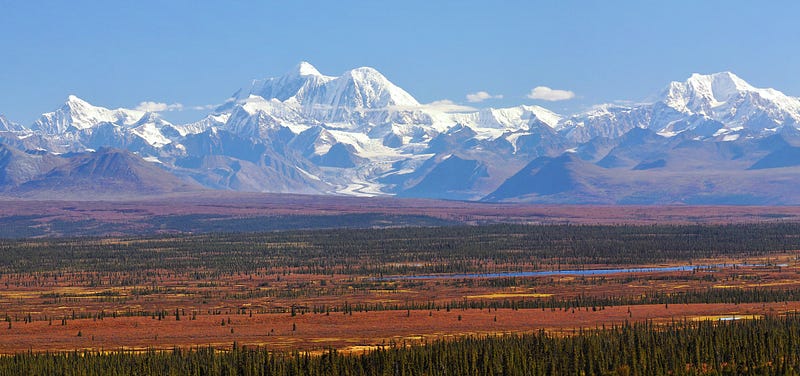
My gaze was initially drawn to the mountain range some 30 miles (50 kilometers) distant which served as the far back wall of this open space. Decorating it were snow-capped peaks of the Alaska Range as high as 13,000 feet (3900 meters). This mountain range extended so far left and right it appeared curved and seemed to envelop us.
As I reeled in my sight across the miles of landscape between us and the distant mountains, everything my eyes laid rest upon was the embodiment of perfection, both in appearance and arrangement. Grassy tundra interspersed with clusters of dark green, slender spruce trees, and dotted with occasional blue ponds, formed the decor of this spacious wilderness. The ceiling of blue skies interspersed with both thick dark and wispy light clouds created dramatic lighting while the sun warmed our backs.
We were absorbed in the view and lost track of time when some movement at a nearby pond caught our attention. Intrigued, we shifted our focus on the spot and waited, and waited some more, until a moose emerged from the brush. It stepped into the pond and swam toward us, its head above the waterline. In its wake, ripples spread out across the water surface, temporarily disturbing the otherwise tranquil pond. If ever there was a classic image of wildlife living in the wild, this was it and we were watching it live.
I grabbed the video camera (this was before digital cameras and smartphones), zoomed in as much as possible, and began filming the moose on its midday swim. The moose eventually emerged from the water closer to us and disappeared from view behind some trees. I turned off the camera and we looked at each other in silence. Years later I learned John Denver had said some words that best captured the feeling of that special moment:
It feels good to see something wild and free because we, too, want to be wild and free. We can remember that as long as there are wild places and wild things.
A visit to the Alaskan wilderness wouldn’t be complete without mosquitoes and flies. In honor of our visit, they were less abundant than usual that summer which allowed us to enjoy this vista longer. Brushing aside the notion of nuisance, I reflected on the vital role mosquitoes play in the local food chain. If we don’t appreciate them, then at least we can appreciate the fish, birds, and mammals they support further up the food chain. It’s further evidence of the miracle of nature, in this case transforming something seemingly “bad” into something “good.”
As we consumed more of this exhilarating view and digested the experience, more thoughts entered my mind — what if there are no other human beings for as far as the eyes can see? The highest mountain peaks had been ascended only 50 years ago and given names, but what about the rest of the expanse? Had a human being ever set foot there?
The implications of a place without a human footprint were intriguing but elicited an uncomfortable feeling in me, like that of an intruder. This feeling only added to the sense of smallness and insignificance I already felt standing before this vast expanse. The road that had allowed us to get here was cut across a place where humans didn’t belong. This was not our place.
A feeling of resignation started coming on and I was about to leave when something very strange happened. The image before me appeared to transform, as though taking on a new meaning. And in that moment, sheer joy followed upon realizing where we were.
We had set foot in the living room of the Creator!
If ever there was an understanding that had the power to transform physical reality into greater beauty, this was it! I quickly rescanned the landscape to validate this newfound sense of appreciation for its perfection. And indeed, the room now seemed bigger, the design more exquisite, the colors brighter, the purpose — grander.
Humans, despite all their abilities, could never have created something like this. This was a place allowed to develop through the ages without human intervention, according to the program instilled at birth in every living thing that called this home. I even hesitated to speak any more out of concern my voice might disrupt the “local residents” who were living here in harmony.
We spent a few more minutes savoring this spot and then understood it was time for us to leave. We had been touched and had received our blessing to continue our journey.
We bid this special place farewell, walked back across the road to our car, and drove away. After 45 minutes, another car passed us, heading west. We were back on Earth.
In recounting this event, I remembered visiting other natural wonders that elicited a similar sense of awe. Perhaps what made this place so memorable was the scale, remoteness, presence of wildlife and absence of humans, and the intensity of emotion.
This vista also reminded me of how our own journey on Earth is laid out — a living and fluid beginning that transitions into a dead and frozen ending where we are reduced to dust. Much the same way this living plain in the foreground transitions into lifeless mountain peaks in the distance, their tops being reduced to dust by glaciers. In both our lives and this landscape, however, there is a most fitting reward at the end — we are closest to the heavens.
Author’s note: After writing this piece, it occurred to me no place in the world is truly free from human footprints when we consider our carbon footprint. While that “footprint” is in the sky and not on the ground, it undoubtedly affects all living creatures down here on Earth, including us. We are at an interesting point in history when thinking about the climate has been replaced with talking about it. The next step is doing something about it.
Thank you, Warren Patterson, for hosting the travel publication “Globetrotters” and inviting us to write about “The Best Place I’ve Been.” Tagging A. Grace whose writing and photography bring us closer to the western United States.
Dear Reader, If you made it this far and enjoyed this story, hopefully, you will get the chance to visit Alaska one day. To read more of my stories, plus those of Medium’s top travel writers, please feel free to click my referral link below and sign up for Medium. Thank you for empowering us to write and be of service to you!