
Why Democrats are as Nihilistic as President Trump
The tragedy of science-centered progress
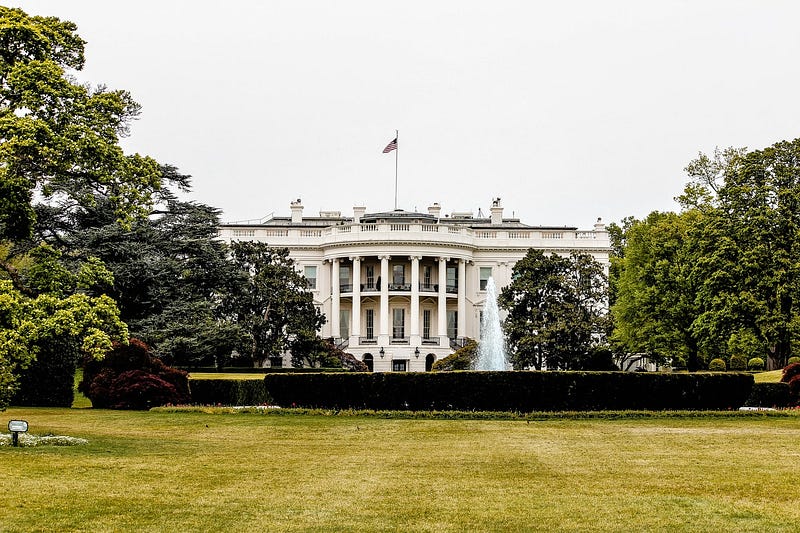
How grotesque was “President” Donald Trump’s era of transactionalism, his lack of ideology or moral compass, his nihilistic willingness to make deals with anyone as long as they served his narcissistic craving to be worshipped by the cultists he’d conned?
The Democrats and the liberal American mass media loved to condescend to Trump and to denounce his hollowness. “What good is a politician with no principles?” they asked. “Negotiating with Trump is like negotiating with Jell-O,” said Senator Chuck Schumer.
These Democrats practically rent their garments and tore out their head in exasperation that such an inhuman, unfeeling creature could have been elected to the White House.
A leader is supposed to believe in something, surely.
Precisely here, though, Democrats and liberals in general reveal the Jungian aspect of their disgust for Trump’s vacuity. Trump is their shadow or reflection, revealing a side of themselves they’d rather not acknowledge.
Modern Liberalism and Scientific Progress
To see this, consider what it means to have principles. A principle in that sense is a firmly held belief about which conduct is best.
Notice, then, that the very act of having principles goes against the scientific ethos. Scientific beliefs are held tentatively, because the scientist is inherently skeptical, is open to the possibility of finding additional evidence, and understands that scientific methods don’t confirm statements as much as they disconfirm them. As part of merely the best available explanations, scientific statements are probabilistic.
Scientific truths aren’t necessary, absolute revelations from a higher reality, but are hypotheses that compete to account for observed regularities. When the hypothesis fits into a model that makes sense of a whole system, including the effects predicted or entailed by the hypothesis, the scientist’s confidence in that initial guess is increased. But the scientist knows that a better, fuller, more empowering explanation can come along.
Notice, further, that liberalism is primarily a post-scientific phenomenon. Liberalism is part of the modern world, having roots in ancient Greco-Roman humanism and in Protestant individualism, but finding its secular rationale primarily in the progressive values of the Renaissance, the Enlightenment, and the scientific and industrial revolutions.
The Scientific Threat of Nihilism
Do you already see the problem for the liberal? Those progressive values that justified the turn from theocracy and feudalism to democratic republics and capitalism are at odds with the underlying rationalist, scientific methods. The moderns observed that science clearly works better than medieval dogma and blind trust in authority, in part because science generates technological applications that enable further scientific exploration — a positive feedback loop.
The early-modern liberal philosophers that inspired the American and French revolutions believed that society could progress in something like the scientific manner. For example, they assumed the industrial applications of scientific knowledge would raise the living standard for everyone.
But what could be the overall point of this scientific and social progress? Are knowledge and material happiness good things? Yet how is anything good from the objective, scientific standpoint? Where exactly is goodness and badness in the material world? What value does each individual have if scientists explain that a person is more like an animal than an immortal, God-given spirit? Aren’t animals precisely the things we’ve been busy enslaving (“domesticating”) or hunting for thousands of years?
Here, then, is the problem. As scientific knowledge increases, values, ideals, and principles begin to look more and more antiquated, like articles of faith and irrational dogmas. Scientists don’t like to think about why science is good or why we ought to proceed with its methods. They know that science, technology, and free societies make us happier and more powerful, but they know also that those presuppositions are hardly themselves scientifically or even rationally justified.
There is no scientific experiment that demonstrates that anything under the sun is good or bad. Neither is there a knockdown philosophical argument that this or that value, ideal, or vision of how things should be is best. Compared to scientific methods of inquiry, our principles are quasi-theological and therefore suspect. Values and principles have causes and effects, but their conventional justifications are illusory or fraudulent.
Not only does this demythologization of values and ideals include modern, liberal principles about the goodness of individual liberty in the economic and political contexts, but liberals are more likely than conservatives to understand this inclusion. Liberals have a bird’s-eye view of this incoherence of modernity, because they’re committed to honouring modern rational institutions, whereas conservatism is as old as the hills.
The Tragedy of Conservatism
Conservatism’s tragedy is different and more appalling than that of liberalism, since the conservative contradicts herself at every turn as long as she defends some way of organizing society that’s advanced beyond the most primitive form of animalism, that is, beyond the wretched dominance hierarchy or oppressive pecking order. Any such advancement represents a progressive application of humanism which entails the full suite of socialist, anti-conservative policies.
Therefore, to avoid self-contradiction, the conservative must advocate social systems that treat their members as though they were animals rather than people, and she must do this secretly, using dishonest rhetoric to cover her tracks, because the conservative’s embrace of animalism is so wrongheaded as to be insane. That is, the conservative must advocate monarchies, aristocracies, dictatorships or other authoritarian arrangements that distribute power like primitive dominance hierarchies, with the alphas and their beta lieutenants ruling over the lower classes.
Crucial to the conservative’s con is her attempt to discredit reason and scientific skepticism, to make room for religious faith. That’s how she deals with her cognitive dissonance: if the “higher,” revealed truth needn’t be rational, we needn’t worry about fully justifying the conservative’s preference for monarchies and dictatorships that dehumanize the bulk of the population. God will clarify it for us in the afterlife.
Thus, the conservative is free to have principles. This is to say that the conservative’s worldview is actually regressive enough to have made room for arbitrary articles of religious faith. Donald Trump’s transactionalism is anomalous in conservative circles, because American conservatives are supposed to be smitten ideologues, and their ideologies in turn are designed to be rhetorical flourishes that con the majority of people into accepting animalistic (highly unequal and top-down) social divisions and power distributions.
Neoliberalism as the Hollowness of Liberalism
Where, then, does this leave the liberal? Whence her principles that could be arrived at only by an arbitrary leap of faith? The conservative can take the leap because she’s managed to con herself into advocating animalism at the expense of humanism, into thinking it would be great if most people would just submit to emperors or plutocrats like the sheep and pigs our species has domesticated in turn.
But the liberal prides herself on being more sophisticated and less anachronistic, that is, more in tune with the scientific zeitgeist. Thus, when Joe Biden said, “Principles must never be compromised, but ‘compromise’ is not a dirty word,” he was attempting to contrast himself with President Donald “Transactional” Trump even as he was conceding that liberals have no legs on which to stand.
What are the principles of American liberalism? As Thomas Frank explains in Listen, Liberal: Or, What Ever Happened to the Party of the People?, in the first half of the twentieth century, the Democratic Party came to stand for the workers, not for the robber barons or the owners of big businesses. This was the party of the New Deal, of the egalitarian, socialist or redistributive response to the instability of crony capitalism that led to the Great Depression. The main principle was just humanistic individualism, the view that every person is precious, in which case none should be left behind in a libertarian or social Darwinian free-for-all.
But it’s no coincidence that the Democrats began to betray that principle when liberal societies shifted into the high gear of postmodernity or hypermodernity, after the Reagan Revolution and Thatcherism, when Bill Clinton started to compromise by triangulating with the Republicans.
Hypermodernity is the point at which people suspect that reason doesn’t just figure out how nature works, but produces self-knowledge that undermines trust in all irrational myths and feel-good narratives. Liberals began to doubt themselves and to opt for so-called neoliberalism, giving conservatives the reins over the economy even when a Democrat was in the White House, because liberals had based their faith in social progress on the treacherous advances of science and philosophy.
Now reason had turned against them, showing there’s no immortal soul or absolute freewill or much substance to the talk of morality, theology, political principles, or social progress. The real world is objective and inhuman in its mindless indifference to our preferences. Animals evolve for no good reason and towards no redeeming end; ultimately, humans are no different, as Charles Darwin showed.
Thus, the United States lurched rightward, as Chris Hedges explains in Death of the Liberal Class. Likewise, Jeff Rubin shows in How Globalization Destroyed the Middle Class that Democrats (and the OECD countries in general) haven’t recently been fighting for their vaunted liberal principles.
Union membership has steeply declined in Canada, the US, and in other so-called bastions of liberal humanism, and as a result there hasn’t been a real wage increase for most North Americans since 1975, according to Rubin. Membership in the middle class today is precarious because of the illiberal gig economy.
Big businesses have all the power and workers have none, so workers have to take whatever scraps they can get. Trade deals like NAFTA favoured transnational corporations and the plutocratic minority that hogs the profit from modern industry, giving few protections to the average worker. In the gig economy, full employment and an increasing GDP no longer translate into wage growth for the majority, because the worker can no longer go on strike to force the corrupted management to share the wealth, without the threat that the corporation will ship its operations overseas.
The Tragedy of Liberalism
What could be the empowered Democrat’s centrist principles she would never compromise, the ones that drove her to neoliberal globalization and towards turning the Democratic Party into a mouthpiece for the professional class of coastal elites at the expense of the middle class? What cherished ideals compelled this liberal to systematically betray the average workers and fuel their populist rage that enabled a malignant narcissist to desecrate all American principles and values for four years straight, under the fake, trolling presidency of Donald Trump?
These questions are rhetorical. Evidently, the Democrats no longer have confidence in their humanistic principles, because the latter, along with the very concept of principles or of necessary truths was ironically undermined by the engine of modern progress, by scientific hyperskepticism which led to Democratic capitulation to Republican animalism, along with the wider liberal malaise and slide into cultural relativism, apathy, and cynicism.
The centrist neoliberalism of Bill and Hillary Clinton and Barack Obama could only be rudderless, because these technocrats are sophisticated cosmopolitans who were educated at elite institutions and who understand the tragedy of rational progress. Joe Biden may be less intellectually sophisticated, but he has a long record as a fellow traveller of neoliberals.
Donald Trump’s nihilism is due simply to his mental disorders, which prevent him from empathizing with others or from caring about anything other than himself. The liberal Democrat’s implicit nihilism is more fashionable but no less regressive. In the absence of humanistic ideals, liberals cede the stage to “conservatives” and to their schemes for dressing up animalistic social arrangements as blessings from God.


