Why Cultural Sensitivity Is Good, but Political Correctness Is Not
Doing a bad thing in the name of doing good
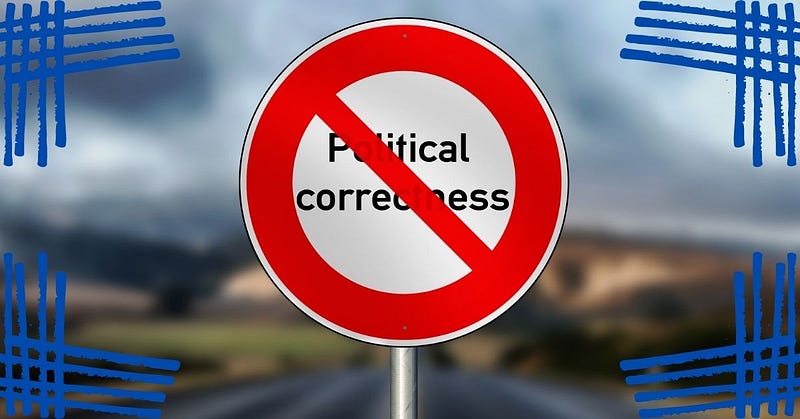
When I was first starting to travel overseas, my company gave me a crash course in how not to offend coworkers (or clients) in other countries. The gist of it was never use the thumbs-up or okay signs, and let them signal if they want to shake hands. Oh, and never ask the conversion rate by comparing their local currency to “real money”.
It was the 90s. We were still trying to convince people that swatting someone on the backside (especially if you barely knew them) was not okay. And that there were names you shouldn’t call people unless you wanted to start a riot.
Sometime between then and now, political correctness got into the picture.
The beginnings of political correctness
It started as a handy guide for clueless but well-intentioned people — “they” don’t like to be called this, or that. This other thing is okay.
Part of that was because the terminology was changing so rapidly. People were using words they’d always used, and suddenly they were considered insulting. I mean, the “CP” in NAACP stands for “Colored People”. But anyone else who referred to “colored people” was being racist. I can understand how my grandparents’ generation could be confused.
Part of it, however, was that some words had always been insulting. It was just that the people being insulted had finally achieved enough social credit that they were able to say, “Stop saying that. It’s insulting.” And instead of being dismissed, they prompted other people to try not to say those things.
All of this was good. People who were no longer being insulted felt good about not being insulted. People who had never meant to insult them felt good about not accidentally insulting others.
People who meant to insult other people found other insults to use.
It’s not hard to make a word into an insult. You just have to convince enough people that’s how you’re using it. It’s the same logic that made “bad” and “wicked” into compliments, but in reverse.
Getting onto the PC crazy train
Soon it escalated into a checklist of shame. You used this term? You’re choose-your-favorite-derogatory-description.
It stopped being a way that well-meaning people could avoid accidentally insulting people who were not part of their immediate social circle. It started being a way to use language to enforce social policy.
For example, gender equality would indicate that when you talk about a doctor, you don’t automatically say “he/him”. When you talk about a nurse, you don’t automatically say “she/her”.
Gender identity inclusivity indicates that you don’t automatically assume a pronoun for anyone, and ask them which pronouns they identify with.
How it should work
If you’re a kind and considerate person, and you misstate someone’s gender, they will correct you. You immediately apologize and move on. The same thing happens in a conversation about someone.
“Doctor Smith gets great reviews. You’re lucky to be seeing him.”
“I am lucky to be seeing her. She’s a fabulous doctor.”
A brief moment of awkwardness is quickly smoothed over. Doctor Smith probably gets annoyed at having to constantly tell people she’s a woman, but eventually enough female doctors tell enough people that the consciousness shifts. People don’t want to be corrected, so they don’t assume gender based on profession.
This is a natural evolution of culture and language.
How it does work
Unfortunately, that’s not how it works in modern America.
Overeager language watchdogs started pouncing on people, getting offended on others’ behalf.
“Doctor Smith gets great reviews. You’re lucky to be seeing him.”
“Doctor Smith is a woman. I can’t believe you’re so sexist!”
First of all, this assumes that the person who called the doctor male was doing so because they thought all doctors must be male, or good doctors must be male, or any other sexist line of thought. They could simply have been playing the odds, since 64% of doctors are male. If they didn’t know the sex of the doctor, they may have simply guessed. (As opposed to using “they” for an unknown sex, like I just did.)
Second, while the protesting person gets to feel smug and superior, they do so by making the person who misspoke feel stupid and inferior. That sort of behavior leads to fear and disengagement, not embracing the new cultural norm.
It actually leads to a backlash against the group (in this case, female doctors) who are seen as the cause of the feelings of stupidity and inferiority.
How is cultural sensitivity different from political correctness?
Cultural sensitivity starts from the assumption that everyone involved wants to be respectful of each other. However, they acknowledge that they are not familiar with each other’s cultures, and therefore need assistance to not accidentally disrespect each other.
This is not always immediately obvious. You may be able to guess at my culture from looking at me. But you have no idea what culture my friends and family may belong to.
Assuming respect means that corrections are also made respectfully. For example, I asked my friend how her niece was doing. My friend informed me that the gender-fluid child of her sister was neither her niece nor nephew, but was her nibling. She knew I did not mean disrespect toward the child, and did not disrespect me in her response.
Political correctness
Political correctness, though, starts from the assumption that someone wants to oppress and demean someone else. Language must be vigilantly observed, to ensure that all instances of oppression are called out. Moreover, those who use the oppressive language must be forced to pay in some fashion for that oppression. That payment may take the form of a public apology, or even financial losses.
It goes further off the rails by assuming that there are only two categories of people — oppressors and anti-oppressors. If you do not want to be an oppressor, it’s not enough to refrain from using negative and insulting words. If you let anyone else use those words without calling them out, you’re also an oppressor.
Political correctness leaves no room for the vast majority of people, who are well-meaning but clueless. By forcing them to be either oppressors or anti-oppressors, it forces them to either insult others on purpose, or abuse others in the name of protecting people from them.
In other words, no matter what their feelings on the matter, they’re forced to be cruel to someone. That’s a horrible system. And produces people who feel since they’re “damned if they do, damned if they don’t”, they may as well vent their rage at the people they feel are the cause of it.
Final thoughts
If you want to produce a culture of inclusivity and respect, political correctness is the wrong way to go about doing it. Instead, try assuming that everyone means well, but is just uninformed or misinformed. Offer gentle, respectful corrections where appropriate.
What if you’re not a member of the group being spoken of improperly? You’re not even a friend or family member of a member of that group? Then be extra humble and respectful in your correction. After all, your knowledge that the words being used are offensive or insulting is second hand, at best.
Be thoughtful and considerate when speaking to and about others. But get off the PC crazy train. That’s going nowhere good.
Ready to have a better tomorrow?
I’ve created a guide to help you increase your confidence and improve your life. If you follow these tips, you will level up your life very quickly!