Culture
Why Conservatives Are Flipping Out About “Quiet Quitting”
Heaven forbid the plebs don’t want to worship Mammon anymore

In case you’ve been trapped under a heavy object for the last week, or so, there’s an idea floating about that’s causing quite a stir. It’s called “quiet quitting.” But it doesn’t mean what you might think: ghosting your employer or something like that.
Instead, “quiet quitting” basically means doing what you’re paid for and nothing more. It’s about refusing to go along with the “hustle” mentality that says you always have to go above and beyond if you want to “succeed.” Quiet quitters are, in their own way, rejecting the ethos that places professional and financial success at the center of their identity.
Working hard, or hardly working?
There is a myth that American workers are uniquely industrious and productive. We like to think that we work longer hours and produce more wealth per hour than people in most other countries.
There is some truth to that, but the real picture is more nuanced. According to data compiled by the OECD (a club of mostly rich countries that includes Europe, North America, Japan, Korea, and Australia), the United States is only the fifth most productive country in the world, generating about $68 per hour worked. (Luxembourg is number one, at $93 per hour).
But American workers put in more hours per week than those in the top four countries. They also enjoy less vacation time and pay more for things like health care and child care.
Indeed, the data cited above suggest there is a negative correlation between hours worked per week and productivity across the OECD. The countries where people work the most hours per week (Greece, Korea, Chile, Russia, Mexico) are clustered around the bottom, while those with the fewest hours worked per week (Luxembourg, Denmark, France, Germany, Holland) are clustered at the top.
I think the myth persists because it is used to justify relatively low levels of taxation and redistribution of wealth. The idea is that if you tax people more, they will work less hard and produce less wealth. Beyond a certain point, this is certainly true, but as the data cited above show, countries with very high rates of taxation, like Denmark, can also have very high rates of productivity.
Indeed, there seems to be a positive correlation between not just shorter work weeks and higher productivity but also between both of these things and lower rates of inequality and higher rates of reported happiness. (Denmark, Switzerland, Luxembourg, Holland, and Norway are among the happiest countries in the world; they’re also among the most productive).
“What concerns one ultimately becomes holy”
In 2017, France passed a law requiring companies with 50 or more employees to establish hours when the company would be prohibited from contacting employees. The so-called “right to disconnect” is rooted in the idea — common in French culture but, until recently, alien to Americans — that work is just something you do for money; your real life happens the rest of the time.
Unlike the French, Americans have bought into the idea that wealth and professional stature reflect the intrinsic moral value of the individual. These cultural values motivate people to work especially hard, even beyond doing the tasks for which they are compensated, in order to “climb the corporate ladder” and attain the status and income that they believe will bring them happiness.
The theologian Paul Tillich wrote that “what concerns one ultimately becomes holy.” He meant that all people, unless they are nihilists, will be ultimately concerned with some value or other. This is an unavoidable, existential feature of being human.
But not all ultimate concerns are created equal. Every ultimate concern demands total submission, but not every ultimate concern promises total fulfillment. The cost of placing one’s faith in a concern that lacks ultimacy is nothing short of devastating.
Another example… is the ultimate concern with “success” and with social standing and economic power. It is the god of many people in the highly competitive Western culture and it does what every ultimate concern must do: it demands unconditional surrender to its laws even if the price is the sacrifice of genuine human relations, personal conviction, and creative eros. It’s threat is social and economic defeat, and its promise — indefinite as all such promises — the fulfillment of one’s being…. When fulfilled, the promise of this faith turns out to be empty.
Pay no attention to the man behind the curtain
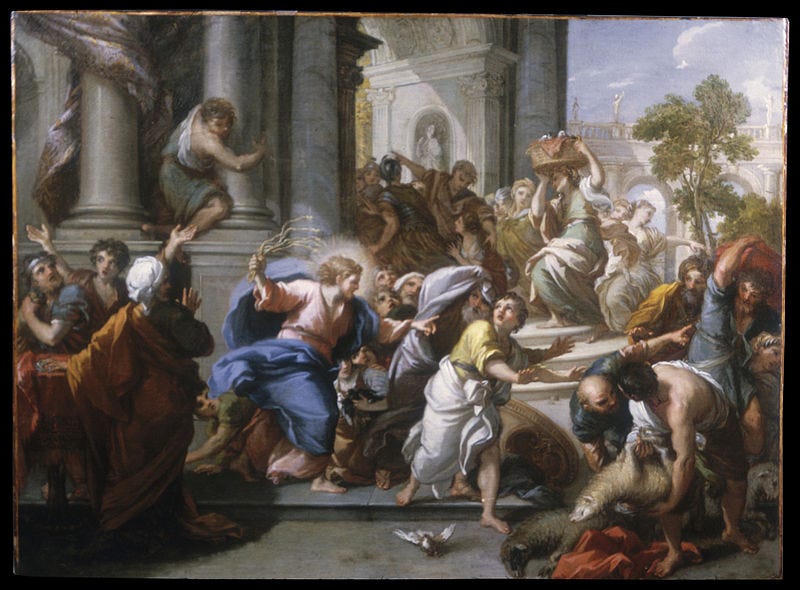
Conservatives are up in arms about quiet quitting. They’re asking if it’s just further evidence that Millennials and Gen-Zers have no work ethic. But given their claim to be Christians, the real question they ought to be asking is, “what took you so long?”
Tillich was writing in the 1950s, but he was drawing from a rich trove of Biblical references to the idolatrous love of money and social status. There are far too many quotes to fit into one article, but here are a few highlights:
“No one can serve two masters; for either he will hate the one and love the other, or else he will be loyal to the one and despise the other. You cannot serve God and mammon.” Matthew, 6:24
“The Pharisees, who loved money, heard all this and were sneering at Jesus. He said to them, ‘You are the ones who justify yourselves in the eyes of others, but God knows your hearts. What people value highly is detestable in God’s sight.’” Luke, 16: 14–15
“Keep your life free from the love of money, and be content with what you have…” Hebrews, 13:5
“[T]hose who desire to be rich fall into temptation, into a snare, into many senseless and harmful desires that plunge people into ruin and destruction. For the love of money is a root of all kinds of evils.” 1 Timothy 6:8–9
I don’t know what ultimately broke the spell. Maybe it was the financial crisis of 2008–09. Maybe it was an ever-widening inequality. Maybe it was the internet and social media breaking down barriers to allow us to glimpse what life is like for the insanely wealthy, many of whom can hardly be said to have “earned” all that excess wealth.
Whatever it was, young people today clearly understand that Success is a lot like Oz, a god that only seems great and powerful but is little more than a huckster behind a silk curtain. The trinkets he offers are little more than labels for the things of genuine value — like creativity, kindness, and courage — that we all possessed all along.