
Why Clapping on Medium Should be Automated — Just Hear Me Out
Your articles deserve more applause
There’s nothing more disheartening on Medium than when your article receives no claps. The views and reads are there but no one made the extra “effort” to click on those outlined hands. Claps are the only visual indicator in Medium to let other readers know that your article is worth reading. They are difficult to come by unless you’re a top writer like Tim Denning, Tom Kuegler, or Zulie Rane, who have over 250K followers combined.
A way to remedy the lack of followers is by submitting your article to the big publications but that can be a hurdle in itself. The multiple rejections are discouraging until an editor finally accepts your article. You feel recognized for your hard work but then this is when the anxiety begins. The article is released and you wait in anticipation for views to come in, then the money-making reads, and finally the claps — except the claps may never come.
Why aren’t readers clapping for your article?
Is there something wrong with it?
Did you not convey what you wanted?
Was the article offensive?
There’s nothing wrong with your article. It’s as it should be but the lack of clapping is making you second guess yourself. Something needs to change and it’s not your article.
A New Clapping Formula
From what I’ve read on Medium, claps don’t even matter when it comes to how much your article is paid. If this is in fact true, then it is purely a measurement of how much readers “like” your article. When no one claps, it’s the equivalent of when no one likes your Facebook or Instagram post but worse — on Medium you have stats that tell you that people have viewed or read your article.
One solution to removing the social anxiety associated with clapping is to get rid of the feature completely. That might be extreme given it is a simple way for readers to interact with writers. Instead, I think it would be better if clapping were directly tied to the viewing and reading time.
This would make clapping into less of an arbitrary feature and more into a useful indicator of interest.
Here is an alternative formula for how clapping should be.
- A member has viewed your article. This should be an automatic 5 claps. Your title alone was worth clicking in so you should be rewarded for your cleverness.
- The remaining 45 claps are calculated based on the member reading time in relation to your article read time.
Math.min( 1, member reading time / article read time ) x 45 remaining claps = calculated claps
Math.ceil( calculated claps ) = total claps
Okay, so that’s not the easiest formula to read but let’s break it down.
Math.min( 1, member reading time / article read time )
Math.min is a function that will pick the smaller number between 1 and the calculated value of reading time divided by the article read time. This ensures that we never multiply with a value greater than 1.
Math.ceil( calculated claps )
The Math.ceil function will round up the calculated claps to the nearest whole number.
If you’re still following, let’s say you have a 5-minute read article and a viewer reads it for only 1 minute. The number of claps would be calculated like the following.
Math.min( 1, 1/5 ) x 45 = 9
Math.ceil( 9 ) = 9 claps
Make sense? If not, here’s another example where a user reads a 4-minute read article for 3 minutes.
Math.min( 1, 3/4 ) x 45 = 33.75
Math.ceil( 33.75 ) = 34 claps
Finally, one more example for when a user exceeds the estimated read time. In this scenario, the user reads a 4-minute read article but takes 5 minutes to finish it.
Math.min( 1, 5/4 ) x 45 = 45
Math.ceil( 45 ) = 45 claps
A Modified Version of Undo Applause
The clapping formula is simple but it is not perfect. Some people read faster than others so their reading time will always be less than the article read time. Others may leave the article up and step away for a moment so their reading time is skewed too high. In these scenarios, people may want to undo their applause but there is a better way for that too.
If for some reason you really don’t agree with the calculated claps, then you can change it, excluding the initial 5 claps for viewing — if you accidentally clicked on the article then oh well. For the remaining 45 claps, the “undo applause” option would be replaced by an “update applause". When selecting this new option, you would be prompted to select how many claps you think the article deserves between 1 and 45. If you choose to decrease the number of claps from the calculated amount then you must provide a reason. If you decide to add more, the reason is optional.
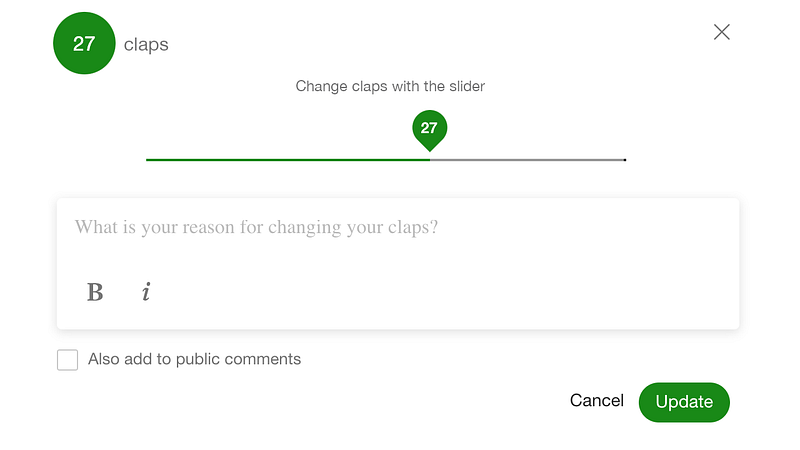
As a reader, consider this your opportunity to provide feedback to the writer as a private note, unlike the public comments. This would be a way to offer constructive criticism to help writers improve and preferably not something meaningless like “This sucked” or “This was a waste of my time.” Medium seems like a community that genuinely wants to help each other succeed so hopefully everyone would try to stay positive.
Conclusion
Overall, I think this approach reflects the “popularity" of an article in a way that is more useful to a reader. If you see an article that has 1K claps, you’re probably more likely to read it than one with only 10. At least with this strategy, the clapping indicator would indicate a level of interest based on reading time but would still retain its original meaning if the reader so chooses. The change from the undo feature to an “update applause” would give readers a chance to provide feedback to a writer privately.
If you think this automated strategy makes sense, then let’s put this idea on Medium’s radar to add to their list of changes.
Clap 50 for this article.
If not for this change specifically, then clap for at least something to change. Otherwise, this clapping feature will remain in the same bucket as the rest of the reasons why social media is bad for you. I think the Medium community is better than that.
Thanks for making it this far and for hearing me out! 50 claps for you!
Disclaimer: As far as I know, nothing like these ideas were published on Medium or anywhere else before this article was written. These are my own ideas without any reference to other writings and were not copied.


