
Why China’s Pragmatism Should Haunt the West
Secularism and reason without the Christian underpinnings
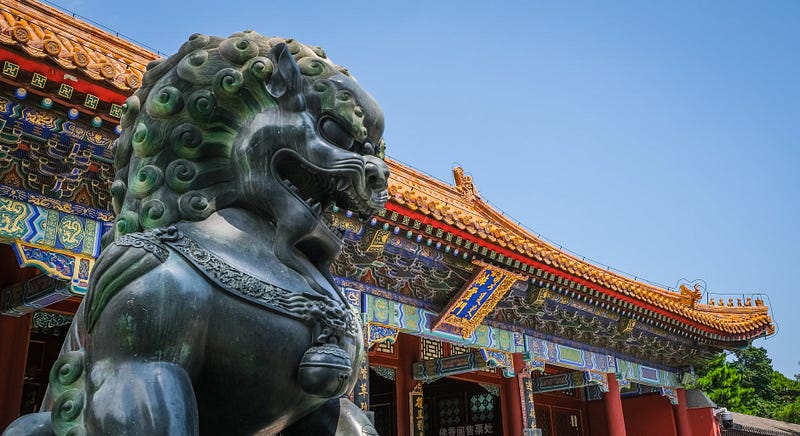
China is arguably the most pragmatic civilization in history.
A pragmatic society eschews fantasies that foster false optimism — unless the society finds a use for convenient religious myths or other noble lies to bind the people together and motivate them to work hard in the service of some worthy cause. Alternatively, a realistic society might hew more closely to the natural truth, putting a premium on accepting and working with the harsh facts.
While the cynical leaders of many polytheistic and monotheistic societies likely chose the former path, China chose the latter.
China’s Collectivism and Social Stability
India is also a very long-lived civilization, but unlike India’s mysticism and eclecticism, China’s guiding philosophies have been secular and practical. Both Confucianism and Daoism are ethical systems promoting life in harmony with underlying patterns, the difference being that Confucians focus on building up virtues to fit into artificial society, while Daoists emphasize our place in broader natural processes.
There were few grandiose dreams in China of praying or of sacrificing your earthly life for eternal reward in the hereafter. Rather than renouncing worldly opportunities or seeking zealously to convert heathens to a Chinese creed, the Chinese produced a social order that was meant to work for everyone despite the people’s lack of otherworldly illusions.
This isn’t to say the Chinese masses have been perfectly rational. Some Chinese superstitions persist from their traditional medicine, as in the lamentable markets for shark fins, tiger penises, and the like, which animal parts are supposed to have magical properties. But even these practices are pseudoscientific rather than anti-natural, the goal being to cleverly modify natural rhythms rather than to participate in abolishing them with an apocalyptic final judgment from God.
Instead of leaving the social order to chance or to chaos, as in individualistic societies that hope for course corrections by an “invisible hand,” as Adam Smith put it, China created a meritocratic bureaucracy using rigorous government examinations for promotion to the civil service.
Thus, from at least 1600 BCE to 1912 CE, one dynasty after another has ruled China, apart from a time of decentralization known as the Spring and Autumn period (722 BCE — 476 BCE), which led to internal strife and ultimately to a return to imperial rule when Qin Shi Huang conquered the warring states. That stability is a testament to the prudent collectivist ethos in China.
We might also compare the Chinese mandate of heaven to Christendom’s divine right of kings. The latter is meant to excuse any harm done by a king, by associating the ruler with a tyrannical God whose will can’t be resisted. The Christian masses fear the king as a Hobbesian leviathan.
By contrast, the mandate of heaven in China was meritocratic, the idea being that a ruler’s right to rule depends on his performance so that even natural disasters befalling the people were taken as indicators that they should rebel. This mandate was implicitly Lockean in its respect for the Chinese people and for their right to be well-ruled.
Thus, the Confucian philosopher Mencius said in the fourth century BCE, “The people are of supreme importance; the altars of the gods of earth and grain come next; last comes the ruler. That is why he who gains the confidence of the multitudinous people will be Emperor…When a feudal lord endangers the altars of the gods of earth and grain, he should be replaced.”
On top of that, China has excelled in technological innovation, again because its people were focussed on improving their workflow in the here and now, not on speculating about otherworldly ideals or on deceiving themselves with fantasies. These inventions include the abacus, sundial, lantern, compass, gunpowder, paper, printing press, matches, bricks, lacquer, parachutes, wheelbarrows, crossbows, firecrackers, fishing reels, fuses, gas lighting, oil refining, pinhole cameras, and on and on.
In 1912, China modernized itself and became a republic. This led to much havoc under Mao Zedong and the Great Leap Forward, although this wasn’t a uniquely Chinese result: similar collapses of monarchies in Europe, Russia, and Japan made for wars of conquest that resulted in the two global catastrophes of the twentieth century, as well as in a new form of exploitation with industrial dehumanization.
In any case, China turned to communism in 1949, retaining its pragmatic ethos of secular, centralized collectivism. But eventually China made room for capitalism, which leads us to what are perhaps some harbingers of the outcome of Western secularism.
How China Props Up the American Economy
Take, for example, China’s resilience in the Asian Financial Crisis of 1997. In part that strength was due to China’s ‘massive trade surpluses and a formidable “war chest” in foreign exchange reserves (totaling some $150 billion in mid-1999), and second in size only to Japan,’ which “reduced the pressure to devalue the currency or raise interest rates.”
As another analyst points out, “The U.S. debt to China was $1.07 trillion in July 2020. That’s more than 15% of the $7 trillion in Treasury bills, notes, and bonds held by foreign countries…Owning U.S. Treasury notes helps China’s economy grow. Demand for dollar-denominated bonds raises the dollar value compared to that of the yuan. That makes Chinese exports cheaper than American-made goods, increasing sales. U.S. consumers benefit from low consumer prices.”
Indeed, China has become the largest economy in the world, and as the BBC shows, “In 1990 there were more than 750 million people in China living below the international poverty line — about two-thirds of the population. By 2012, that had fallen to fewer than 90 million, and by 2016 — the most recent year for which World Bank figures are available — it had fallen to 7.2 million people (0.5% of the population).”
While Western countries navel-gaze in frivolous internecine culture wars, China is busy forging economic partnerships with the rest of the world. China didn’t buy up American bonds to threaten Americans with that leverage since China would hurt itself too if it sold those bonds. Instead, China buys American debt to prop up and stabilize the American economy, saving Americans from the full costs of their ruinous foreign misadventures (such as George W. Bush’s Iraq War), and enabling them to keep buying Chinese goods.
China’s Realism and Totalitarian Surveillance State
More ominously, however, there’s China’s political realism that lacks even the appearance of a moral high ground.
Take, for instance, China’s response to the American-Canadian detention of Meng Wanzhou, daughter of Huawei’s founder and CFO of that company. She was arrested so that the US could prosecute charges of fraud against her, because she allegedly was preparing to do business with Iran in violation of US sanctions. In the background is the competition between the US and China for dominance of the emerging 5G network market.
In response to that detention, China detained two Canadians on charges of national security violations. When Australia condemned those apparent acts of hostage diplomacy, China detained an Australian citizen in China, again on a charge of espionage. This tit-for-tat hostage-taking is reminiscent of China’s attitude towards intellectual property. Without a second thought for creators’ rights, China freely steals foreign technologies, going as far as to demand that foreign companies surrender their technologies as a condition for doing business in China.
All of which demonstrates the purest amoral pragmatism. China’s behaviour, if not its Orwellian rhetoric, indicates that the Chinse government dismisses international law as a fiction. Of course, the US started this round of hostage-taking by pressuring Canada to detain Meng, but the difference is that American society is rife with sanctimony and with every kind of frivolous delusion.
In China, the people are as atheistic and pragmatic as their government — and that’s around a billion shrewd, materialistic secularists and amoral pragmatists to contend with. Even Chinese folk religionists are arbitrary in selecting from Buddhist, Taoist, or Confucian expressions of animism, whereas Hindus were more systematic in their eclecticism.
The US is concerned that China will use its 5G technology to spy on its customers. China, of course, is too shrewd to entertain that pretext since while American law has greater respect for private property, everyone knows that the NSA dwarfs its competitors’ capabilities in the areas of spying and espionage.
Yet the American concern is hardly ill-founded since China is in the process of turning itself into a surveillance state. As Time reports about Chongqing, a city in China, “Every move in the city is seemingly captured digitally. Cameras perch over sidewalks, hover across busy intersections and swivel above shopping districts…Eight of the top 10 most surveilled cities in the world are in China, according to Comparitech…Facial–recognition software is used to access office buildings, snare criminals and even shame jaywalkers at busy intersections. China today is a harbinger of what society looks like when surveillance proliferates unchecked.”
Viewing religion as a counterproductive delusion, the Chinese government is holding a million Muslims in secretive re-education camps with no legal process to brainwash, torture, and sterilize them, straight out of a dystopian novel.
Even China’s holding of so much American debt might be interpreted as insidious. Just as the US government’s policy of bailing out Wall Street has a moral hazard in emboldening the bankers to pursue frauds with impunity, China’s paying much of the cost of American individualism helps to infantilize the American population, making them more reckless and self-centered. Trumpism would be one unintended consequence of that Chinese policy of subsidizing American-style capitalism.
Reason in China and in the Semi-Christian West
Of course, this isn’t to say that all political wrongdoing is being done in China. Virtually every powerful person in history has been effectively amoral. Individuals and governments become addicted to the privileges that come with dominance, and in any case face on a daily basis Sophie’s choices between the lesser of two evils, which make for a mockery of moral principles.
What distinguish Chinese pragmatism are its enormous scale and its independence from Christianity and Western individualism. Western morality is based on human rights which we’re supposed to have as individuals, because of our God-given spiritual core or our rational capacity for self-determination. That tradition began with monotheistic formulations from the Middle East (from Zoroastrianism and Judaism) which were later secularized in early-modern Christendom.
For most of its history China was unaffected by those developments. Such as it is, Chinese morality is conservative and based largely on the individual’s obligation to defer to the needs of the group, to function well in society and, more mystically, in nature. From that standpoint, the alternative of individualism seems imprudent since it’s not conducive to social cohesion.
Daoism thus works as a proto-Darwinian rationale for conservative social policies, given that groups of social animals, which Daoists implicitly admire, are typically regimented in dominance hierarchies that centralize command. At any rate, Chinese religions in general are naturalistic or even overtly atheistic and philosophical rather than theological.
Western reason is humanistic in that Western Scholastic theologians and philosophers taught we should think our way out of problems either to give glory to God and to his Church or to fill in as gods. Yet Chinese reason isn’t so bold. China solves problems by tinkering with conditions in the context of real-world understanding of how things operate, with little creative vision of how to progress or to overcome those conditions.
In that respect, Chinese pragmatism has been protoscientific for many centuries. Scientists, too, are often pitiless in devising their experiments, justifying the use of lab animals, for example, by appealing to the greater good of scientific advancement or of the protection of species. The Chinese seem to apply that same objectivity to their social dealings with people. In effect, human life becomes an experiment, and we’re all lab animals that need to be sized up and optimized by the Chinese technocracy.
Note, for instance, how Chinese diplomats defend their baldly totalitarian (amoral, pragmatic, anti-idealistic) policies. They do so with equanimity in their deployment of sophistical excuses and fallacious diversions. These diplomats sound perfectly reasonable even as they’re dedicated to an Orwellian enterprise, as in the case of the apparent Uyghur genocide.
There seems in those cases little in the way of self-reflection, let alone of remorse or humility in the face of where atheistic pragmatism has led China. On the one hand, that freedom from delusions, including the delusions of morality, has preserved China for millennia and has lifted hundreds of millions of Chinese people out of extreme poverty. On the other hand, modern China has entrusted its fate to a totalitarian technocracy that will likely function with great efficiency even as it forbids the envisioning of a higher purpose to vindicate its Machiavellian compromises. For that higher purpose, you need an irrational leap of faith, which seems anathema to the Chinese ethos.
A question raised by the popular historian Yuval Harari, in Homo Deus, is whether Western secular humanists can sustain their liberal values even as technological progress threatens us with the godlike control over nature that we thought we’d wanted. The increasing anachronism of the Christian rationale for those endangered human rights exacerbates the threat — as does the emerging alternative of Chinese secularism.
China’s no-nonsense culture and overt surveillance state show us what un-Christianized reason can accomplish. After all, reason itself as logic is bereft of compassion, and objectivity is depersonalizing as the detachment from all preferences and obligations apart from the interest in knowing the truth.
China reflects that cold heart of rationality, whereas the Western societies that were built on the now crumbling edifice of Christendom are convinced we have the right to empower ourselves with scientific knowledge, because we’re godlike beings. The result is the series of holocausts we’ve perpetrated on our end of the Anthropocene, against each other, most animal species, and the world’s ecosystems. Global warming, industrial farming, the arrogance of consumerism and of the conceit of limitless economic growth — these testify not to Western amorality but to our delusions of moral superiority.
Thus, a conundrum presents itself: Which is worse, pure amoral reasoning with no childlike delusions of grandeur, or rational expertise coupled with such delusions? Perhaps this is a Sophie’s choice that would be welcome only in China.


