Thunderdome
Why Captain America is the Greatest Avenger
“There’s only one God ma’am, and I’m pretty sure he doesn’t dress like that.”
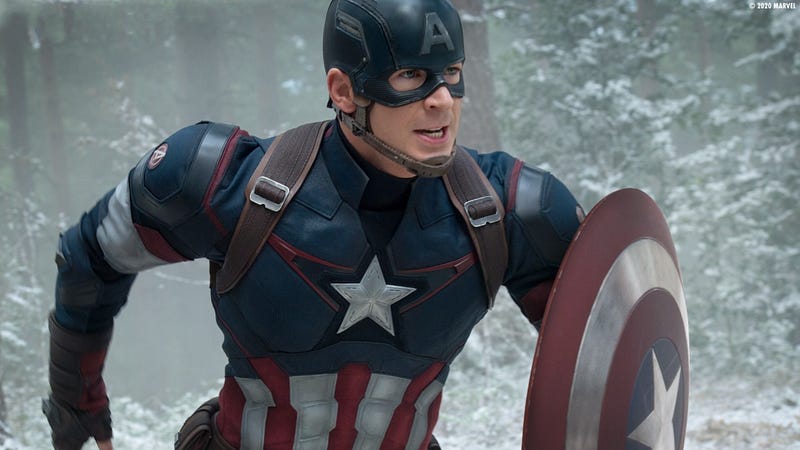
Thunderdome is a FanFare series where our writers good-naturedly debate some matter of pop culture and then leave it to the readers to decide. Read each post and vote at the bottom!Even if you only include the first act of Captain America: The First Avenger, Steve Rogers aka Captain America would be the greatest Avenger on grounds of moral fortitude alone. Even before he gets the super-soldier serum, transforming him from runty to ripped, his moral compass points to true north. Steve Rogers is courageous, self-sacrificing, and possessed of a 24-carat sense of decency and fair play.
Consider the evidence: He repeatedly tries to enlist in the army to fight the Nazis, despite being under regulation height, asthmatic, and generally unfit for military service. He does this because he despises bullies, and sees Hitler as the ultimate bully. An early fight in an alley after (rightly) showing zero tolerance for obnoxious cinema heckling demonstrates how Steve Rogers never backs down, even when faced with an opponent of superior strength. As he famously and bravely declares between bloody noses and black eyes: “I can do this all day.”
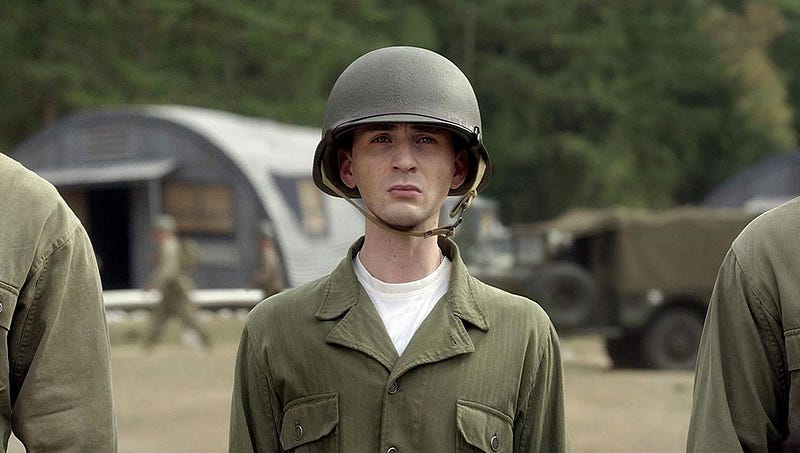
Steve is bailed out of his alleyway beating by best friend Bucky Barnes, to whom Steve is fiercely and faithfully loyal. Again, the moral fortitude of this man is never in question. When approached by exiled German scientist Dr Abraham Erskine to be a potential candidate for the super-soldier programme, he is asked to train under the command of Colonel Chester Phillips. The gruelling physical training is a sore test for Steve. However, he not only perseveres, but proves himself capable of lateral thinking (the flagpole incident), and also proves he is willing to sacrifice his life to save others (the dummy grenade incident). This makes him an ideal subject for the super-soldier serum, because, as his mentor Dr Erskine puts it:
“The serum amplifies everything that is inside, so good becomes great; bad becomes worse. This is why you were chosen. Because the strong man who has known power all his life, may lose respect for that power, but a weak man knows the value of strength, and knows… compassion.” — Dr Erskine, Captain America: The First Avenger.
Contrast this with the beginnings of Thor and Tony Stark. Thor is a vain, selfish, spoilt brat. Starkers is a billionaire narcissist arms dealer. Yes, both change as they get to take a look in the mirror, but Cap never needed to look in the mirror. He’s heroic from the word go, and therefore, unquestionably the greatest.
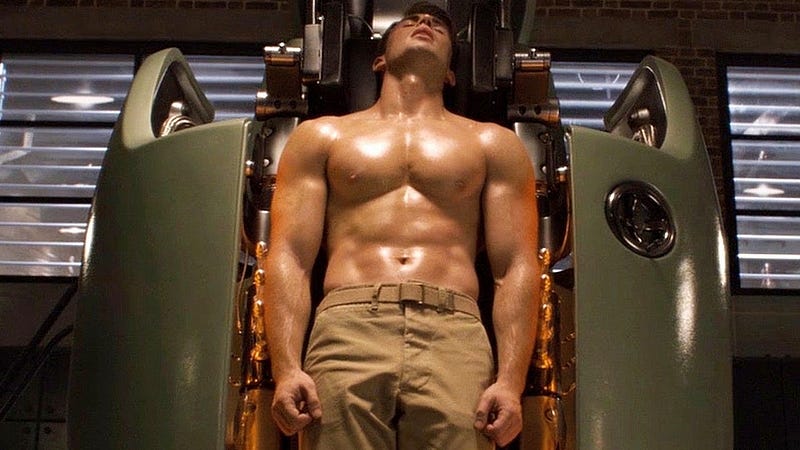
Once he becomes Captain America, Steve Rogers remains humble and is willing to do whatever it takes for the greater good of the war effort, even if it means appearing in banal, somewhat humiliating theatrical war bond fundraising endeavours. Mind you, the Star-Spangled Man with a Plan number with the chorus girls is a bit of an earworm. No wonder they sold war bonds.
Of course, Cap eventually gets to see some action, forming his own commando squad and taking down HYDRA. These life-saving heroics speak for themselves so there is no need to dwell on them, except to say that they come at great personal cost. Steve Rogers loses best friend Bucky Barnes during one mission (although of course, as we now know, Barnes doesn’t die but gets press-ganged and psychologically retrofitted by HYDRA into a brainwashed assassin, Manchurian Candidate style). Cruelly, Steve can’t even drown out his grief with booze, as alcohol doesn’t affect him (a side-effect of the super-soldier serum). Later, he pays yet another hefty price on the self-sacrifice front, in his efforts to defeat the plans of Red Skull. Steve is forced to sacrifice his relationship with Peggy Carter (in a poignant scene echoing the opening of Powell/Pressburger’s A Matter of Life and Death).
Once Cap wakes up in the 21st Century, he does his best to fit in, and actually makes a pretty good job of it. I’d like to see Starkers try and emotionally adjust to the culture shock of being flung into the next century. At any rate, it isn’t long before Steve proves his worth as commander of the Avengers. His courage is beyond doubt, even when advised not to engage in combat with those who are “basically gods”. “There’s only one God ma’am,” he replies. “And I’m pretty sure he doesn’t dress like that.” This line is an excellent rebuttal to those who claim Starkers has all the best quips.
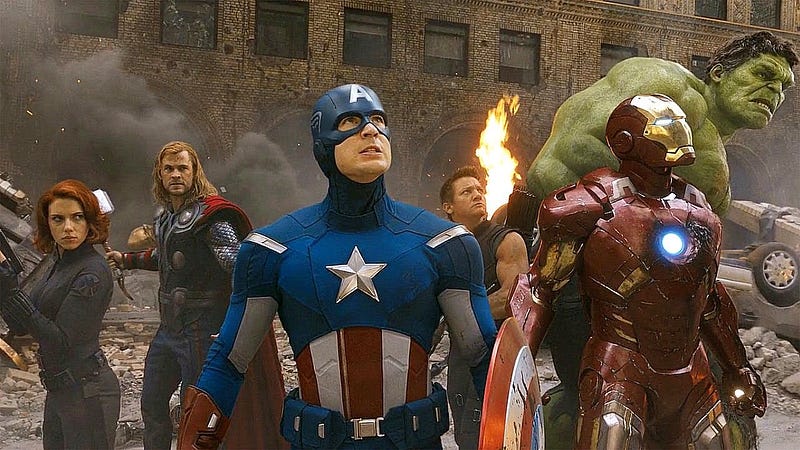
Speaking of Iron Man, where the bloody hell is he during the absolutely crucial, game-changing events of The Winter Soldier? He didn’t think something as monumental as discovering HYDRA cancerously embedded in SHIELD worthy of his time? Cap does his heroic best, of course, scaling new heights of moral imperviousness. Not only does he rightly condemn SHIELD’s Minority Report style pre-emptive death sentence machinery (“This isn’t freedom. This is fear.”), but he is fully prepared to take down both SHIELD and HYDRA when it becomes clear that SHIELD is too far gone to be saved. Sometimes building a better world means tearing down the old one, as the villainous Alexander Pierce points out. Cap takes that advice to heart in the best possible way, bravely giving this superb speech, urging others to join him:
“The price of freedom is high. It always has been. And it’s a price I’m willing to pay. And if I’m the only one, then so be it. But I’m willing to bet I’m not.” — Steve Rogers, Captain America: The Winter Soldier.
And lest we believe for one second Steve Rogers is too good to be true, he’s always ready to laugh at himself a little, as demonstrated by Sam Wilson’s quip immediately following that speech: “Did you write that down first, or was it off the top of your head?”
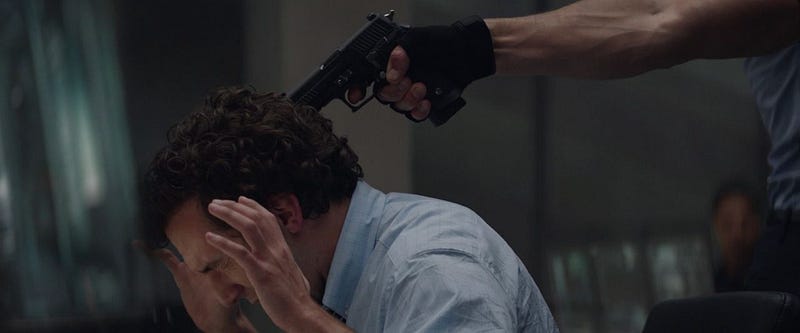
Needless to say, Cap isn’t the only one prepared to pay the price of freedom, and others do join him in his stand against evil — most notably a functionary in the control room called Cameron Klein, who heroically refuses to launch the execution helicarriers. This is a hugely important scene in the film, and it once provoked an hour’s conversation with my children, about the courage to do the right thing in the face of unspeakable evil and almost certain death. Inspired by Captain America, Klein takes a stand, even though he is scared, even though doesn’t have the weapons or superpowers to fight back against those threatening him, and even though it will probably cost him his life. Instead, he bravely responds: “I’m not gonna launch those ships. Captain’s orders.”
I don’t see Starkers inspiring that kind of courage. Again, where was he when this was all going down? Once he turns up to assist in the HYDRA mop-up, in Age of Ultron, he goes Stark-raving-mad by playing God and creating a deadly AI nightmare that almost destroys the human race. Way to go Starkers. And who has to clean up his mess? Cap, of course. Of the main Avengers, he’s the one doing most of the heavy lifting. Even Thor decides to wander off some of the time to investigate inexplicable visions in a mystical puddle.
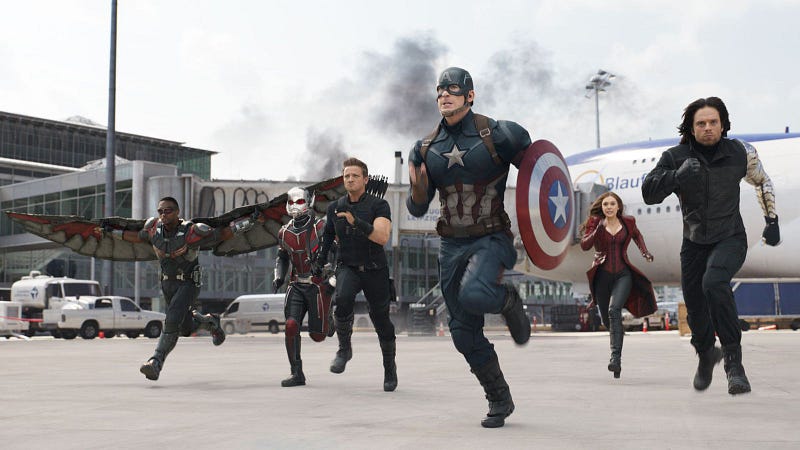
Things come to a head with Starkers during the events of Civil War, when an Iron Man humbled by the aftermath of his Ultron ineptitude decides it’s time for the Avengers to have government oversight. Immediately seeing the flaws in this well-intended but spectacularly foolish idea, Steve Rogers refuses to be told that he cannot act in accordance with his conscience when his intervention is necessary. Nor will he be a weapon in the hands of a potentially corrupt government. At Peggy’s funeral (a very moving scene) Steve is reminded of what she once said to her niece Sharon:
“Compromise where you can. Where you can’t, don’t. Even if everyone is telling you that something wrong is something right. Even if the whole world is telling you to move, it is your duty to plant yourself like a tree, look them in the eye, and say ‘No, you move.’” — Sharon Carter (quoting Peggy Carter), Captain America: Civil War.
This affirmation of Steve’s moral code from the love of his life makes him more determined than ever to stand his ground, even if it means he winds up a criminal in the eyes of the law. Said stand causes a permanent ideological schism between him and Starkers. What’s more Steve’s loyalty to his friends (the reformed, de-brainwashed Bucky Barnes) is another inspiring lesson in refusing to compromise on what we know to be right.
Oh, and once again, where was Thor? Swanning around with the Hulk on some silly gladiatorial planet impressing Jeff Goldblum, whilst failing to prevent the funniest apocalypse in cinema history. At this point, he’s just starting to be a self-loathing liability.
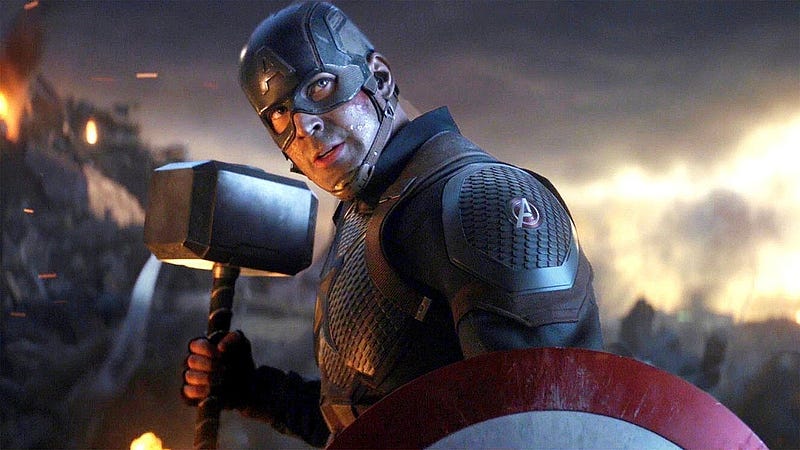
Avengers: Infinity War sees a crushing defeat for the Avengers, as half the world’s population is wiped out by Thanos. But Cap manages to turn things around in Avengers: Endgame, in what has to be the most cheer-out-loud moment in the entire series, when we discover what we suspected all along: He is worthy to carry Thor’s hammer. Yes, Starkers ultimately gets to snap his fingers and put things to rights, sacrificing his life in the process, but on points, Cap is the most consistently heroic, hands down.
Best of all, Cap understands the importance of his legacy. He knows who is meant to be the next Captain America, and passes the shield to Sam Wilson. It takes the world — including Sam himself — considerable time and mental gymnastics to accept this. But Cap knew best, and that is why he is the greatest Avenger.
What say you?
Based only on the arguments presented (you have read all of them, haven’t you?) and not on personal preference: who wins this bout? Voting closes on July 7 at 11:59 PM.The other entries:

Author’s note: I hope you enjoyed this article. For more about me and my writing, please click here.


