
Why Can’t the U.S. Sustain a Vital Music Press?
Pitchfork’s probable demise smacks of sexism, corporate stupidity and a generation gap

Condé Nast’s decision last week to fold Pitchfork.com into GQ underscores American corporate media’s failure to provide music fans with vibrant journalism that also meets their financial objectives in the digital age.
Of course, such a void represents an opportunity for The Riff here on Medium to expand its reach.
What’s happened to Pitchfork is akin to 1980s indie bands (e.g., R.E.M., The Replacements) getting signed to a major label by the 1990s, and most of their fans think they sold out, and the resulting new music pales to the early albums.
Play it safe, homogenize, commercialize, make me puke.
All the free content swimming around the Internet makes it hard for any publisher to survive these days. I am as guilty as anyone grabbing my weekly fix of The Guardian’s music pieces that come at no charge through the transom.
Coinciding with the Pitchfork/GQ development is the imminent closing of ‘Sports Illustrated.’ What does that say about our society that such a brand only gets attention for its annual swimsuit issue?
But I wonder if Condé Nast understood why it acquired Pitchfork in 2015 in the first place when Fred Santarpia, the company’s chief digital officer, told The New York Times:
“Pitchfork brings a very passionate audience of millennial males into our roster.”
Fast forward to today, when the publishers of Glamour, Vogue, Self, and Teen Vogue, et al., believe men under 35 are still the best candidates to read Pitchfork. Have they followed the charts lately? In fact, Taylor Swift herself was responsible in 2023 for one of every 27 streams and five of the top 10 selling albums (streaming and physical), according to Luminate. Indie record stores reported that six of the ten best-selling vinyl records in the last week of December were by Swift. Filling out the chart were Boy Genius, Olivia Rodrigo, Pink Floyd, and Fleetwood Mac.
Since 2018, the Pitchfork editorial team has been led by a woman of color, Puja Patel, who was laid off among other staffers. In the Jan. 17 staff announcement, Condé Nast chief content officer Anna Wintour explained:
“This decision was made after a careful evaluation of Pitchfork’s performance, and what we believe is the best path forward for the brand so that our coverage of music can continue to thrive within the company.”
Considering that GQ, at its core, is a men’s fashion magazine, that’s doubtful. So does that mean Condé Nast is trying to justify the acquisition? Don’t they realize music has changed in the last five years?
A media reporter for Semafor shared the Condé Nast announcement on X:
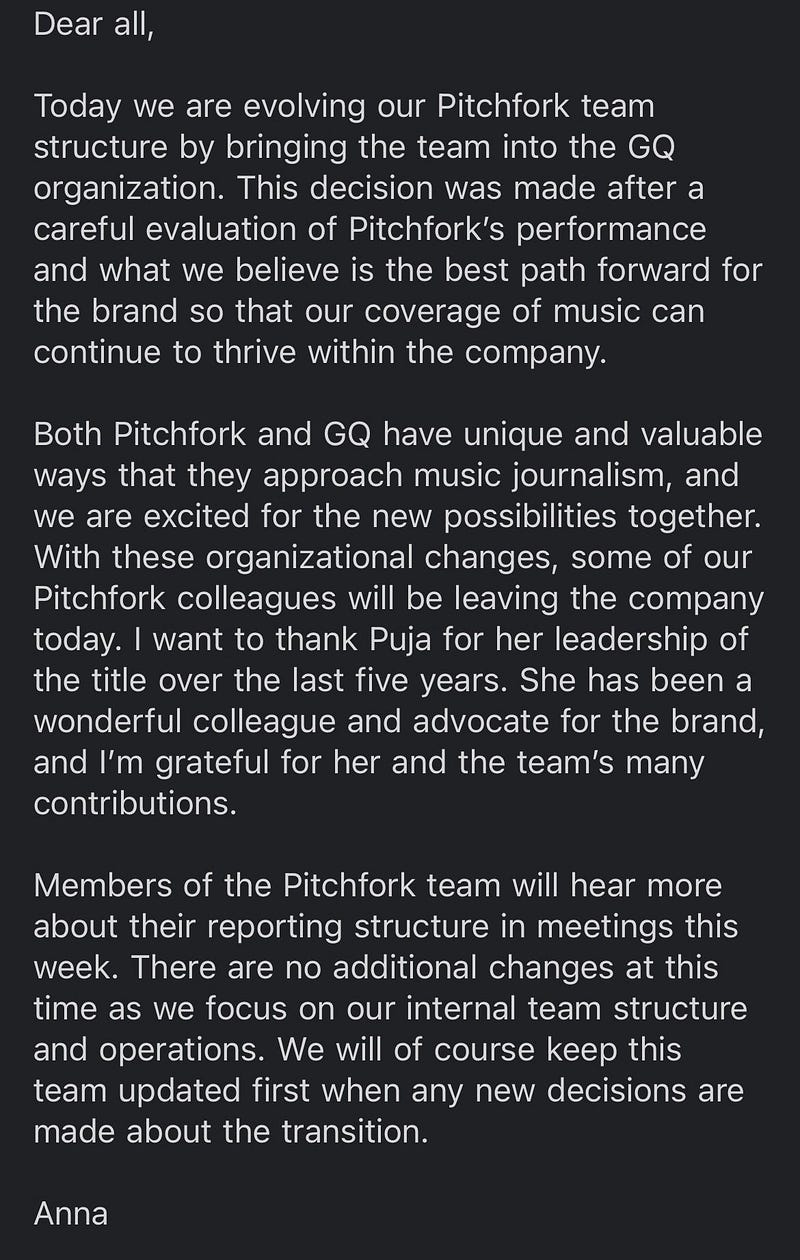
On Instagram, Pitchfork calls itself “The most trusted voice in music.” Instead of trying a different way to widen the publication’s appeal, Condé Nast pared back.
I know enough about business during the digital age that I am willing to bet the GQ move signals a first step towards cutting their losses and taking a tax write-off on the balance sheet. The company never revealed a purchase price back in 2015.
Having been laid off twice under similar circumstances, I experienced firsthand how old media corporations still never figured out how to adapt to this disruptive technology. They would just as well stuff the genie back into the bottle.
Coinciding with the Pitchfork/GQ development is the imminent closing of Sports Illustrated. What does that say about our patriarchal, sexist society that such a brand only gets attention for its annual swimsuit issue?

Already on staff as a senior editor for nearly three years of a direct marketing weekly, in 1994, I became DM News’s first “web editor.” Being a massive record collector, I remember suggesting to an e-commerce pioneer they should erect an online platform similar to what turned into Discogs. The guy thought I was crazy.
My employer at the time also ignored my suggestion to put our website URL in the printed pagination. Fed up in 1996, I jumped into cyberspace full-time to become managing editor and then editor-in-chief of Cowles New Media’s MediaCentral.com.
My boss who headed the “New Media” department, wanted to know if she could place her coffee cup in the disk drive that popped out of her desktop.
Wall Street lost its mind, falsely pumping up IPOs for startups that never had a prayer to make a profit, let alone generate revenue. During those halcyon days, I’d get daily calls from headhunters with ludicrous come-ons, like “This is how you become rich.”
The only reason Mediacentral.com was in business its first two years was AOL paid us $550,000 a year in 1995 and 1996. Then radio veteran Bob Pittman became CEO and squashed the deal. I was told his reaction was, “They should be paying us.”
I spent 1997 renegotiating a contract that allowed us to stay on the platform and split the non-existent ad revenue. Meanwhile, the boss who initially headed the company’s “New Media” department wanted to know if the disk drive of her desktop was there to hold her takeout coffee, according to my co-workers.
Its absurdity was right out of the British sitcom The IT Crowd more than a decade later.
To clarify, I am not picking on the hapless “Jen” or the former head of my department. Two of my Media Central co-workers were women and far more tech-savvy than me, even though I had more responsibility as “editor.”
In 1998, I jumped at the opportunity to jump back into print to edit a trade magazine (Medialine) that covered CD and DVD production, areas I found interesting. It was the closest I was going to get to the music business and Hollywood, true interests, and a damn good monthly that covered the rapidly changing business.
The sales manager was so desperate to sell space ads in the print magazine that I repeatedly watched him give away free web banners in sales calls. Consequently, the powers-that-be were never able to find paying advertisers. The parent company changed hands three times over the next eight years. By December 2005, I was no longer needed, especially when they realized my #2 made half the money.
I was laid off again two-and-a-half years later in June 2008 by another now-defunct publisher, Penton, as editor-in-chief of Promo, which was full of articles that explained how to tame this brave new digital world.
In my opinion, all media companies devalued themselves as soon as they started referring to what they published as “content” instead of essential journalism. This is true for consumer or trade pubs.

A corporate survivor, 74-year-old fashion icon British expat Ms. Wintour carried out the Pitchfork dirty work. The number of jobs lost wasn’t revealed. Editor of Vogue since 1988, Wintour was promoted in 2020 to oversee all of its magazines worldwide, as well as artistic director of Condé Nast and global editorial director of Vogue.
Back home, the U.K.’s Mojo, Uncut, and Record Collector set the bar for music journalism catering to boomer tastes at least for nearly a quarter century. Condé Nast publishes none of those titles. Exported to the U.S., they carry price tags upwards of $15. American music magazines have never reached such quality.
In the mid-1970s, I grew up insanely jealous of Cameron Crowe when a teenager with allowance money could afford subscriptions to Rolling Stone, Circus, and Creem, which recently made a comeback as a deluxe publication. I wish them success. Unlike the Crowe’s stand-in in Almost Famous, I never received a response from Lester Bangs, who, in my opinion, wrote in 1973 an unnecessarily harsh review of Goat’s Head Soup, which I’d easily take over the recent Hackney Diamonds. (Pitchfork’s often snarky tone at times wasn’t that different from Lester’s.)
My 1976 high school yearbook stated my ambition was to be editor of Rolling Stone. The closest I came was publishing one feature in 1983. Penske Media took total ownership of Rolling Stone in 2020 to join a roster that already included Billboard, Hollywood Reporter, Variety, and Luminate, which formerly went by Nielsen.
Rolling Stone founder Jann Wenner ruined his legacy last year while hawking a book of interviews with his favorite white rock star friends. In an embarrassing interview with The New York Times, he explained women and Black artists weren’t included because they were not “intellectual” enough about rock music.
Yeah, tell that to Nina Simone or Aretha Franklin, neither of whom had the opportunity back in the day.
Condé Nast’s Pitchfork acquisition might have appeared hip in 2015. So did AOL, acquiring Time Warner in 2003, and we saw how far that lasted.
At the time of the Pitchfork purchase, the company pledged to continue publishing its quarterly edition while realizing the online presence was key to reaching the younger demographic. Condé Nast’s flagship titles, The New Yorker and Vanity Fair, still survive on print subscriptions and display advertising because their demographics skew older. Millennials don’t read print, and social media feeds their short attention spans.
With a few exceptions (i.e., Joni Mitchell or Patti Smith), I doubt most millennials or Gen Z care about legacy artists. But they’re not the type of musicians who would be featured either in the pages of Condé Nast’s Glamour or Vogue. Nor would Brandi Carlile or Boy Genius. Perhaps the more glamorous Harry Styles, Dua Lipa, or Lana Del Rey makes sense for GQ/Pitchfork.
Sure, fashion plus music could make an occasional special issue, but it’s hardly the stuff to pin a music acquisition you screwed up. Just ask Microsoft about Zune or News Corp. about MySpace.